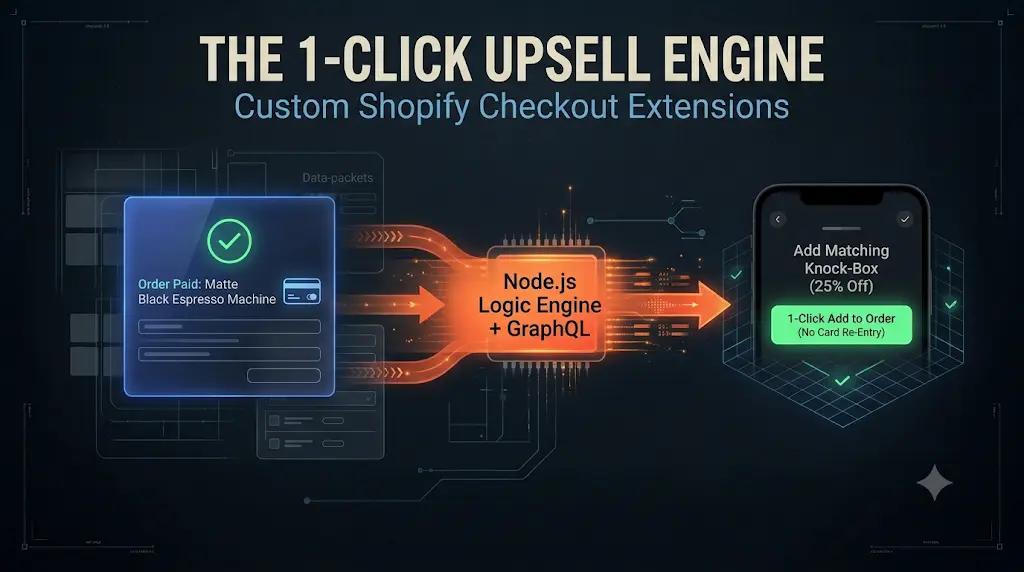
To maximize Customer Lifetime Value (LTV) and offset rising Customer Acquisition Costs (CAC), elite brands are abandoning bloated third-party upsell plugins. Instead, they are engineering bespoke Shopify Checkout Extensions building custom, logic-driven 1-click upsell engines that know exactly what the customer just bought, what they own from past orders, and what complementary product will convert them instantly without ever asking them to re-enter their credit card.
In 2026, the brutal economics of Direct-to-Consumer (DTC) e-commerce come down to a single mathematical reality: first-order acquisition is expensive.
Between rising Meta CPMs and hyper-competitive Google Shopping auctions, mid-market and enterprise brands routinely spend $65 to $120 just to acquire a single new customer. You fight tooth and nail to optimize your ad creative, nail your landing page speed, and get that buyer to enter their credit card details and click “Pay Now.”
And what do 90% of Shopify Plus stores do the exact millisecond that transaction clears?
They show the customer a dead-end “Thank You” page.
Or almost as bad they install a generic, off-the-shelf post-purchase upsell app from the Shopify App Store. The customer just spent $180 on a luxury vegan leather weekender bag, and the generic app pops up with a jarring, off-brand modal yelling: “WAIT! Buy our Best-Selling Canvas Tote for 10% off!” Worse yet, sometimes the app tries to upsell them the exact same item they literally just purchased two seconds ago.
The customer closes the tab. You just left 15% to 25% of pure, net-margin revenue sitting on the table revenue that costs you zero additional ad spend to capture.
Here is the definitive, CTO-level engineering playbook on how Datronix Tech leverages Shopify’s Checkout Extensibility API, React UI Extensions, and custom Node.js recommendation middleware to turn your checkout into a high-margin LTV machine.
01The Bleeding Neck: Why Generic Post-Purchase Apps Fail at Scale
Before we dive into the engineering blueprint, we must diagnose why off-the-shelf upsell apps and legacy checkout hacks are silently draining your margins and degrading your customer experience.
1. The Death of checkout.liquid and Legacy Hacks
For years, enterprise Shopify Plus brands customized their checkouts by hacking checkout.liquid injecting raw jQuery scripts and DOM manipulation directly into the payment flow. Those days are officially over. Shopify has deprecated checkout.liquid across Information, Shipping, Payment, Thank You, and Order Status pages in favor of Checkout Extensibility.
Any brand still clinging to legacy scripts or un-upgraded third-party apps faces broken checkouts, failed Shop Pay compatibility, and severe PCI compliance risks. Modern checkout optimization must be built natively on Shopify Checkout Extensions.
2. The “Dumb Logic” Conversion Killer
Generic $99/month upsell apps rely on primitive, static rules (e.g., “If cart total > $100, show Product A”). They have no contextual intelligence:
- Zero Cart-Level Synergy: They cannot analyze complex product combinations (e.g., if a customer buys a 30-day supply of Vitamin D + Magnesium, offer the Sleep Support bundle at a tiered discount; if they only buy Magnesium, offer the 90-day subscription upgrade).
- Zero Customer History Awareness: They do not query the customer’s historical order data. Offering a “First-Time Starter Kit” to a VIP customer who has placed six previous orders makes your brand look completely disconnected.
- Zero Margin Protection: Generic apps do not know your live Cost of Goods Sold (COGS) or warehouse overstock flags. They frequently discount low-margin items that erode your unit economics.
3. The Hidden “Success Tax” (SaaS Revenue Share Fees)
This is the financial trap that shocks CFOs when we audit their P&L statements. Many popular enterprise upsell apps charge a modest base fee ($200–$500/month), plus a 1% to 5% revenue share on every dollar generated by the upsell funnel.
Do the math for a $20M/year Shopify Plus brand. If a well-tuned post-purchase funnel adds 10% in incremental revenue ($2,000,000/year), a 2.5% SaaS revenue-share fee costs you $50,000 every single year forever just to rent a generic pop-up widget you don’t even own.
4. Attribution & Tracking Breakage
Legacy upsell apps often rely on clunky redirect flows that fire duplicate purchase events or completely drop the incremental upsell value from your analytics. When your Meta Conversions API (CAPI) or Google Ads Enhanced Conversions fails to record the extra $45 post-purchase add-on, your ad algorithms undervalue your best customers. (We cover how to fix this exact data gap in our guide on Server-Side Tracking 2026).
02The Tourniquet: How Shopify Checkout Extensions Change the Game
Shopify Checkout Extensibility was engineered from the ground up to give enterprise developers full programmatic control over the checkout and post-purchase experience without compromising speed, security, or Shop Pay conversion rates.
When Datronix Tech builds custom Shopify Checkout Extensions, we gain three massive architectural advantages:
- Sandboxed Web Workers (Zero Main-Thread Lag): Unlike legacy scripts that could freeze the checkout page or expose credit card fields to XSS attacks, Checkout UI Extensions execute inside isolated Web Workers. They cannot access sensitive DOM elements, cannot slow down checkout rendering, and are 100% upgrade-safe.
- Native Brand Cohesion: Extensions render using Shopify’s native UI component library and automatically inherit your store’s typography, color palette, and border radii via the Checkout Branding API. The upsell looks like a native, first-party part of your brand not a spammy third-party pop-up.
- Tokenized 1-Click Order Modification: On the post-purchase screen (which appears after the customer clicks “Pay Now” and before the Thank You page), Shopify holds a secure payment token. If the customer clicks “Add to My Order,” Shopify atomically modifies the existing order and charges the stored payment method in one click. No re-entering credit cards, no duplicate shipping labels, and no second order number confusing your warehouse.
(This architectural rigor mirrors how we engineer bespoke Shopify custom bundle apps and B2B Shopify architectures when off-the-shelf plugins hit a ceiling).
03The 5-Pillar Engineering Blueprint for a 1-Click Upsell Engine
Building a high-converting upsell engine requires far more than slapping a React button onto a checkout block. It requires a unified data pipeline connecting Shopify’s frontend extensions, a custom recommendation engine, server-side discounting, and analytics.
Here is the exact 5-pillar architecture our senior Shopify engineers deploy.
Pillar 1: Pre-Purchase Checkout UI Extensions (In-Checkout Cross-Sells)
Before the customer even hits “Pay Now,” we can capture high-intent micro-upsells such as shipping protection, gift wrapping, or sub-$25 impulse accessories directly inside the checkout sidebar using Checkout UI Extensions.
Using the purchase.checkout.block.render target, our React extension inspects the live cart state via the useCartLines() hook. If the customer has a pair of suede boots in their cart, the extension renders a sleek, native checkbox: “Add Waterproof Suede Protector Spray (+$14.00)”.
When checked, useApplyCartLinesChange() instantly mutates the checkout line items in milliseconds with zero page reloads and full compatibility with Shop Pay and Apple Pay. (Review Shopify’s native component constraints in the Shopify Checkout UI Extensions Documentation).
Pillar 2: Post-Purchase UI Extensions (The Tokenized 1-Click Engine)
The highest-converting real estate in e-commerce is the Post-Purchase Surface. The customer’s credit card has already been authorized; buyer resistance is at its absolute lowest, and dopamine is at its peak.
A custom Post-Purchase Extension operates in two distinct, lightning-fast phases:
ShouldRenderPhase: The millisecond the initial payment succeeds, Shopify invokes yourpurchase.post-purchase.should-renderextension point. Your extension sends the initial order’s exact line items, customer ID, and subtotal to your custom backend API. Your backend runs your proprietary recommendation matrix and returns the exact upsell offer (plus a signed JWT token) in under 250ms. If no relevant offer exists, it returns{ render: false }and routes the user straight to the Thank You page with zero delay.RenderPhase: If{ render: true }, Shopify displays your custom React UI with the tailored product, dynamic discount, and a 1-click “Add to Order” button.
Here is a conceptual look at how our engineers structure the Post-Purchase Extension using Shopify’s Post-Purchase API:
// Conceptual Post-Purchase UI Extension (TypeScript / React)
import {
  extend,
  render,
  BlockStack,
  Button,
  CalloutBanner,
  Heading,
  Image,
  Layout,
  Text,
  useExtensionInput,
} from '@shopify/post-purchase-ui-extensions-react';

// 1. Evaluate what the customer just bought & fetch hyper-relevant offer
extend('Checkout::PostPurchase::ShouldRender', async ({ inputData, storage }) => {
  const response = await fetch('https://api.yourbrand.com/v1/upsell-engine', {
    method: 'POST',
    headers: {
      'Content-Type': 'application/json',
      Authorization: `Bearer ${inputData.token}`,
    },
    body: JSON.stringify({
      referenceId: inputData.initialPurchase.referenceId,
      lineItems: inputData.initialPurchase.lineItems,
      customerId: inputData.initialPurchase.customerId,
    }),
  });

  const offerData = await response.json();

  if (!offerData.eligible) {
    return { render: false };
  }

  await storage.update(offerData);
  return { render: true };
});

// 2. Render the 1-Click Tokenized Offer
render('Checkout::PostPurchase::Render', () => <PostPurchaseUpsell />);

function PostPurchaseUpsell() {
  const { storage, applyChangeset, done } = useExtensionInput();
  const { offer, signedChangesetToken } = storage.initialData;

  async function handleAcceptOffer() {
    // Atomically modifies the order & charges the tokenized card in 1 click
    await applyChangeset(signedChangesetToken);
    done();
  }

  return (
    <BlockStack spacing="loose">
      <CalloutBanner title="Exclusive 1-Click Offer   No Re-Entering Payment">
        Complete your {offer.triggerProductName} kit and save {offer.discountPercent}%.
      </CalloutBanner>
      <Layout media={[{ viewportSize: 'small', sizes: [1, 30, 1] }]}>
        <Image source={offer.imageUrl} description={offer.title} />
        <BlockStack spacing="tight">
          <Heading>{offer.title}</Heading>
          <Text appearance="subdued">{offer.dynamicPitchCopy}</Text>
          <Button submit onPress={handleAcceptOffer}>
            Add to Order • {offer.discountedPrice}
          </Button>
          <Button plain onPress={done}>
            No thanks, take me to my receipt
          </Button>
        </BlockStack>
      </Layout>
    </BlockStack>
  );
}
Why this matters: Notice the applyChangeset(signedChangesetToken) method. The offer and discount are cryptographically signed on your secure Node.js server using your Shopify API Secret. A malicious user cannot inspect the network request and tamper with the discount price. It is mathematically secure and executes in a single click. (Explore the full specification in the Shopify Post-Purchase Extensions Documentation).
Pillar 3: The Logic-Driven Recommendation Backend (Node.js + GraphQL)
The UI extension is only as profitable as the brain powering it. Instead of static “If X then Y” rules, we engineer a dedicated Node.js / Redis Recommendation Microservice that evaluates four real-time data dimensions in under 150 milliseconds:
- Exact Cart & Variant Intelligence: If the user bought a Size Large, Matte Black espresso machine, the engine knows to offer the Matte Black knock-box and matching tamper never a silver accessory or a duplicate machine.
- Customer Purchase History (GraphQL Admin API): By querying the customer’s historical orders (cached in Redis for sub-millisecond lookups), the engine suppresses products the customer already owns and surfaces replenishment consumables or VIP tier upgrades.
- Live Inventory & Profit Margin Rules: The middleware checks real-time warehouse stock levels and internal SKU margin metafields. It will never waste a prime post-purchase impression on a low-stock item (preventing overselling) or a low-margin loss leader.
- Subscription Conversion Logic: For wellness, supplement, and consumable brands, if a customer just bought a one-time 30-day jar of protein powder, our engine can trigger a 1-click offer to add a second jar at 30% off or upgrade their order to an auto-replenish subscription, instantly multiplying LTV.
Pillar 4: Server-Side Discounting with Shopify Functions (Rust / WebAssembly)
When offering dynamic in-checkout cross-sells or complex tiered post-purchase bundles, you cannot rely on fragile discount codes that conflict with welcome coupons (like WELCOME10).
We deploy Shopify Functions compiled to WebAssembly (Wasm) that run directly inside Shopify’s backend infrastructure in under 5 milliseconds. Our custom Discount Function inspects the cart and automatically applies stackable, logic-verified upsell discounts only when the exact trigger conditions are met eliminating coupon leakage and browser-side hacks.
Pillar 5: Web Pixels API & Server-Side Attribution Sync
What happens to your ad tracking when a customer converts on a $45 post-purchase upsell?
If your tracking is configured poorly, Meta and Google Ads only record the initial $120 purchase and completely miss the $45 upsell. Over a month, your ad platforms under-report tens of thousands of dollars in ROAS, starving your bidding algorithms of high-AOV signals.
Because Checkout Extensibility strictly sandboxes third-party tracking scripts, we implement custom Shopify Web Pixels listening specifically to the checkout_completed event (which fires after the post-purchase funnel resolves with the final, updated order total). We pair this with our server-side webhook listeners to push the exact, deduplicated final order value directly to Meta CAPI and Google Ads Enhanced Conversions.
(Want to ensure your pre-checkout mobile experience is just as fast? Read our breakdown on Shopify mobile theme speed optimization).
04The Financial ROI: Why Owning Your Upsell Engine Pays for Itself
Engineering custom Shopify Checkout Extensions and a bespoke recommendation API requires an upfront Capital Expenditure (CapEx) rather than a cheap monthly app install. However, for any Shopify Plus brand generating $5M to $50M+ in annual GMV, the Return on Investment is overwhelming and typically achieves full payback in under 60 days.
1. Eliminating the SaaS Revenue-Share Tax
Let’s look at the hard numbers for a $15M/year DTC brand:
- Take Rate: A hyper-relevant, logic-driven 1-click post-purchase funnel routinely converts 10% to 18% of all buyers (compared to 2%–4% for generic “bestseller” pop-ups).
- Incremental Revenue: On 150,000 annual orders, a 12% take rate on a $45 average upsell adds $810,000 in incremental top-line revenue with zero incremental CAC.
- SaaS Fee Savings: A generic upsell app charging $399/month + 2.5% revenue share would bill you $25,038 every single year for that performance. By owning your custom extension hosted on lightweight AWS/GCP serverless infrastructure (costing roughly $50–$100/month), you permanently keep that margin in-house.
2. Subsidizing Paid Media Acquisition
According to McKinsey’s personalization research, companies that excel at real-time, data-driven personalization generate 40% more revenue from those activities than average players.
When your custom Shopify Checkout Extensions reliably add $8 to $15 in pure contribution margin to your blended Average Order Value (AOV), you fundamentally change your acquisition math. You can afford to bid 15% more aggressively on Meta and Google Ads than your competitors stealing market share while remaining cash-flow positive on Day 1.
3. Zero-Friction Fulfillment & Support Reduction
Because Shopify’s Post-Purchase API modifies the original order atomically (and holds fulfillment webhooks briefly until the post-purchase window closes), your 3PL warehouse receives one clean, consolidated packing slip. You save $6 to $10 in secondary shipping box costs per upsell, and your customer support team stops dealing with “Can you combine my two orders?” tickets.
05Strategic Rollout: How We Upgrade Your Checkout Without Risk
Touching the checkout of an eight-figure e-commerce store is open-heart surgery. You cannot afford a single minute of broken payments or Shop Pay regressions.
At Datronix Tech, we deploy custom Shopify Checkout Extensions using a strict, four-phase SiteOps methodology:
- Phase 1: Data & Margin Matrix Audit. We analyze your last 12 months of Shopify order data to uncover statistically proven product affinities (Market Basket Analysis) and map your SKU profit margins, inventory rules, and exclusion logic.
- Phase 2: Sandbox & Extension Engineering. We build the React Checkout UI Extension, the Post-Purchase Extension, and the Node.js/Redis recommendation API inside an isolated Shopify Plus Sandbox store, stress-testing sub-200ms response times and fallback timeouts.
- Phase 3: Branding API Polish & Pixel QA. We align the extension styling natively via the Checkout Branding API and verify that Shop Pay, Apple Pay, PayPal, and Web Pixels (GA4 / Meta CAPI) fire with 100% accuracy.
- Phase 4: Controlled A/B Holdout Testing. We deploy to production with a built-in 50/50 split test (or holdout group) inside our Node.js engine, proving the exact incremental LTV lift and net-margin contribution in hard numbers before scaling to 100% of traffic.
06Conclusion: Turn Your Checkout Into a Proprietary Profit Center
Your checkout is not just a payment terminal; it is the highest-leverage conversion asset in your entire business.
Showing every buyer the exact same generic, off-brand upsell pop-up while handing 2.5% of your hard-earned upsell revenue to a third-party SaaS app is an operational leak you can no longer afford in 2026.
By investing in custom Shopify Checkout Extensions powered by a real-time, logic-driven recommendation engine, you deliver a frictionless, 1-click experience that feels natively designed for each individual buyer. You boost AOV, maximize LTV, protect your checkout speed, and own 100% of the intellectual property.
It is time to stop leaving zero-CAC revenue on the table.
(Note: When scoping custom Shopify Checkout Extensions, Node.js recommendation engines, and Shopify Plus migrations, all Datronix Tech B2B service proposals natively include the requisite 18% GST charge, ensuring complete financial transparency from the initial code audit to final deployment).
07Ready to replace generic upsell plugins with a 1-click, logic-driven checkout engine?
👉 Book a Checkout Extensibility Code Audit: Upgrade your cart securely. Stop paying SaaS revenue-share fees and stop showing irrelevant upsells. Let our senior Shopify Plus architects audit your current checkout scripts, analyze your order affinity data, and deliver a secure, high-ROI engineering roadmap to maximize your LTV.
Schedule your strategic technical review today and upgrade your cart securely.