Shopify was born as a Direct-to-Consumer (DTC) retail engine. Forcing it to run a complex wholesale empire using cheap retail plugins is a recipe for operational chaos. To unlock true wholesale scale, you need a custom-engineered B2B Shopify architecture.
It is a scenario playing out across industrial manufacturing, medical supply, and wholesale distribution boardrooms every single week.
A $30M wholesale distributor decides it is finally time to modernize. For the last twenty years, their B2B buyers have placed orders by emailing messy Excel spreadsheets, calling overloaded sales reps, or worse sending faxed Purchase Orders (POs). The leadership team wants a sleek, modern digital catalog where their distributors can browse 15,000 SKUs, check real-time warehouse availability, and submit bulk orders online.
They look at the e-commerce landscape and choose Shopify. The platform’s uptime is legendary, the admin interface is clean, and the total cost of ownership is a fraction of legacy dinosaurs like Magento (Adobe Commerce) or SAP Commerce Cloud.
Then, reality collides with the checkout button.
Wholesale buyers do not pull out a corporate Visa card to buy $85,000 worth of industrial valves or three pallets of commercial lighting fixtures. They buy via Purchase Orders, Net-60 payment terms, custom freight quotes, and account-specific negotiated pricing. Furthermore, the distributor cannot legally or competitively display their wholesale unit prices to the public internet where rival suppliers can scrape them in seconds.
To patch this gap, the distributor’s internal team heads to the Shopify App Store. They install a $49/month “Hide Price & Request a Quote” app.
Within 48 hours, the storefront is a disaster. The app injects bloated JavaScript that causes prices to awkwardly “flicker” on the screen for half a second before disappearing. The “Add to Quote” button clashes violently with the brand’s custom theme and breaks the mobile slide-out cart drawer. Worst of all, when a buyer actually submits a 40-line quote request, the app simply emails a plain-text summary to sales@distributor.com forcing sales reps right back into manually re-keying 40 SKUs into NetSuite or SAP.
Here is the definitive, CTO-level technical blueprint on how Datronix Tech conditionally gates pricing at the server level, replaces the retail shopping cart with a dynamic “Quote Builder,” and connects the entire workflow directly to your ERP via a custom API pipeline.
01The Bleeding Neck: Why Standard Wholesale & RFQ Apps Fail at Scale
Before we architect the solution, we must diagnose why off-the-shelf Request a Quote (RFQ) and wholesale apps consistently fail mid-market and enterprise distributors.
1. The “Price Flicker” Security Vulnerability
Almost every third-party “Hide Price” app on the Shopify App Store operates via client-side JavaScript DOM manipulation.
Here is what actually happens when an unregistered competitor visits your product page: Shopify’s server renders the page with your confidential wholesale price intact in the raw HTML. The browser downloads the page, displays the price for 300 to 600 milliseconds, and then the third-party app’s JavaScript finally executes and applies display: none; to hide it.
Not only does this visual flicker make your enterprise brand look amateurish, it provides zero actual security. Any competitor can right-click, select “View Page Source,” or run a basic Python scraper to harvest your entire confidential wholesale price list in minutes.
2. Theme Breakage and Performance Bloat
Wholesale buyers are busy procurement officers. They do not have patience for sluggish websites. Generic RFQ apps force-inject massive external CSS stylesheets and unoptimized jQuery libraries into your theme.liquid file to hijack the native “Add to Cart” button.
As we have documented in our technical breakdown of Shopify mobile theme speed optimization, third-party app bloat destroys your Time to First Byte (TTFB) and causes frequent JavaScript collisions. Every time you update your theme, the quote button disappears or the cart drawer freezes.
3. The ERP “Black Hole” (Zero Operational Sync)
This is the most expensive failure point. Standard Shopify quote apps are completely disconnected from your Enterprise Resource Planning (ERP) system (NetSuite, SAP, Microsoft Dynamics 365, or Epicor).
When a buyer requests a quote for 500 units across 25 SKUs, the generic app creates an isolated record inside its own third-party dashboard and sends an email notification. Your sales rep then has to open the email, check live warehouse allocation in the ERP, calculate LTL freight manually, generate a PDF, email it back, and if approved manually type the entire order into the ERP. You didn’t automate your wholesale business; you just built a prettier contact form.
4. The Limitations of Out-of-the-Box Shopify Plus B2B
Even on Shopify Plus, native B2B features (like Company Profiles and Catalogs) often hit a hard ceiling for complex distributors. If your business relies on dynamic contract pricing pulled from a legacy ERP, multi-tier freight calculations based on pallet weight, or strict approval workflows where a junior buyer builds a quote that a CFO must sign off on via PO before it ever becomes an order, native settings alone will not suffice. You need bespoke B2B Shopify architecture.
02The Tourniquet: Architecting a Custom ‘Request a Quote’ Flow
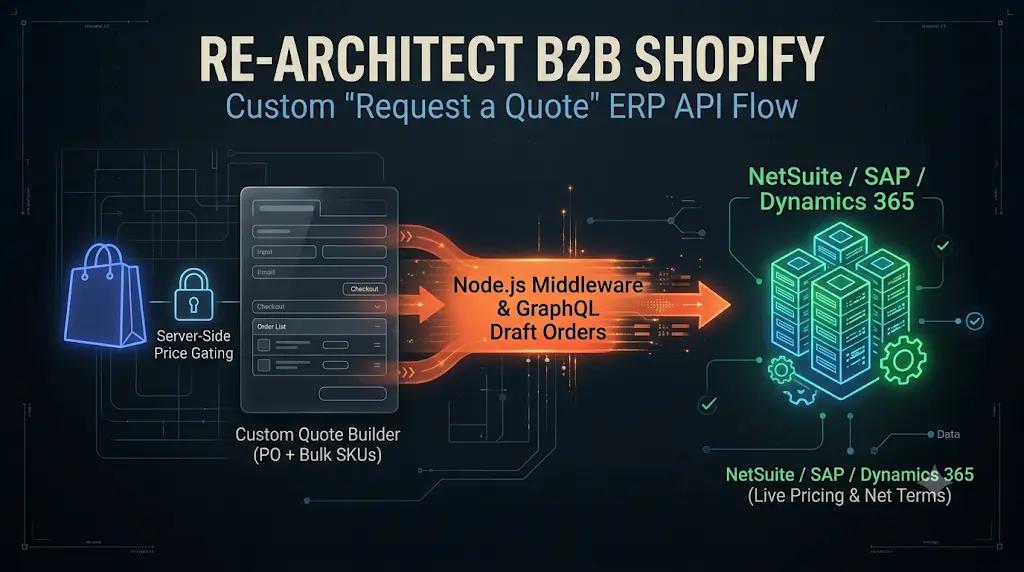
To stop the operational bleeding, we completely abandon third-party RFQ plugins. Instead, we treat Shopify as a high-speed, headless-capable presentation layer and build a proprietary B2B Shopify architecture directly into the theme and a dedicated cloud middleware layer.
By owning the code, we achieve three mission-critical outcomes:
- True Server-Side Security: Confidential pricing is never sent to unauthorized browsers.
- Frictionless UX: The “Quote Builder” matches your brand’s design system pixel-for-pixel and loads in milliseconds.
- Zero-Touch ERP Sync: Quotes flow instantaneously into your ERP as structured records, eliminating manual data entry forever.
(This architectural philosophy mirrors how we build bespoke Shopify custom bundle apps when native Shopify limits stifle complex merchandising).
03The 5-Pillar Engineering Blueprint for B2B Shopify Architecture
Here is the exact technical stack and data flow our senior engineers deploy to replace the retail cart with an enterprise-grade, ERP-synced Quote Builder.
Pillar 1: Server-Side Conditional Gating (Liquid + Customer Metafields)
To eliminate the “Price Flicker” and protect your margins from scrapers, access control must happen server-side inside Shopify’s Liquid rendering engine before a single byte of HTML is transmitted to the user’s browser.
When a wholesale client applies for an account and is approved by your credit team, your ERP syncs a specific tag (e.g., b2b_approved) and a Customer Metafield (custom.pricing_tier) to their Shopify Customer record.
In our custom theme architecture, we wrap all pricing elements, inventory counts, and transactional buttons in strict server-side Liquid conditionals:
{% comment %} Server-Side B2B Price & Action Gating {% endcomment %}
{% if customer and customer.tags contains 'b2b_approved' %}
  <div class="b2b-pricing-block" data-tier="{{ customer.metafields.custom.pricing_tier }}">
    <span class="wholesale-price">{{ product.price | money }}</span>
    <span class="moq-badge">MOQ: {{ product.metafields.custom.minimum_order_qty | default: 10 }} units</span>
  </div>

  <button type="button" class="btn-add-to-quote" data-variant-id="{{ product.selected_or_first_available_variant.id }}">
    Add to Quote Builder
  </button>
{% else %}
  <div class="b2b-gated-notice">
    <p>Wholesale pricing is restricted to verified trade partners.</p>
    <a href="/account/login" class="btn-primary">Sign In for Trade Pricing</a>
    <a href="/pages/wholesale-application" class="btn-secondary">Apply for a Trade Account</a>
  </div>
{% endif %}
Why this matters: If an unregistered user or a competitor’s scraping bot inspects the page source, the price HTML simply does not exist. The server never rendered it. Zero flicker, zero leaks, and zero JavaScript overhead. (You can review Shopify’s native Liquid architecture patterns in the Shopify Theme Architecture Documentation).
Pillar 2: Replacing the Cart with a Dynamic “Quote Builder”
A wholesale procurement officer does not want to click through 30 different product pages just to build a restock order. In our custom B2B Shopify architecture, we repurpose Shopify’s native Ajax Cart API (/cart/add.js, /cart/update.js) or engineer a lightweight, embedded React Quote Drawer that completely replaces the retail shopping cart.
What makes an enterprise Quote Builder convert?
- Bulk Matrix & Quick Order: Buyers can add 50 units of Size Small, 100 units of Size Medium, and 75 units of Size Large from a single grid view, or paste a list of SKUs and quantities directly from a CSV file.
- Custom B2B Line Item Properties: Every line item added to the quote can carry custom metadata (e.g.,
Requested Delivery Date,Project Reference Code, orCustom Packaging Specs). - Quote-Level B2B Attributes: Instead of a “Proceed to Checkout” button that asks for a credit card, the Quote Builder drawer captures critical B2B payload data:
- Purchase Order (PO) Number (with optional PDF upload for formal company POs).
- Target Ship Date & Freight Preference (LTL Freight, Will Call, or Collect Shipping Account #).
- Negotiation Notes (e.g., “Can you match last quarter’s 12% volume discount on SKU-402?”).
We also programmatically lock down the /checkout route for B2B-tagged accounts so a wholesale buyer can never accidentally stumble into a standard retail credit card flow.
Pillar 3: Custom API Middleware (The Secure Bridge)
When the buyer clicks “Submit Quote Request,” the frontend does not talk to Shopify’s checkout. Instead, it compiles the entire cart JSON including all SKUs, quantities, customer ERP IDs, PO numbers, and freight notes and fires an encrypted POST request to a dedicated Node.js / Express API Middleware hosted on AWS or Google Cloud.
Why do we use a middleware layer instead of connecting Shopify directly to your ERP?
- Security & Credential Isolation: Your ERP API keys (NetSuite Token-Based Auth, SAP OAuth credentials) live strictly on your secure backend server, completely hidden from the Shopify storefront.
- Data Transformation: Shopify speaks JSON; legacy ERPs often speak rigid XML, SOAP, or deeply nested proprietary schemas. The middleware translates the Shopify cart payload into the exact format your ERP demands.
- Resilience & Queueing: If your legacy ERP goes down for nightly maintenance at 2:00 AM while a distributor in another time zone submits a $50,000 quote, the middleware catches the timeout, stores the quote in a Redis queue, and automatically retries until the ERP is back online. Zero lost quotes.
(For a deeper look at how we engineer bulletproof ERP bridges, read our full teardown on API Middleware Integration: Connecting Legacy ERPs to Modern E-Commerce).
Pillar 4: Real-Time ERP Sync & Shopify Draft Orders API
This is where the magic of a unified B2B Shopify architecture transforms your sales operations. The millisecond our Node.js middleware receives the Quote Builder payload, it executes a dual-sync transaction:
- ERP Quote Creation: It hits your ERP’s API to pull the buyer’s exact real-time contract pricing (accounting for customer-specific price books, volume breaks, and current warehouse stock) and automatically generates a formal Estimate / Sales Quote inside NetSuite, SAP, or Dynamics 365, assigning it directly to the account’s dedicated sales representative.
- Shopify Draft Order Generation: Simultaneously, the middleware authenticates with the Shopify GraphQL Admin API and executes a
draftOrderCreatemutation.
// Conceptual Node.js Middleware: Syncing Quote to ERP & Shopify Draft Order
async function processB2BQuote(req, res) {
  const { customerId, erpAccountId, poNumber, freightType, items } = req.body;

  // 1. Validate live contract pricing & create Estimate in ERP (e.g., NetSuite)
  const erpQuote = await erpClient.createEstimate({
    entityId: erpAccountId,
    otherRefNum: poNumber,
    shippingMethod: freightType,
    lineItems: items
  });

  // 2. Mirror the ERP Quote as a Shopify Draft Order for Portal Visibility
  const shopifyDraft = await shopifyGraphQL.request(DRAFT_ORDER_CREATE_MUTATION, {
    input: {
      customerId: `gid://shopify/Customer/${customerId}`,
      poNumber: poNumber,
      note: `ERP Quote ID: ${erpQuote.id} | Freight: ${freightType}`,
      lineItems: erpQuote.pricedItems.map(item => ({
        variantId: item.shopifyVariantGid,
        quantity: item.qty,
        appliedDiscount: item.negotiatedDiscount
      }))
    }
  });

  return res.status(200).json({
    status: 'QUOTE_SYNCED',
    quoteReference: erpQuote.documentNumber,
    draftOrderId: shopifyDraft.draftOrderCreate.draftOrder.id
  });
}
Instantly, the buyer’s screen displays a branded confirmation with their official ERP Quote Number (e.g., QT-2026-8841), and the quote appears in their custom Shopify Account Dashboard under “Pending Quotes.”
Pillar 5: Automated Quote-to-Cash (Approval, PDF, and Net Terms)
The workflow doesn’t stop at submission. In traditional B2B sales, the back-and-forth negotiation is where deals stall.
In our custom architecture, the sales rep reviews the generated quote inside their native ERP (where they already work all day). They adjust the freight cost, apply an extra 5% volume discount on a slow-moving SKU, and click “Approve Quote” inside the ERP.
That single click triggers an outbound ERP webhook back to our Node.js middleware:
- The middleware updates the corresponding Shopify Draft Order with the final negotiated pricing and freight line item.
- It automatically generates a branded, downloadable PDF Quote and emails it to the buyer.
- The email contains a secure, 1-click “Approve & Convert to Order” link.
- When the buyer clicks the link, they review the final negotiated total, verify their PO number, and execute the order under their pre-approved Net-30 / Net-60 terms (or pay via ACH/Wire/Credit Card if they are a COD account).
- The finalized order syncs right back to the ERP as a Sales Order ready for warehouse picking and packing.
Zero spreadsheets. Zero manual re-keying. Complete bi-directional synchronization.
04The Financial ROI: Why Custom B2B Shopify Architecture Pays for Itself
According to McKinsey’s B2B growth research, over 70% of B2B decision-makers are now willing to spend $50,000 or more in a single self-serve or remote e-commerce transaction provided the digital buying experience is frictionless and transparent.
While engineering a custom B2B Shopify architecture requires a higher upfront Capital Expenditure (CapEx) than installing a $49 plugin, the financial Return on Investment for a wholesale distributor doing $10M to $100M+ in annual revenue is overwhelming.
1. Eradicating Manual Order Entry Overhead
Calculate how many hours your Customer Service Representatives (CSRs) and Inside Sales Reps spend every week manually transcribing emailed POs and quote requests into your ERP. At an average cost of $35 to $50 per manually processed B2B order (factoring in payroll and the cost of human SKU typos), a distributor processing 500 wholesale orders a month bleeds over $200,000 a year in pure administrative friction. Automating the Quote-to-ERP pipeline reclaims thousands of hours of payroll, allowing your sales reps to stop acting like data-entry clerks and start closing new accounts.
2. Accelerating the Quote-to-Cash Velocity
In wholesale distribution, speed wins the PO. If a procurement officer requests quotes from three suppliers, the supplier who delivers an accurate, ERP-verified quote with live stock availability in 10 minutes wins the order 80% of the time while the competitor taking 48 hours to manually calculate freight loses out. Custom B2B Shopify architecture shrinks your quote turnaround time from days to minutes.
3. Protecting Margin Confidentiality
By replacing client-side JavaScript “hiders” with server-side Liquid gating, you permanently close the door on competitor price scraping. Your negotiated contract pricing remains strictly locked behind authenticated B2B accounts.
4. Eliminating Recurring SaaS App Bloat
Enterprise B2B SaaS portals and third-party wholesale plugins frequently charge $1,000 to $3,000+ per month plus a percentage of GMV (Gross Merchandise Value) or per-quote transaction fees. When you own your custom Quote Builder and Node.js middleware, your ongoing infrastructure cost is merely a tiny cloud hosting bill (often under $150/month on AWS/GCP). You convert perpetual OpEx into a high-value, proprietary digital asset.
05Strategic Rollout: How We Migrate Wholesale Distributors Without Downtime
Wholesale executives are rightfully terrified of breaking their ordering pipeline during a digital transformation. You cannot afford to alienate your top 20 distributors who account for 60% of your revenue.
At Datronix Tech, we execute B2B Shopify migrations using a zero-disruption, four-phase engineering roadmap:
- Phase 1: ERP Schema & Pricing Matrix Audit. Before touching Shopify, our architects map your ERP’s exact pricing rules, customer groups, tax-exemption flags, and freight logic. We identify every edge case up front.
- Phase 2: Middleware & Sandbox Integration. We build the Node.js API bridge in an isolated staging environment connected to your ERP Sandbox and a Shopify Development Store, stress-testing thousands of simulated 100-SKU quote payloads.
- Phase 3: Server-Side Theme Gating & Quote Builder UI. We engineer the conditional Liquid templates and the custom Quote Builder drawer, ensuring sub-second load times and effortless mobile usability for buyers on warehouse floors.
- Phase 4: VIP Pilot Launch. We invite 5 to 10 of your most collaborative wholesale clients into the new portal first. We gather real-world feedback, refine the UX, and then roll out credentials to your entire distributor network with zero operational downtime.
06Conclusion: Stop Forcing a Retail Cart to Run a Wholesale Empire
Shopify is an extraordinary commerce foundation fast, secure, and infinitely scalable. But out of the box, its shopping cart was engineered for a consumer buying a $40 t-shirt with Apple Pay, not a procurement director issuing a $75,000 Purchase Order on Net-60 terms.
Trying to bridge that massive operational gap with clunky, third-party quote apps will only break your theme, expose your pricing, and trap your sales team in manual data entry.
By investing in a bespoke B2B Shopify architecture combining server-side price gating, a lightning-fast custom Quote Builder, and a real-time ERP API bridge you give your wholesale buyers the consumer-grade digital experience they expect, backed by the complex B2B business logic your enterprise demands.
It is time to stop patching retail tools and start engineering a true wholesale growth engine.
(Note: When scoping custom B2B Shopify architectures, ERP middleware integrations, and theme migrations, all Datronix Tech B2B service proposals natively include the requisite 18% GST charge, ensuring complete financial transparency from the initial architecture audit to final deployment).
Ready to replace clunky wholesale plugins with an ERP-synced Quote Builder?
👉 Get a B2B Shopify Migration Cost Estimator. Stop guessing what a custom wholesale architecture will cost or how long it will take to integrate with NetSuite, SAP, or Dynamics 365. Let our senior Shopify and ERP architects audit your SKU count, pricing tiers, and API requirements to deliver an exact, transparent engineering roadmap and cost estimate.
Schedule your strategic technical review today and modernize your wholesale pipeline.