The 2026 PHP Crisis Post-Mortem: Transitioning from Reactive Band-Aids to Proactive Infrastructure Architecture
Datronix · October 2026 · 10 min read
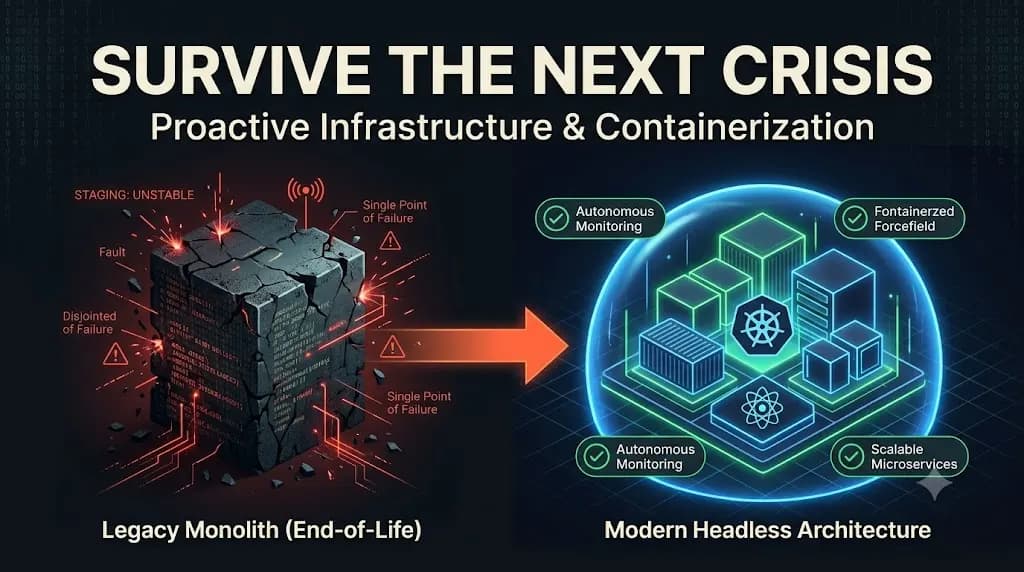
It is late 2026. The dust is finally settling on what the global developer community is now referring to as the PHP Crisis 2026. Over the last few months, a cascading series of critical vulnerabilities, deprecated version sunsets, and monolithic framework failures brought millions of enterprise websites to their knees.
For Chief Technology Officers (CTOs) and IT Directors, the crisis was a wake-up call of unprecedented magnitude. You likely watched your engineering team pull 80-hour workweeks, desperately applying hotfixes to legacy PHP 7.4 or early 8.0 environments just to keep the digital storefront online. You may have experienced severe downtime, fighting the dreaded WordPress White Screen of Death while your competitors captured your lost revenue.
The immediate bleeding has stopped, but the underlying disease remains.
The hard truth is that the PHP Crisis 2026 was not an unpredictable “Black Swan” event; it was the inevitable mathematical conclusion of years of accumulated technical debt. If your enterprise is still running a monolithic application on shared or legacy server infrastructure, you are sitting on a time bomb.
To ensure a global disruption like this never paralyzes your business operations again, you must stop treating IT as a reactive repair shop. You must transition to a proactive, resilient infrastructure architecture.
Here is the definitive, CTO-level engineering post-mortem on why legacy architectures collapsed, the catastrophic financial cost of “software duct tape,” and the exact blueprint Datronix Tech uses to future-proof enterprise systems using Headless Architecture, Kubernetes containerization, and strict CI/CD governance.
The Bleeding Neck: Why the PHP Crisis 2026 Was Inevitable
To inoculate your business against future failures, we must deeply analyze the architectural anti-patterns that made the PHP Crisis 2026 so devastating for mid-market and enterprise organizations.
1. The Monolithic Coupling Trap
The vast majority of the websites that crashed during the crisis were built on monolithic architectures specifically, traditional WordPress, Magento, or legacy Laravel applications. In a monolith, your database, your backend logic (PHP), and your frontend rendering (HTML/CSS/JS) are tightly coupled and hosted on the exact same server environment.
When a critical PHP vulnerability was exposed at the core runtime level, it compromised the entire stack simultaneously. The frontend went down because the backend could not process the rendering logic. There was no separation of concerns. If the engine caught fire, the entire car exploded.
2. End-of-Life (EOL) Negligence
According to official data from PHP.net’s Supported Versions documentation, support for older PHP versions is ruthlessly deprecated. Yet, leading up to the PHP Crisis 2026, nearly 40% of enterprise applications were still running on unsupported PHP 7.x or 8.0 environments.
Why? Because updating PHP in a monolithic, plugin-heavy environment is terrifying. Upgrading the server environment often breaks legacy plugins, custom theme functions, and unmaintained API integrations. Instead of refactoring the codebase, companies chose the path of least resistance: they ignored the End-of-Life warnings and hoped for the best. When the zero-day exploits hit, there were no security patches available for these outdated versions.
3. The “Stateful” Server Vulnerability
Traditional architectures often rely on “stateful” servers. A developer SSHs into a specific DigitalOcean droplet or AWS EC2 instance, manually updates packages, tweaks the php.ini file, and restarts Apache or Nginx.
This creates “Snowflake Servers” environments that are completely unique, undocumented, and impossible to replicate quickly. When the crisis forced companies to migrate to patched servers, teams spent days trying to figure out exactly what dependencies were required to make the application run, prolonging the downtime and compounding the financial losses.
The Cost of Reactive Band-Aids
When the crisis hit, the immediate reaction of most IT departments was to apply a reactive band-aid. They disabled vulnerable plugins, rolled back features, or hastily migrated to “managed” hosting environments that slapped a Web Application Firewall (WAF) in front of the broken code.
This approach is financially toxic for an enterprise:
- The Agility Penalty: Your development team is so traumatized by the fragility of the server that feature development drops to zero. They become terrified to deploy new code, stalling your product roadmap.
- Compliance Violations: Reactive patching often introduces new, undocumented loopholes. If you are handling sensitive user data, maintaining SOC2 or GDPR compliance on a fractured, band-aided monolith is nearly impossible.
- Sustained OpEx Drain: You end up paying massive retainer fees to emergency dev-ops teams just to keep the lights on, converting your technology from a revenue driver into a massive operational expense (OpEx).
(If you are currently evaluating if your application needs a complete rewrite rather than a patch, review our technical guide on when to transition from Monolith to Microservices).
The Tourniquet: Architecting Proactive Infrastructure
The only way to survive the next generation of web vulnerabilities is to fundamentally change how your software is built, deployed, and hosted.
At Datronix Tech, we do not patch legacy servers. We engineer resilient, decoupled ecosystems designed to withstand massive localized failures without taking the enterprise offline. Here is the three-pillar blueprint to surviving the post-PHP Crisis 2026 landscape.
Pillar 1: Decoupling via Headless Architecture
The ultimate defense against a backend crisis is ensuring that your frontend does not care if the backend goes down. This is the philosophy of Headless Architecture.
By migrating your application to a Headless WordPress Architecture, we separate the “Head” (the user interface) from the “Body” (the PHP database and logic).
- The React/Next.js Frontend: We build a blazing-fast, static frontend using Next.js. This frontend is hosted on a globally distributed CDN (like Vercel or Cloudflare). It serves pre-rendered, static HTML to your users. It requires zero PHP to load.
- The API Backend: Your WordPress or Laravel application is hidden behind a secure firewall, often on a completely unlisted subdomain (e.g.,
api.yourbrand.com). Its only job is to serve JSON data to the frontend via GraphQL or REST APIs.
The Resilience Factor: If a new PHP vulnerability takes your backend offline for 4 hours while you apply patches, your customers will not notice. The Next.js frontend will continue to serve the cached, static version of your website from the edge. E-commerce visitors can still browse products, and lead generation forms can queue submissions in a serverless function until the backend is restored. Total business continuity.
Pillar 2: Immutable Infrastructure with Docker & Kubernetes
To eliminate the “Snowflake Server” problem, you must strip humans of the ability to manually tweak production servers. You achieve this through Containerization.
We encapsulate your entire PHP environment the exact PHP version (e.g., PHP 8.3), the Nginx configuration, the required extensions, and the application code into an immutable Docker container. (Learn more about containerization best practices via Docker’s official architecture documentation).
Once containerized, we orchestrate the deployment using Kubernetes.
- Instant Rollbacks: If a new PHP version update breaks your application in production, Kubernetes can terminate the broken container and instantly spin up the previous, working container in a matter of milliseconds.
- Self-Healing: If a memory leak causes the PHP process to crash, Kubernetes detects the failure and automatically restarts a fresh instance before a user ever sees a 502 Bad Gateway error.
- Infinite Scaling: As we detailed in our teardown of Kubernetes auto-scaling for E-Commerce Black Swans, this architecture allows your infrastructure to dynamically clone itself during traffic spikes, ensuring you never go offline during a major product launch.
Pillar 3: Automated CI/CD Governance and Strict Version Control
The root cause of the PHP Crisis 2026 was neglected updates. In a proactive infrastructure, updates are not an annual, terrifying event; they are an automated, daily routine.
We implement strict Continuous Integration and Continuous Deployment (CI/CD) pipelines using tools like GitHub Actions or GitLab CI.
When a new version of PHP is released, or a critical security patch is announced:
- The CI/CD pipeline automatically builds a new Docker container with the updated PHP version.
- The pipeline spins up a completely isolated, ephemeral staging environment.
- Automated end-to-end testing scripts (using Cypress or Playwright) interact with the application, ensuring that the new PHP version hasn’t broken the checkout flow, the API integrations, or the database connections.
- Only if 100% of the tests pass does the pipeline deploy the new container to the production Kubernetes cluster using a “Zero-Downtime Rolling Update.”
If the update breaks the tests, the deployment is halted, and your engineering team is alerted immediately. You update your software continuously and fearlessly, completely eradicating the technical debt that causes global crises.
(If you are considering leaving legacy PHP environments entirely for high-concurrency applications, explore our roadmap on when to migrate your app to Node.js for real-time scaling).
The Financial ROI of Modernization
For a C-Suite executive, migrating from a legacy monolith to a containerized, headless architecture represents a significant initial Capital Expenditure (CapEx). However, when evaluated through the lens of enterprise risk management, the ROI is staggering and undeniable.
1. Eradicating the Cost of Downtime
According to Gartner, the average cost of enterprise IT downtime is $5,600 per minute. If the PHP Crisis 2026 took your operations offline for just 4 hours, you hemorrhaged over $1.3 million in lost revenue, wasted payroll, and reputational damage. Proactive infrastructure acts as an insurance policy, ensuring that localized backend failures never cascade into public-facing outages.
2. Accelerating Developer Velocity
When engineers are not spending 40% of their week fighting server fires, managing deprecated plugins, and nursing fragile deployments, they can actually focus on building software that generates revenue. Moving to a decoupled architecture allows your frontend and backend teams to work independently, drastically accelerating your time-to-market for new features.
3. Ultimate Security Posture
By hiding your backend API behind strict firewalls and serving a static frontend, you effectively reduce your public attack surface by 90%. Hackers cannot execute SQL injections or malicious PHP scripts on a Next.js frontend that contains no database and no PHP runtime. Your security posture shifts from “trying to block attacks” to “making attacks mathematically impossible.”
Conclusion: Refuse to Be a Victim of the Next Crisis
The digital landscape of 2026 is unforgiving. Relying on outdated server architectures, hoping that your host will protect you, and treating updates as an afterthought is a dereliction of technological duty.
The PHP Crisis 2026 was a harsh lesson in the realities of technical debt. But it also provided a clear roadmap forward.
By aggressively modernizing your stack embracing Headless decoupling, enforcing immutable containerization with Kubernetes, and automating your governance through CI/CD pipelines you transform your infrastructure from a fragile liability into an impenetrable, competitive advantage.
It is time to stop applying reactive band-aids. It is time to engineer for the future.
(Note: When scoping custom enterprise architectures, Kubernetes deployments, and Headless migrations, all Datronix Tech B2B service proposals natively include the requisite 18% GST charge, ensuring complete financial transparency from the initial architecture audit to final deployment).
Will your enterprise survive the next global software disruption?

👉 Schedule a Modernization Strategy Session.

Stop waiting for the next crisis to paralyze your business. Let our senior cloud architects audit your current monolithic infrastructure, map your technical debt, and provide a strict engineering roadmap to transition your enterprise to a decoupled, proactive ecosystem.

Schedule your strategic technical review today and future-proof your digital infrastructure.
Related Posts

Custom Shopify Meta Product Feed: The Engineering Secret to 3x Ad Placements
To scale high-volume e-commerce, you cannot rely on native plug-and-play apps. You must engineer a custom Shopify Meta product feed. Here is the definitive, CTO-level blueprint on how Datronix Tech utilizes custom Liquid scripting, Metafields, and advanced XML manipulation to push pristine, highly-optimized data directly into Meta’s machine learning engine, instantly multiplying your Return on […]
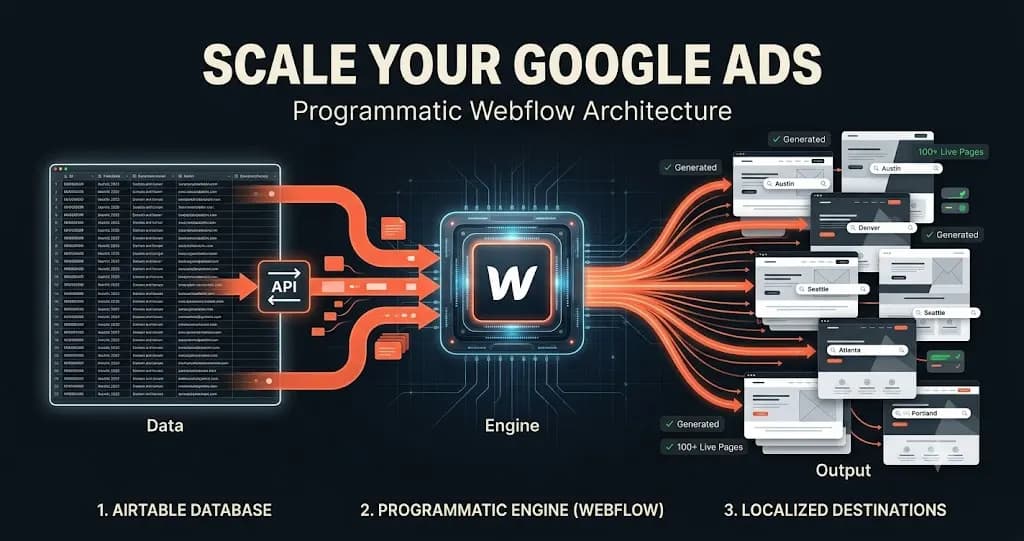
Programmatic Webflow Landing Pages: 7 Proven Secrets to Halving Your Google Ads CPC
Programmatic Webflow landing pages are the ultimate competitive advantage for scaling B2B SaaS platforms and national service businesses in 2026. Picture this: It is the start of Q3. Your Chief Marketing Officer (CMO) has just secured a massive $50,000/month budget to run highly targeted Google Ads. The strategy is brilliant on paper. If you are […]