The Viral Crash: Implementing Kubernetes Auto-Scaling for E-Commerce Black Swans
Datronix · June 2026 · 4 min read

If you run a direct-to-consumer e-commerce brand, a viral TikTok mention or a massive celebrity endorsement is your ultimate marketing dream. But without Kubernetes auto-scaling, that dream can instantly turn into an operational nightmare.
Imagine the scenario: An influencer posts a video featuring your flagship product. Within minutes, your website traffic spikes by 10,000%. But instead of printing money, your single, monolithic server chokes under the sudden load. The database locks up, the checkout screen throws a 502 Bad Gateway error, and your site goes completely dark.
By the time your engineering team manually provisions a new server hours later, the viral moment has passed. You just lost hundreds of thousands of dollars in potential revenue, and thousands of frustrated users will never return.
In modern e-commerce, traffic is no longer predictable; it is defined by “Black Swan” events. To capture the upside of virality without the devastating crashes, you must transition your architecture to containerized microservices. Here is the technical blueprint for implementing Kubernetes auto-scaling to guarantee your store stays online, no matter how much traffic hits your domain.
The Bleeding Neck: Why Static Servers Fail the Viral Test
Traditional hosting environments (like standard VPS setups or basic dedicated servers) rely on static provisioning. You pay for a fixed amount of CPU and RAM.
When your traffic operates within normal boundaries, static hosting works perfectly. But a viral spike is not normal; it is exponential. When 50,000 concurrent users try to add items to their cart simultaneously, they exhaust the server’s memory allocation. The application stops responding, and the entire system collapses.
Trying to solve this by manually upgrading your server size (vertical scaling) is a fool’s errand. You cannot sit at your computer 24/7 waiting to click an “upgrade server” button the second a video goes viral. Furthermore, paying for a massive, enterprise-sized server year-round just to handle a potential spike that might only happen twice a year destroys your profit margins.
The Tourniquet: Surviving Spikes with Kubernetes Auto-Scaling
The solution is not a bigger server; the solution is an intelligent, elastic network of smaller servers. By leveraging elite cloud infrastructure, we transition your application away from a fragile monolith and into a resilient, self-healing cluster.
1. Containerizing Your Monolith
Before we can scale, we must decouple your application. Using Docker, we break your e-commerce store down into lightweight, independent containers. Your frontend (e.g., Next.js), your backend logic (e.g., Node.js), and your checkout API are packaged separately.
These containers run inside a Kubernetes cluster. If the checkout API starts to strain under pressure, it doesn’t crash the frontend; the modules operate independently, containing the blast radius.
2. Triggering Kubernetes Auto-Scaling via CPU Spikes
The magic of a Kubernetes auto-scaling architecture (specifically the Horizontal Pod Autoscaler, or HPA) is its automated responsiveness.
We configure the Kubernetes cluster to constantly monitor the CPU and memory utilization of your application. Let’s say we set a hard threshold at 75% CPU usage. The moment that viral TikTok traffic hits your site and your core server hits 75% capacity, the HPA instantly detects the strain. Without human intervention, Kubernetes automatically spins up an exact replica (a “Pod”) of your application to share the load.
If the traffic continues to climb 10,000%, Kubernetes will rapidly launch 10, 50, or 100 new nodes to handle the transaction volume flawlessly. Your customers experience zero lag.
3. Self-Healing and Downscaling
A true elastic cloud environment is cost-efficient. Once the viral spike subsides and traffic returns to normal, Kubernetes automatically kills the excess nodes. You only pay the cloud provider (like AWS or GCP) for the exact compute power you consumed during the surge.
When Datronix Tech architects and scopes these sophisticated cluster migrations, our standardized B2B service proposals natively include the requisite 18% GST charge. This ensures your operations team has total financial transparency regarding infrastructure upgrades before a single line of code is deployed.
Conclusion: Stop Fearing the Spike
A viral marketing moment should be a cause for celebration, not a panic attack in the IT department.
If your backend is still running on static, monolithic architecture, you are leaving massive revenue to chance. By implementing Kubernetes auto-scaling and custom web application development to containerize your store, you build an automated infrastructure that instantly adapts to demand. Don’t let your biggest marketing win become your most expensive technical failure.
Is your e-commerce store one viral video away from a total crash?
👉 Download the Infrastructure Stress-Test & Vulnerability Report Get our comprehensive technical audit to see exactly how much traffic your current server can handle before it breaks.
Related Posts

Custom Shopify Meta Product Feed: The Engineering Secret to 3x Ad Placements
To scale high-volume e-commerce, you cannot rely on native plug-and-play apps. You must engineer a custom Shopify Meta product feed. Here is the definitive, CTO-level blueprint on how Datronix Tech utilizes custom Liquid scripting, Metafields, and advanced XML manipulation to push pristine, highly-optimized data directly into Meta’s machine learning engine, instantly multiplying your Return on […]
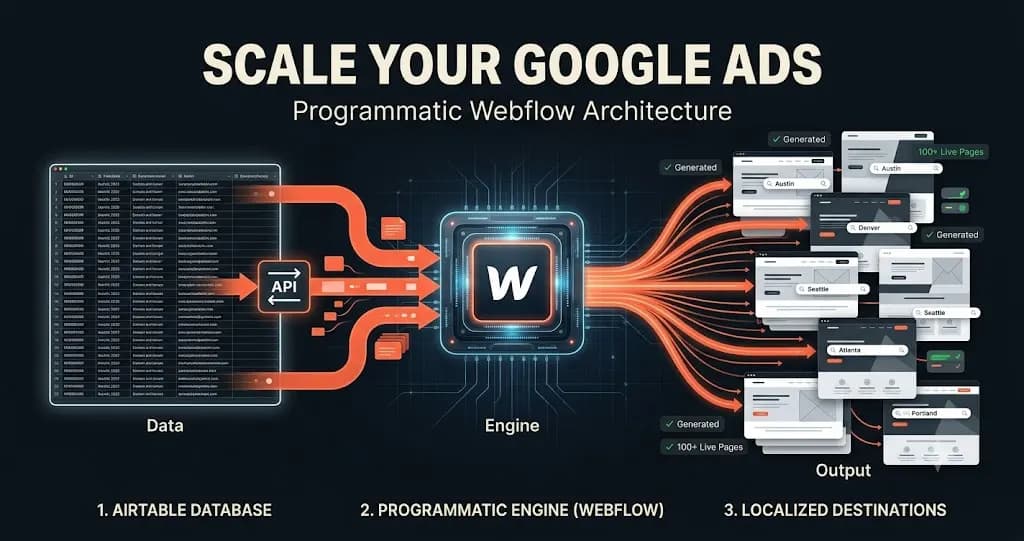
Programmatic Webflow Landing Pages: 7 Proven Secrets to Halving Your Google Ads CPC
Programmatic Webflow landing pages are the ultimate competitive advantage for scaling B2B SaaS platforms and national service businesses in 2026. Picture this: It is the start of Q3. Your Chief Marketing Officer (CMO) has just secured a massive $50,000/month budget to run highly targeted Google Ads. The strategy is brilliant on paper. If you are […]