Custom Shopify Meta Product Feed: The Engineering Secret to 3x Ad Placements
Datronix · October 2026 · 10 min read

To scale high-volume e-commerce, you cannot rely on native plug-and-play apps. You must engineer a custom Shopify Meta product feed. Here is the definitive, CTO-level blueprint on how Datronix Tech utilizes custom Liquid scripting, Metafields, and advanced XML manipulation to push pristine, highly-optimized data directly into Meta’s machine learning engine, instantly multiplying your Return on Ad Spend (ROAS).
It is the middle of Q3, and your performance marketing agency has just launched a massive Advantage+ Shopping Campaign (ASC) on Meta (Facebook and Instagram). They are utilizing Dynamic Product Ads (DPAs) to automatically retarget users who abandoned their carts, as well as prospecting for new customers using your full e-commerce catalog.
The ad spend is aggressive $2,000 a day. The media buying strategy is flawless. But when the Chief Marketing Officer (CMO) scrolls through their own Instagram feed and sees the ad, they are horrified.
The dynamic carousel ad looks terrible.
Your beautiful, high-end apparel photography originally shot in a 3:4 portrait aspect ratio for your website has been violently cropped into a 1:1 square by Meta. The models’ heads are cut off. The product title reads a messy, internal SKU format like “Premium Hoodie – Navy – Size XL,” cutting off before the user can even read the brand name. The price is showing the default variant, not the bundle price you wanted to advertise.
Users scroll right past the ad. Your Click-Through Rate (CTR) plummets, your Cost Per Acquisition (CPA) skyrockets, and your Meta Ads budget is effectively set on fire.
The agency blames the algorithm. The creative team blames the agency.
But the reality is a deep, structural data issue: Your default Shopify catalog integration is feeding Meta garbage data.
The Bleeding Neck: Why the Default Shopify Feed Fails
To fix the leak in your marketing funnel, we must first deeply understand why the native Shopify-to-Meta integration fails enterprise and mid-market brands.
When you install the standard “Facebook & Instagram” app from the Shopify App Store, it creates a “black box” API connection. It automatically scrapes your product data and sends it to your Meta Commerce Manager. While convenient for beginners, it forces you into a rigid, unchangeable data structure.
1. The Aspect Ratio Disaster
Your website’s Product Detail Page (PDP) requires a specific image aspect ratio to look good (often 3:4 or 16:9). Meta Dynamic Ads, however, strictly require a 1:1 (square) image for carousels. The default Shopify integration simply grabs your primary PDP image and sends it to Meta. Meta’s algorithm then aggressively center-crops it to make it a square. If your product isn’t perfectly centered with massive white space, the ad looks broken, cheap, and unprofessional.
2. Messy, Unoptimized Titles
Your website product titles are designed for on-site navigation, not social media scrolling. A title like “The Explorer Backpack” works on your website because it sits next to a descriptive paragraph. On Meta, that title lacks context. The default feed sends this raw title, ignoring the opportunity to dynamically inject powerful marketing copy (e.g., “The Explorer Backpack – Waterproof & Durable”).
3. The Algorithmic Blind Spot
Meta’s Advantage+ algorithm thrives on rich, structured data. It wants to know your product margins, inventory scarcity, and custom categories to find the most profitable buyers. The default Shopify app sends the bare minimum. It does not send your Cost of Goods Sold (COGS), it struggles with dynamic inventory thresholds, and it provides zero ability to map custom business logic to Meta’s custom_label fields.
(This lack of data optimization is precisely why we previously documented the importance of advanced ad strategies in our guide to maximizing your ROI with Meta Ads).
The Tourniquet: Architecting a Custom Shopify Meta Product Feed
To stop the bleeding, you must disconnect the black-box app and take absolute control of your data pipeline. We achieve this by building a custom Shopify Meta product feed using native Liquid code and XML architecture.
Instead of relying on an app to push data via an API, we engineer a hidden, dynamic .xml template directly inside your Shopify theme. Meta’s servers then ping this XML URL every hour, pulling down a perfectly formatted, highly manipulated data feed.
Here is the exact technical blueprint of how we architect this high-converting feed.
Pillar 1: Liquid String Manipulation for Perfect Titles
We create an alternate template in Shopify (e.g., collection.xml.liquid). Inside this file, we write Liquid for loops that iterate through every product in your catalog. But we don’t just output the raw data; we manipulate it.
We use Liquid string filters to dynamically clean and enhance the product titles and descriptions specifically for the ad placement.
<!-- Conceptual Liquid XML Output -->
<title>
  <![CDATA[ {{ product.title | strip_html | truncate: 50 }} - {{ product.vendor }} | Limited Stock ]]>
</title>
<description>
  <![CDATA[ Get the {{ product.title }} today. {{ product.description | strip_html | truncatewords: 20 }} ]]>
</description>
By engineering the feed this way, we ensure every single ad title is punchy, includes the brand name, and fits perfectly within Meta’s character limits before truncation occurs.
Pillar 2: Metafields for Feed-Specific Lifestyle Images
To solve the cropping disaster, we must decouple your website images from your ad images.
We utilize Shopify Metafields (custom data fields attached to your products). We create a specific file reference Metafield called meta.ad_creative_1x1. Your creative team uploads beautiful, pre-cropped, 1080×1080 lifestyle images directly into this Metafield.
In our custom Shopify Meta product feed Liquid script, we write conditional logic:
- If the
meta.ad_creative_1x1field exists, output that image URL to Meta. - If it does not exist, fallback to the standard product image.
Suddenly, your website retains its beautiful 3:4 portrait photography, but your Meta Dynamic Ads display stunning, perfectly framed, context-rich lifestyle images. Your CTR doubles overnight. (To understand how rich imagery plays into modern ad strategies, review our teardown on new Meta Ads creative trends).
Pillar 3: Dynamic Custom Labels (The Bidding Cheat Code)
Meta allows you to pass up to five “Custom Labels” (custom_label_0 through custom_label_4) for every product. This is the most underutilized weapon in e-commerce performance marketing.
Standard feed apps either ignore these or require tedious manual tagging. Our custom Liquid feed calculates these labels dynamically in real-time.
- Inventory Scarcity: We write a Liquid statement that checks
variant.inventory_quantity. If the quantity is between 1 and 10, we output<g:custom_label_0>Low Stock</g:custom_label_0>. Your media buyer can now create an automated dynamic ad set that only shows products tagged “Low Stock” with urgent ad copy. - Margin-Based Bidding: We can read a product’s tag or Metafield denoting its profit margin (e.g., “High Margin,” “Low Margin”). By passing this into
custom_label_1, your media buyer can command Meta’s Smart Bidding algorithm to bid aggressively on high-margin items and conservatively on low-margin items. You stop optimizing for gross revenue and start optimizing for actual net profit.
(According to Meta’s official Catalog documentation, utilizing custom labels is critical for segmenting catalogs for advanced Advantage+ campaigns).
Pillar 4: Bypassing the App Bloat
A common objection from marketing teams is, “Why build a custom feed when I can just use a third-party feed management app like DataFeedWatch?”
Third-party feed apps are powerful, but they present massive technical and financial debt for scaling brands:
- API Latency: Feed apps rely on Shopify’s API to fetch your data, process it on their servers, and then host it. During a massive Black Friday inventory update, their API sync can lag by hours. Your ads might advertise a product that sold out three hours ago.
- Recurring OpEx: Enterprise feed apps often charge $200 to $500 a month based on SKU counts.
- Limited Customization: You are limited to the logic their app allows. If you need a complex, proprietary math calculation to determine a custom label, their UI will block you.
Because our custom Shopify Meta product feed runs natively inside your Shopify theme using Liquid, it has zero API latency. When inventory hits zero in Shopify, the XML feed updates instantly. And because you own the code, there are zero monthly subscription fees. (This aligns perfectly with our ethos of reducing technical debt, as explored in our guide on why growing e-commerce brands need custom Shopify development).
The Financial ROI: Calculating the Impact of Pristine Data
Engineering a custom XML architecture requires an initial capital expenditure (CapEx). However, for a brand spending over $20,000 a month on Meta Ads, the financial ROI is immediate and profoundly impactful.
1. Skyrocketing Click-Through Rates (CTR)
When a user is scrolling through Instagram Reels or Facebook Stories, they are highly distracted. If they see a boring product on a white background with its head cropped off, they will not stop scrolling.
By pushing 1080×1080 lifestyle imagery through your custom feed, your Dynamic Product Ads transform into engaging native content. Brands that switch from default white-background images to custom lifestyle feeds routinely see their CTR increase by 40% to 60%.
2. Lowering Cost Per Acquisition (CPA)
Meta’s algorithm is fundamentally a matching engine. It matches products to people.
When your feed contains perfectly structured titles, detailed product types, and accurate descriptions, you give the algorithm high-definition context. The AI no longer has to guess what your product is. It finds the exact buyer with pinpoint accuracy. Better matching leads to higher conversion rates, which mathematically drives down your CPA.
3. Ultimate Campaign Control
By unlocking dynamic Custom Labels, you give your media buying team superpowers. They can run clearance campaigns that automatically populate with aging inventory. They can run VIP campaigns featuring only top-tier margin products. You move from a “spray and pray” dynamic ad strategy to a highly surgical, data-driven revenue operation.
Advanced Data Engineering: The Google Merchant Center Bridge
The beauty of building a custom XML feed in Liquid is that it is highly extensible. The data structure required by Meta is incredibly similar to the structure required by Google Merchant Center for Google Shopping Ads.
With minor adjustments to the Liquid namespace outputs (adhering to Google’s official RSS/XML specifications), the exact same architectural principles can be applied to generate a highly optimized Google Shopping feed.
You build the core data infrastructure once, and you deploy it to feed every major advertising machine learning algorithm on the internet perfectly clean data. (This level of data mastery is why elite brands trust our professional eCommerce website development services).
Conclusion: Stop Blaming the Algorithm
If your Meta Dynamic Ads are underperforming, the algorithm is likely not the problem. Your media buyer is likely not the problem. The problem is the raw data you are forcing the system to consume.
You cannot win a hyper-competitive digital auction by bringing generic, messy, cropped data to the table.
By leveraging elite Shopify engineering to build a custom Shopify Meta product feed, you seize absolute control over your digital storefront’s distribution. You dictate exactly how your brand appears on the world’s largest social networks, ensuring every single ad impression is visually stunning, contextually accurate, and algorithmically optimized for maximum profit.
Stop settling for the default. Start engineering your ROAS.
(Note: When scoping custom Shopify data architecture, Liquid feed generation, and advanced ad integrations, all Datronix Tech B2B service proposals natively include the requisite 18% GST charge, ensuring complete financial transparency from the initial audit to final deployment).
Are your Meta Ads displaying ugly, cropped images and messy titles?

👉 Get a Free Meta Product Feed Code Audit.

Stop wasting your ad spend on bad data. Submit your URL to Datronix Tech. Our senior Shopify engineers and media buyers will audit your current XML output, identify algorithmic blind spots, and map out a custom Liquid architecture to triple your ad performance.

Schedule your strategic technical review today and start feeding the algorithm what it actually wants.
Related Posts
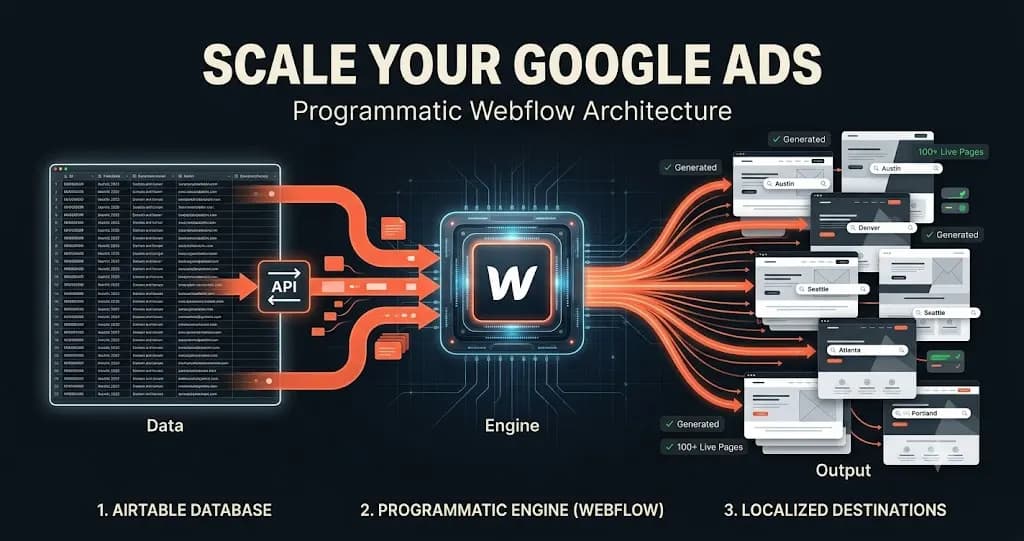
Programmatic Webflow Landing Pages: 7 Proven Secrets to Halving Your Google Ads CPC
Programmatic Webflow landing pages are the ultimate competitive advantage for scaling B2B SaaS platforms and national service businesses in 2026. Picture this: It is the start of Q3. Your Chief Marketing Officer (CMO) has just secured a massive $50,000/month budget to run highly targeted Google Ads. The strategy is brilliant on paper. If you are […]

Custom Quiz Funnel: The Engineering Secret to Halving Your Meta Ads CPA
When you send distracted, scrolling social media traffic directly to a standard, static Shopify Product Detail Page (PDP), you introduce immediate friction, confusion, and the “Paradox of Choice.” To survive and scale profitably in 2026, elite direct-to-consumer (DTC) and wellness brands are abandoning the standard PDP route. Instead, they are implementing a custom quiz funnel. […]