Google Ads Offline Tracking: 7 Proven Secrets to Scaling B2B Revenue via API
Datronix · October 2026 · 10 min read
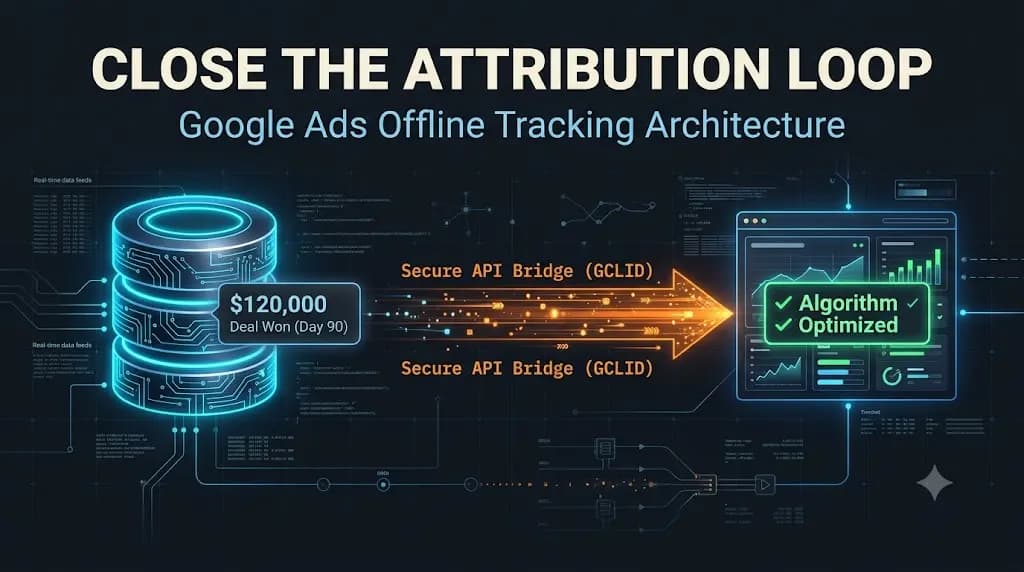
To fix this pipeline rot, you must merge your performance marketing strategy with elite software engineering. You must implement Google Ads offline tracking via a secure API bridge.
It is the end of the quarter. The Chief Marketing Officer (CMO) and the VP of Sales of a high-ticket B2B enterprise are reviewing the pipeline.
The marketing dashboard tells a story of absolute triumph. The company spent $50,000 this month on paid search. The Cost Per Lead (CPL) dropped to an all-time low. Hundreds of leads filled out the consultation form. Google’s Smart Bidding algorithm is working overtime, driving more and more traffic.
Then, the VP of Sales pulls up the custom CRM dashboard. The room goes quiet.
Out of the 500 leads generated by Google Ads over the last 90 days, only three have actually signed a contract. The sales team has wasted hundreds of hours chasing down college students doing research, micro-startups with zero budget, and tire-kickers.
The marketing team blames sales for “not closing.” The sales team blames marketing for “buying garbage traffic.”
But the reality is that both teams are victims of a broken architectural feedback loop. Your Google Ads algorithm is flying blind. Because your sales cycle takes three to six months, and the deal closes offline or inside a custom web portal, Google has no idea what happens after the initial form submit. It assumes all leads are equal. It is optimizing for cheap form fills instead of high-ticket closed revenue.
Here is the definitive, CTO-level engineering deep dive into why the “Cheap Lead Trap” destroys B2B budgets, how client-side pixels are failing you, and the exact Node.js/React architecture we build at Datronix Tech to feed actual, closed-won revenue data directly back into Google’s machine learning engine.
The Bleeding Neck: The “Cheap Lead Trap”
To understand why your advertising budget is bleeding out, we must deeply analyze how Google’s AI bidding algorithms (Target CPA and Maximize Conversions) function.
Google’s Smart Bidding is an incredibly powerful machine-learning engine. But like all machine learning, it is entirely dependent on the quality of the data it consumes.
In e-commerce, the feedback loop is instantaneous. A user clicks an ad for a pair of shoes, adds them to the cart, and buys them three minutes later. The conversion pixel fires, Google records the $150 sale, and immediately looks for more users with similar behavioral profiles.
In B2B SaaS, industrial manufacturing, or enterprise services, the funnel is completely different:
- Day 1: A user clicks an ad and fills out a “Request a Demo” form. (The pixel fires).
- Day 5: The Sales Development Rep (SDR) qualifies the lead.
- Day 30: The Account Executive (AE) performs the demo.
- Day 90: The client signs a $120,000 annual contract inside your custom web application.
If you are only using standard web tracking, Google only sees Step 1.
Google’s algorithm looks at a broke startup that filled out a form (Cost: $15) and a Fortune 500 enterprise that filled out a form (Cost: $150). Because Google doesn’t know the Fortune 500 company generated $120,000 90 days later, it optimizes your entire $50,000 ad budget to aggressively hunt for more of the cheap, useless $15 startup leads.
You enter an algorithmic death spiral. The better your marketing metrics look on the surface, the worse your actual sales revenue becomes.
The Tourniquet: The Mechanics of Google Ads Offline Tracking
The only way to break this cycle is to implement robust Google Ads offline tracking. We must build a system that remembers the exact ad click from Day 1 and mathematically connects it to the $120,000 contract signed on Day 90.
This is fundamentally achieved using a specific parameter: the GCLID (Google Click Identifier).
Every time a user clicks a Google Ad, Google automatically appends a unique, cryptographic string to the end of your URL (e.g., yoursite.com/pricing?gclid=EAIaIQobChMI...).
This GCLID is the golden thread. It contains all the hidden metadata about the click: the exact keyword the user searched, the ad copy they saw, the time of day, and the campaign it belongs to.
The architectural goal of Google Ads offline tracking is to capture this GCLID, store it securely in your backend database alongside the user’s profile, and hold onto it until the deal is won. Once the deal is won, your custom backend automatically packages that GCLID with the revenue value and sends it securely to the Google Ads API.
The Engineering Blueprint: Architecting the Custom API Bridge
Many companies attempt to solve this using tools like Zapier or Make.com. As we have documented extensively in our guide on building custom web apps for internal tools, relying on third-party iPaaS (Integration Platform as a Service) for mission-critical revenue data is highly fragile. Zapier rate limits, webhook timeouts, and formatting errors routinely cause 20% to 30% of your conversions to drop into the void.
To achieve enterprise-grade accuracy, you must build a bespoke API bridge natively into your custom web application. Here is the four-pillar architecture we deploy at Datronix Tech using a React frontend and a Node.js/PostgreSQL backend.
Pillar 1: Capturing the GCLID in React (The Frontend)
When the user lands on your website, our React application must instantly detect, capture, and preserve the GCLID.
- URL Parsing: We utilize a React
useEffecthook or Next.js middleware to parse the URL parameters upon the initial page load. - Persistent Storage: Because the user might browse your site for 20 minutes before filling out a form, we cannot rely on the URL remaining static. We instantly store the GCLID in the browser’s
localStorageand as a first-party HTTP-only cookie. - Hidden Form Fields: When the user finally navigates to your “Request a Demo” multi-step React form, our frontend logic silently injects the stored GCLID into a hidden input field within the form payload.
(Note: If the user is on an iOS device utilizing Apple’s Advanced Tracking Protection, the GCLID may be stripped. In these cases, we engineer the system to capture WBRAID or GBRAID parameters, which act as privacy-safe fallback identifiers provided by Google).
Pillar 2: Database Architecture (The Backend)
When the user clicks “Submit,” the React frontend sends the payload (Name, Email, Company Size, and the hidden GCLID) to your Node.js backend.
We engineer your PostgreSQL or MongoDB database schema to include dedicated tracking columns within the Users or Leads table:
gclid_string(VARCHAR)click_timestamp(TIMESTAMPTZ)conversion_environment(VARCHAR)
Your sales team now takes over. They work the lead inside your custom dashboard for the next three months. The GCLID remains safely dormant in the database, immutably tied to the user’s ID.
Pillar 3: The Event Trigger and Node.js Webhook
Fast forward 90 days. The Account Executive successfully negotiates the contract. They log into your custom B2B web portal and change the user’s status from Negotiating to Closed Won, entering a contract value of $120,000.
This database state change acts as the primary event trigger.
Our Node.js backend detects the Closed Won status update. It immediately queries the database for the user’s profile and extracts the dormant GCLID and the original click timestamp.
Pillar 4: Secure Communication with the Google Ads API
This is where the magic of Google Ads offline tracking happens. Your Node.js server must format this data into a highly specific JSON payload and push it securely to the Google Ads REST API.
- OAuth 2.0 Authentication: Our middleware securely authenticates with Google Cloud using a service account and OAuth 2.0 refresh tokens, ensuring the data tunnel is heavily encrypted and protected against unauthorized access.
- Payload Formatting: The Node.js worker formats the payload, mapping the GCLID, the exact conversion name (e.g., “Enterprise_Contract_Signed”), the timestamp of the click, the timestamp of the conversion, and the exact conversion value ($120,000).
- The Push: The server pushes the payload to Google.
Crucially, we build resilient error-handling logic. If the Google Ads API is temporarily down for maintenance, our Node.js server catches the 500 Internal Server Error, places the conversion payload into a secure Redis queue, and automatically retries the upload an hour later. Zero data is ever lost.
Advanced Data Privacy: Enhanced Conversions for Leads (ECL)
In 2026, relying solely on the GCLID is not always enough. As browsers become more aggressively privacy-focused, URL parameters occasionally get stripped before your React app can capture them.
To create an impenetrable tracking architecture, we supplement GCLID tracking with Enhanced Conversions for Leads (ECL).
If a GCLID is unavailable, our Node.js backend utilizes the user’s first-party data (the email address and phone number they provided on the form). Before sending this data to Google, our server mathematically encrypts the email and phone number using a one-way SHA-256 hashing algorithm.
We send the hashed string to the Google Ads API. Google then compares this hashed string against their own massive database of logged-in Google users. If there is a match, Google successfully attributes the $120,000 offline sale back to the original ad click, even without a GCLID.
This process is 100% GDPR and CCPA compliant because you are never transmitting raw, unencrypted Personally Identifiable Information (PII) across the network. (We utilize similar cryptographic techniques when engineering Server-Side Tracking for Meta and Google Ads architectures).
The Staggering Financial ROI of Value-Based Bidding
Implementing a custom Google Ads offline tracking API requires a significant initial capital expenditure (CapEx) in software engineering. However, for a B2B enterprise spending upwards of $30,000 a month on paid acquisition, the financial Return on Investment is truly staggering.
Once your custom web app is actively feeding $120,000 closed-won values back to Google, you unlock the ultimate weapon in digital marketing: Value-Based Bidding (VBB).
You can switch your Google Ads campaign settings from “Maximize Conversions” (optimizing for volume) to “Maximize Conversion Value” or “Target ROAS” (optimizing for profit).
Google’s machine learning algorithm experiences a paradigm shift. It realizes that the $150 click that took 90 days to close was actually the most profitable click of the year. The algorithm stops bidding on the cheap, low-intent startups and reallocates your entire $50,000 budget to aggressively dominate the auctions for enterprise executives who have a high statistical probability of signing a massive contract.
Your Cost Per Lead (CPL) might actually go up. But your Cost Per Acquisition (CPA) for a signed contract will plummet, and your Return on Ad Spend (ROAS) will multiply exponentially. You transition from buying clicks to actively buying revenue.
(Note: To ensure these expensive, high-intent clicks convert at the highest possible rate, this backend architecture must be paired with lightning-fast frontend delivery, effectively eliminating the Next.js App Router Waterfall to guarantee sub-second load times).
Conclusion: Stop Treating Marketing as a Silo
The most successful enterprise companies in 2026 do not view marketing and software engineering as two separate departments. They view them as a singular, interconnected revenue engine.
If your Google Ads manager does not have direct, programmatic access to the actual revenue data generated inside your custom backend, they are guessing. You cannot win a highly competitive, data-driven auction by guessing.
By bridging the gap between your custom web application and the advertising platforms through a secure Google Ads offline tracking API, you illuminate the entire customer journey. You train the world’s most powerful machine-learning algorithms to act as your ultimate, tireless sales prospector.
It is time to stop optimizing for cheap leads. It is time to engineer your pipeline for profit.
(Note: When scoping custom API integrations, backend architecture, and tracking deployments, all Datronix Tech B2B service proposals natively include the requisite 18% GST charge, ensuring complete financial transparency from the initial audit to final deployment).
Are your Google Ads optimizing for cheap leads instead of closed revenue?
👉 Get an Attribution Architecture Map. Stop flying blind and wasting your ad budget on tire-kickers. Let our senior developers audit your current CRM/Web App setup, map the exact API endpoints required, and architect a secure Node.js bridge to connect your backend revenue directly to your ad spend.
Schedule your strategic technical review today and turn your ad algorithms into revenue generators.
Related Posts
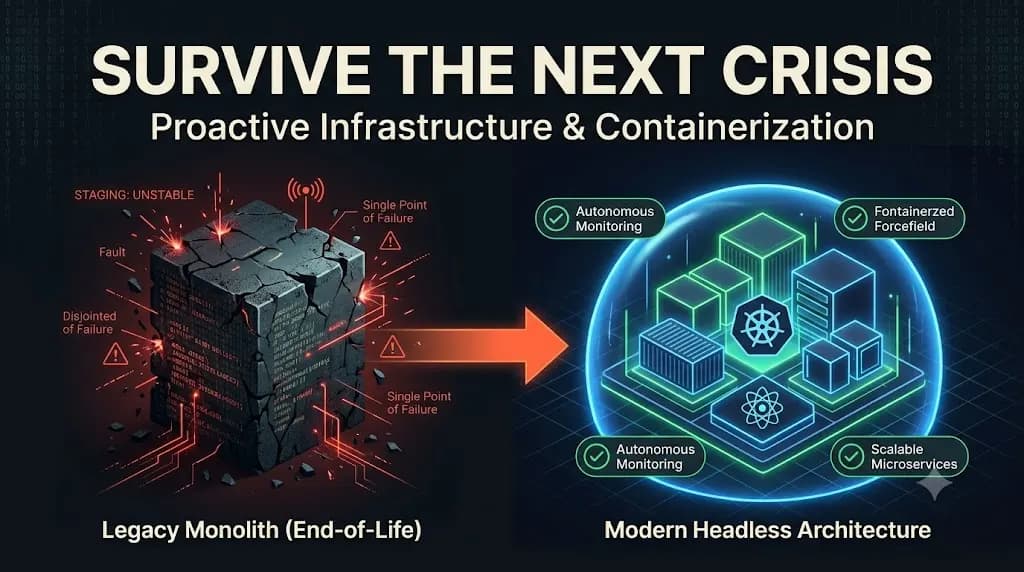
The 2026 PHP Crisis Post-Mortem: Transitioning from Reactive Band-Aids to Proactive Infrastructure Architecture
It is late 2026. The dust is finally settling on what the global developer community is now referring to as the PHP Crisis 2026. Over the last few months, a cascading series of critical vulnerabilities, deprecated version sunsets, and monolithic framework failures brought millions of enterprise websites to their knees. For Chief Technology Officers (CTOs) […]

Custom Shopify Meta Product Feed: The Engineering Secret to 3x Ad Placements
To scale high-volume e-commerce, you cannot rely on native plug-and-play apps. You must engineer a custom Shopify Meta product feed. Here is the definitive, CTO-level blueprint on how Datronix Tech utilizes custom Liquid scripting, Metafields, and advanced XML manipulation to push pristine, highly-optimized data directly into Meta’s machine learning engine, instantly multiplying your Return on […]