Building Custom Web Apps: The Enterprise Cure for the “SaaS Frankenstein”
Datronix · September 2026 · 9 min read
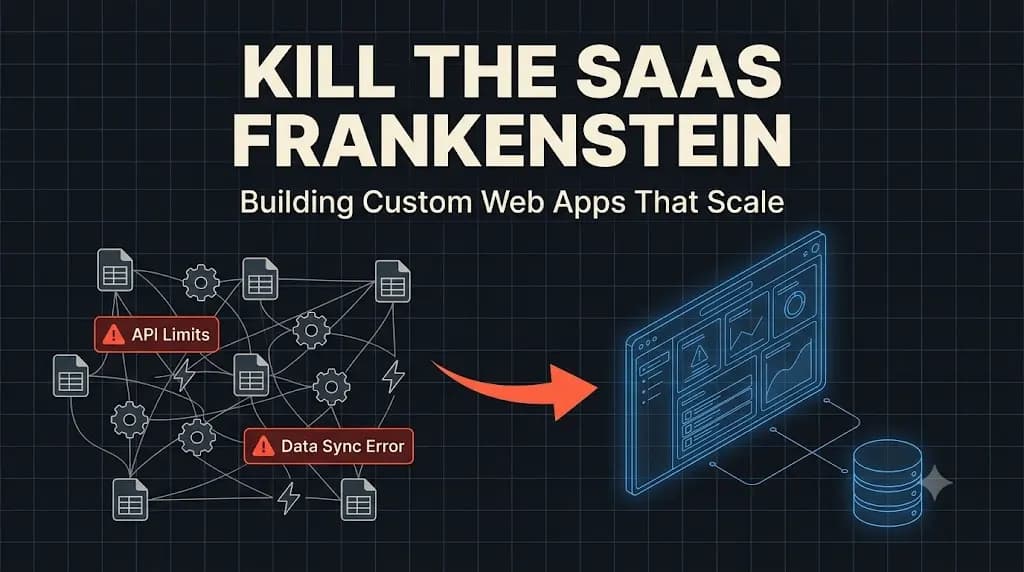
Building custom web apps is no longer a luxury reserved for Fortune 500 companies; it is an absolute survival requirement for mid-market businesses.
It is Wednesday at 10:00 AM. Your Operations Director is panicking. A critical Zapier workflow just silently failed because an API key expired. As a result, 50 high-ticket customer orders were logged into Stripe, but never made it to your Airtable inventory tracker, and the automated onboarding emails via ActiveCampaign were never sent.
Your team is now spending the next eight hours doing manual data entry, apologizing to confused clients, and trying to find where the “software glue” broke.
If this scenario sounds familiar, your company is suffering from the “SaaS Frankenstein” epidemic. In the early days of your business, stitching together six different off-the-shelf software tools was a brilliant, cost-effective way to get moving. But as you cross $5M, $10M, or $20M in revenue, that exact same tech stack becomes your biggest operational bottleneck.
Here is the definitive, elite engineering deep-dive into why off-the-shelf SaaS fails at scale, the hidden financial drain of “No-Code” glue, and the exact React/Node.js architectural blueprint we use to build bespoke internal dashboards that save our enterprise clients 40+ hours of admin work every single week.
The Bleeding Neck: The Hidden Cost of the “SaaS Frankenstein”
To understand the cure, we must first deeply analyze the disease. Why do pre-packaged SaaS tools fail when a business begins to scale aggressively?
1. The API Rate Limit Wall
Tools like Zapier and Make.com are fantastic for prototyping logic. However, they operate on a per-task billing model and are bound by strict API rate limits.
If you launch a massive marketing campaign and 5,000 leads enter your system in an hour, Zapier has to fire 5,000 times. Not only does your monthly bill skyrocket to thousands of dollars, but the third-party endpoints (like your CRM or Google Sheets) will likely throttle the requests, resulting in dropped data. We detailed this exact financial trap in our guide on why Zapier is costing you $2,000/month.
2. The Data Silo Nightmare
When your business logic is split across HubSpot, Airtable, Google Sheets, QuickBooks, and a proprietary dispatch tool, you do not have a “Single Source of Truth.”
Your sales team looks at one dashboard, and your fulfillment team looks at another. Because data synchronization relies on fragile webhooks that trigger every 15 minutes, there is always a lag. This lag creates inventory collisions, double-booking errors, and a fragmented customer experience.
3. Compliance and Security Vulnerabilities (SOC2/GDPR)
In 2026, data privacy is heavily regulated. If you are handling Protected Health Information (PHI) or sensitive financial data, routing that data through four different third-party iPaaS (Integration Platform as a Service) providers is a massive security liability.
Every time data jumps from one tool to another, you increase your attack surface. Achieving strict SOC2 compliance or GDPR compliance is virtually impossible when you don’t control the underlying data pipeline. (Read more about data privacy standards at the OWASP Foundation).
4. The Human Cost (Shadow IT)
The most expensive aspect of a fractured tech stack is human capital.
When off-the-shelf software doesn’t quite do what you need, your employees create workarounds. They export CSVs, manually format them in Excel, and re-upload them to a different system. You are paying senior operations managers $\$120,000$ a year to act as human API bridges.
The Tipping Point: When No-Code Automation Fails
No-code automation is brilliant for validating a Minimum Viable Product (MVP). But when does it fail?
You have reached the tipping point when:
- Your operational workflows are dictated by what your software allows you to do, rather than what your business needs to do.
- You are paying for “Enterprise” SaaS tiers just to access one specific feature, wasting thousands of dollars a month on unused bloatware.
- Your onboarding process for new employees takes three weeks because they have to learn how to navigate six different disconnected platforms.
When you hit this wall, it is time to pivot from renting software to owning your intellectual property.
The Tourniquet: Architecting and Building Custom Web Apps
Building custom web apps flips the operational script. Instead of forcing your unique business logic into a generic template, we engineer a digital environment tailored precisely to your operational DNA.
At Datronix Tech, we specialize in high-performance custom web development services. When we replace a SaaS Frankenstein, we utilize a robust, enterprise-grade architecture typically centered around the MERN (MongoDB, Express, React, Node.js) or PERN (PostgreSQL) stack.
Here is the exact technical blueprint of a custom internal operational dashboard.
Pillar 1: The Single Source of Truth (Database Unification)
The first step in building custom web apps is centralizing your data. We design a bespoke relational (PostgreSQL) or NoSQL (MongoDB) database schema.
Instead of customer data living in a CRM and order data living in a spreadsheet, everything is unified. When an operations manager updates a client’s status, that change is instantly reflected across the entire database with zero synchronization lag. This guarantees data integrity and eliminates the “spreadsheet versioning” problem.
Pillar 2: Custom API Middleware Architecture
You likely still need to talk to the outside world perhaps pulling shipping rates from FedEx or verifying payments through Stripe.
Instead of relying on fragile Zapier connections, we engineer dedicated Custom API Middleware. As we explored in our teardown of connecting legacy ERPs to modern ecommerce, a custom middleware layer handles rate-limiting, secure authentication, and robust error handling natively.
If the FedEx API goes down, our custom application doesn’t just silently drop the order. It catches the error, queues the request in a Redis cache, and automatically retries it when the API comes back online, alerting your team via a unified UI.
Pillar 3: The React/Next.js Administration Dashboard
The frontend is where the magic happens for your employees. We build a high-speed, intuitive custom React admin panel that consolidates the 6 tools they used to use into one single screen.
- Role-Based Access Control (RBAC): An entry-level warehouse worker logs in and sees a simplified, distraction-free barcode scanning interface. The CEO logs in and sees a high-level, real-time financial dashboard. The software adapts to the user.
- Frictionless Workflows: If a process previously took 15 clicks across 3 browser tabs, we engineer it to take 1 click. We utilize React’s state management to create lightning-fast, single-page application (SPA) experiences with zero page reloads.
Pillar 4: Real-Time Event-Driven Architecture
In a fast-paced logistics, healthcare, or financial services environment, you cannot wait for a page to refresh to know if a critical event occurred.
When migrating legacy apps to Node.js, we implement WebSockets (Socket.io) to enable bidirectional, real-time communication. If a high-priority client submits a support ticket, it instantly pops up on your support team’s dashboard in milliseconds, identical to how a Slack message functions.
The ROI: Why Building Custom Web Apps is a Capital Asset
The immediate objection from a CFO to building custom web apps is the upfront capital expenditure (CapEx). Off-the-shelf software is cheap today; custom software requires an initial investment.
However, the ROI of a properly architected internal tool is massive, compounding, and undeniable.
1. Eliminating OpEx Software Bloat
Calculate your monthly spend on Zapier, Airtable Enterprise, generic CRMs, and integration tools. It is not uncommon for a mid-market company to spend $5,000 to $10,000 a month on software subscriptions (OpEx). By building your own tool, you eliminate these recurring costs. You pay for the underlying cloud infrastructure (usually a fraction of the cost via AWS or Google Cloud) and own the IP entirely.
2. Reclaiming 40+ Hours of Payroll a Week
Time studies consistently show that employees in fragmented tech environments waste up to 2 hours a day searching for information, fixing sync errors, and doing manual data entry.
If you have an operations team of 5 people, and a custom web app saves them just 1.5 hours a day each, you have reclaimed 37.5 hours of highly-paid labor a week. You effectively gain an entire full-time employee’s worth of output without increasing your payroll. Your team stops doing data entry and starts doing high-leverage, revenue-generating work.
3. Increasing Enterprise Valuation
If you ever plan to sell your business, private equity firms look closely at operational infrastructure. A company held together by fragile Zapier workflows and Google Sheets is viewed as high-risk.
A company that runs on a proprietary, scalable, secure custom web application is viewed as a high-value tech-enabled business. Building custom web apps directly increases your enterprise multiplier.
Strategic Rollout: MVP to Enterprise
The biggest mistake companies make when commissioning custom software is trying to build the “Death Star” all at once. This leads to scope creep, ballooning budgets, and delayed launches.
At Datronix Tech, we employ an Agile, phased approach to ensure immediate ROI.
- Phase 1: The Workflow Audit. We map out your current “SaaS Frankenstein” to identify the most expensive bottleneck.
- Phase 2: The High-Impact MVP. We build the core React/Node.js application to solve that single biggest bottleneck first. We deploy it within weeks, not years.
- Phase 3: Iterative Strangulation. Over the next few months, we slowly “strangle” the old systems. We migrate the CRM functionality into the new app, then the inventory, then the billing. Your team experiences a seamless transition without massive operational disruption.
Conclusion: Stop Patching the Leaks
Off-the-shelf SaaS is designed to solve 70% of everyone’s problems, which means it solves 100% of nobody’s problems.
If your business has unique operational workflows, relying on generic software limits your growth. Every dollar you spend forcing incompatible tools to talk to each other is a dollar wasted.
By investing in building custom web apps, you stop patching leaks and start building a scalable foundation. You empower your employees, secure your data, and turn your operations into a distinct competitive advantage.
It is time to stop gluing your business together and start engineering it for scale.
(Note: When scoping custom internal applications and architecture migrations, all Datronix Tech B2B service proposals natively include the requisite 18% GST charge, ensuring complete financial transparency from the initial audit to final deployment).
Is your team wasting hours fighting with broken software integrations?
👉 Book an Internal Tool Scoping Session. Stop paying for unused SaaS bloat. Let our senior engineering team map your current workflows and calculate the exact financial ROI of replacing your software glue with a custom React/Node.js application. Schedule your strategic technical review today and build the engine your operations team deserves.
Related Posts
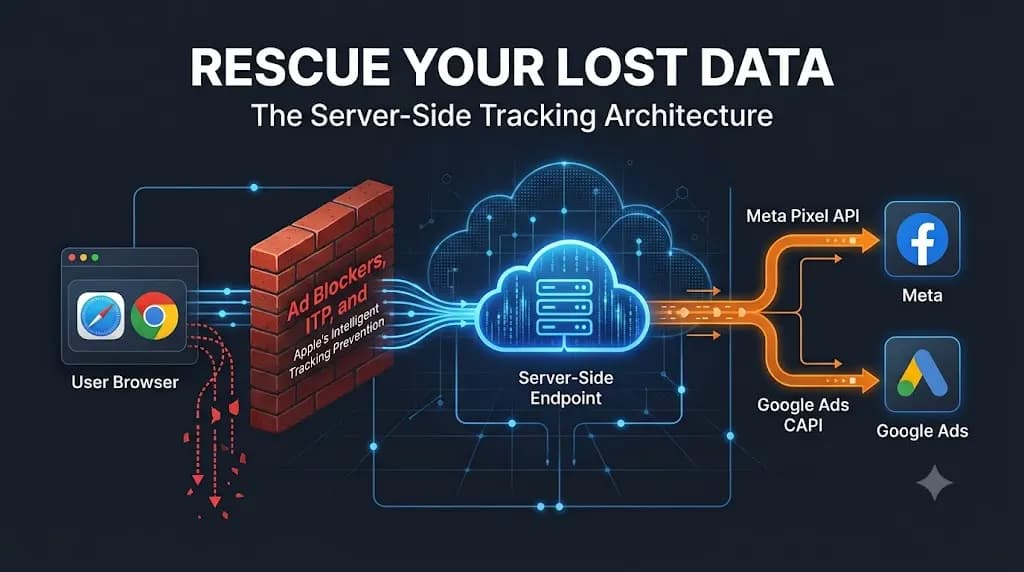
The Death of the Pixel: How Server-Side Tracking 2026 Architecture Rescues Meta and Google Ads Data
To survive and scale in the current digital landscape, you must implement Server-Side Tracking 2026 architectures. Here is the definitive, elite engineering deep-dive into why client-side pixels are dead, how we architect Google Tag Manager Server-Side (sGTM) containers, and how our developers rescue your lost conversion data to instantly restore your Return on Ad Spend […]
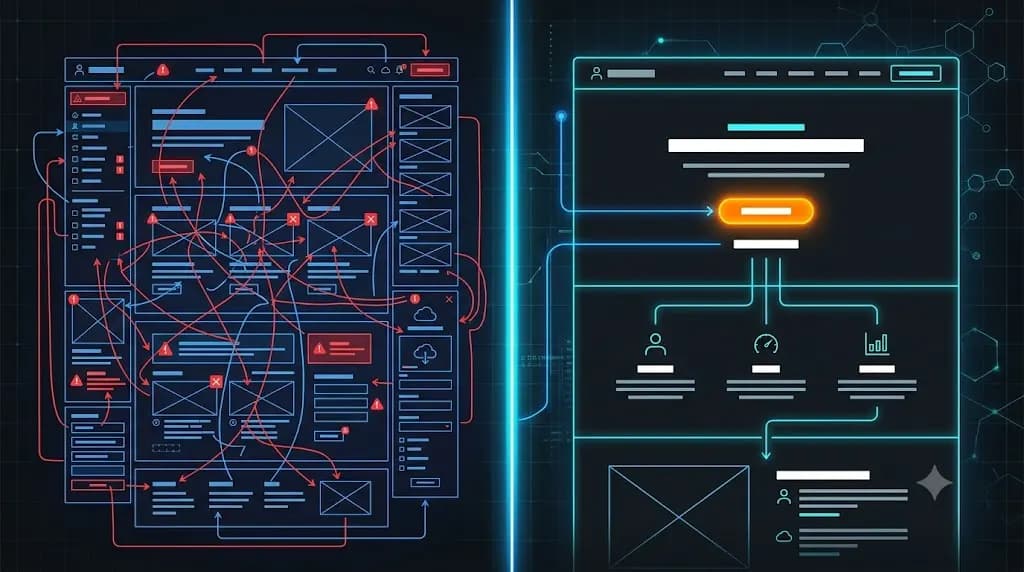
Stop Sending Google Ads Traffic to Your Homepage: The Tech Behind 20% Conversion Rate Landing Pages
If you want to stop setting your marketing budget on fire, you must separate your organic website from your paid acquisition funnels. Here is the definitive, technical deep dive into why homepages destroy your Return on Ad Spend (ROAS), and the exact engineering blueprint we use at Datronix Tech to build custom environments that achieve […]