Why Zapier is Costing You $2,000/Month (And How to Build Dedicated Webhooks)
Datronix · March 2026 · 3 min read
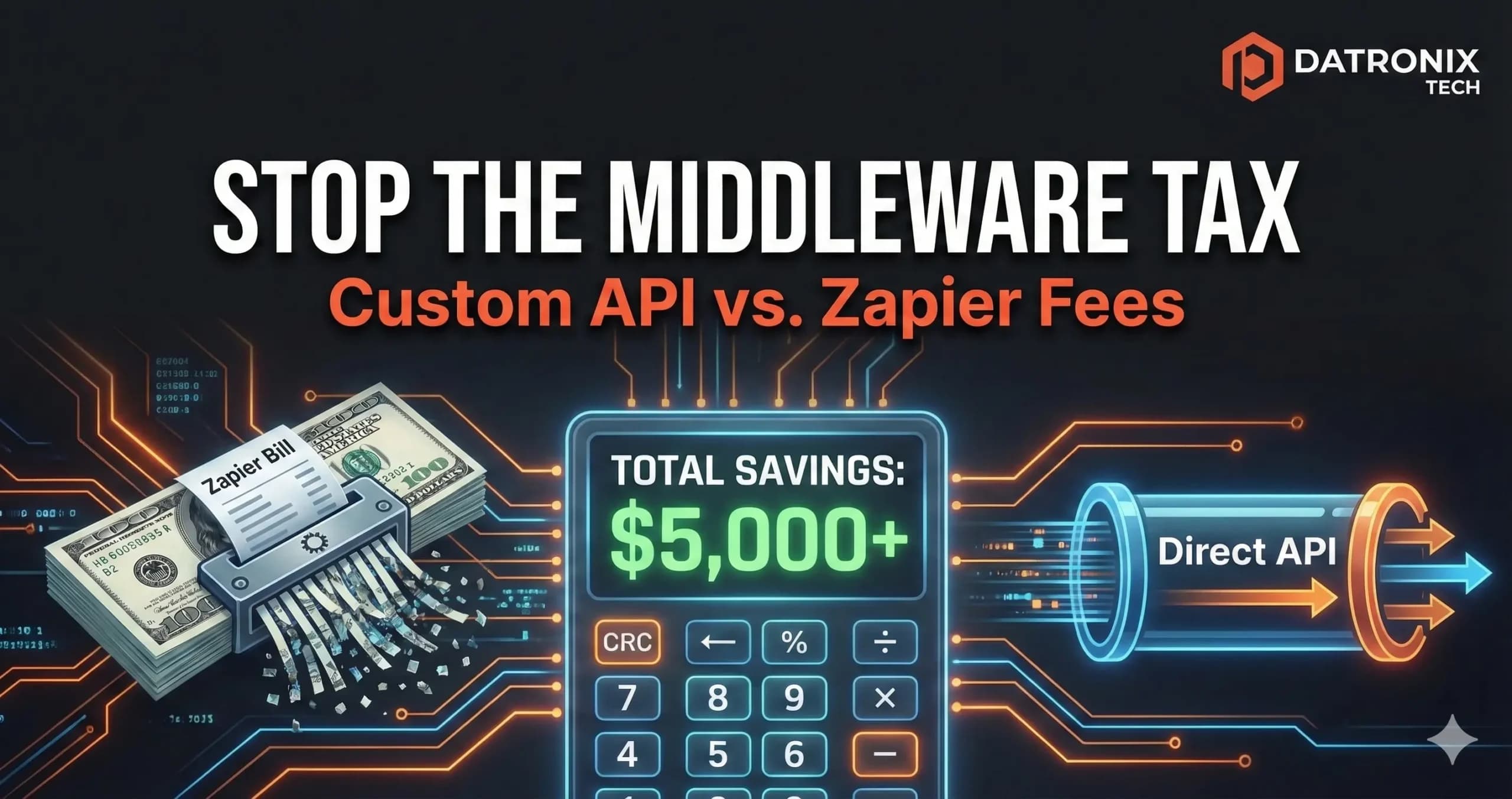
It’s the silent tax on high-growth companies where the debate of API Integration vs Zapier becomes unavoidable as automation costs begin to scale.
When you started, Zapier was a lifesaver. It connected your Shopify store to your CRM and your ERP with a few clicks. But as your order volume scaled from 100 to 10,000 a month, something shifted. Your automation bill is now higher than your hosting bill.
You are hitting “Task Limits” every two weeks. You are paying for “Platinum Plans” just to keep your data moving. In the industry, we call this the “Middleware Tax.”
For a scaling agency or e-commerce brand, relying on third-party “connectors” for core operations is a financial leak. Here is how to swap expensive subscriptions for dedicated, hard-coded webhooks that you own forever.
The Financial Breaking Point: The “Task” Trap
Zapier and Make.com charge you by the Task.
-
One new order in Shopify? 1 Task.
-
Checking if that customer exists in the ERP? 1 Task.
-
Updating the customer record? 1 Task.
-
Creating a shipping label? 1 Task.
A single order can easily burn 5–10 tasks. If you process 5,000 orders a month, you are looking at 50,000 tasks. At that volume, you aren’t just a customer; you are a profit center for the middleware provider.
Beyond the cost, you are dealing with the true cost of a website the hidden maintenance of managing dozens of “Zaps” that can break whenever an app updates its API.
The Tourniquet: Dedicated API Integrations
The alternative is a Direct API Integration. Instead of paying a middleman to translate data between Point A and Point B, we write a dedicated script (a Webhook) that sits on your server.
Why Dedicated Webhooks Win:
-
Zero Per-Task Fees: Whether you process 10 orders or 10,000, the cost is the same: $0.
-
Instant Speed: Middleware often has a “polling” delay (1–15 minutes). Direct webhooks are near-instant.
-
Security & Control: Your data stays within your controlled environment, reducing the “hops” it takes across the internet.
This is a critical component of professional Shopify, ERP, and CRM integration. You move from “renting” your data pipes to “owning” your infrastructure.
The CFO’s Logic: One-Time Fee vs. Perpetual Rent
Let’s look at the ROI.
-
SaaS Subscription: $2,000/month = $24,000/year.
-
Custom Development: A one-time fee of $10,000.
In year one, you’ve already saved $14,000. By year three, you’ve saved $62,000. This is a pure financial play. You are converting a recurring operational expense into a permanent capital asset.
Conclusion: Own Your Infrastructure
If you are a small startup, Zapier is great. If you are a scaling enterprise, it’s a bottleneck.
Stop letting “Task Limits” dictate your growth. By building dedicated webhooks, you regain control over your budget and your data flow. You move from a fragile “No-Code” web to a robust, professional-grade architecture built for scale.
Ready to stop the monthly bleed?
👉 Download the Middleware Cost-Savings Calculator We’ll show you exactly how a one-time development fee stacks up against your current SaaS subscriptions.
Related Posts
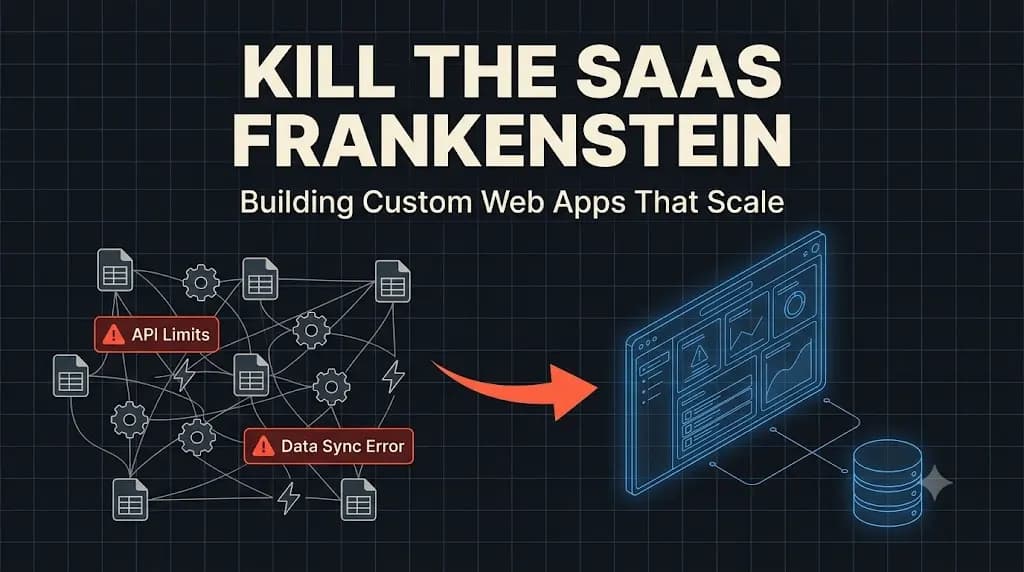
Building Custom Web Apps: The Enterprise Cure for the “SaaS Frankenstein”
Building custom web apps is no longer a luxury reserved for Fortune 500 companies; it is an absolute survival requirement for mid-market businesses. It is Wednesday at 10:00 AM. Your Operations Director is panicking. A critical Zapier workflow just silently failed because an API key expired. As a result, 50 high-ticket customer orders were logged […]
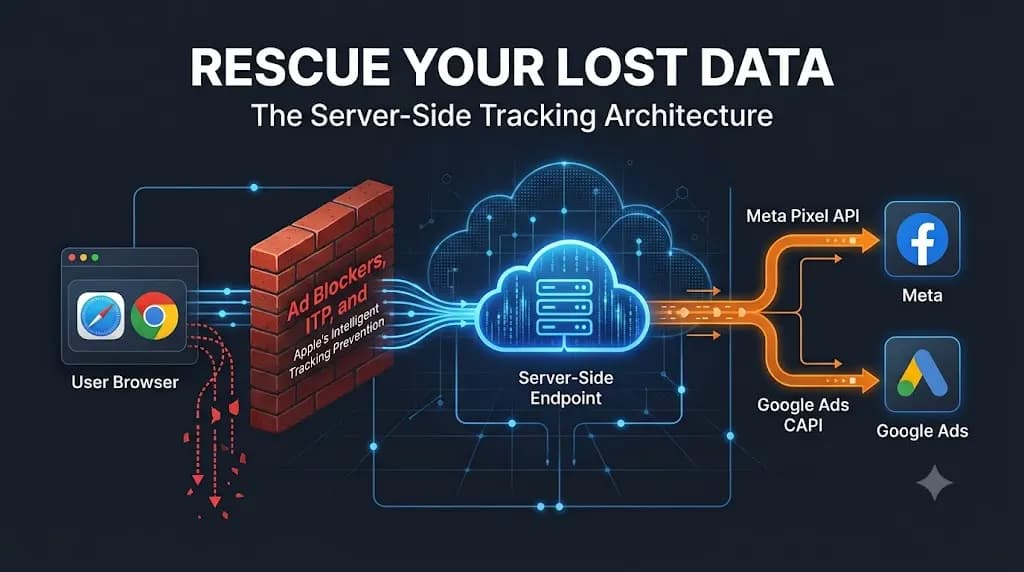
The Death of the Pixel: How Server-Side Tracking 2026 Architecture Rescues Meta and Google Ads Data
To survive and scale in the current digital landscape, you must implement Server-Side Tracking 2026 architectures. Here is the definitive, elite engineering deep-dive into why client-side pixels are dead, how we architect Google Tag Manager Server-Side (sGTM) containers, and how our developers rescue your lost conversion data to instantly restore your Return on Ad Spend […]