The Death of the Pixel: How Server-Side Tracking 2026 Architecture Rescues Meta and Google Ads Data
Datronix · September 2026 · 10 min read
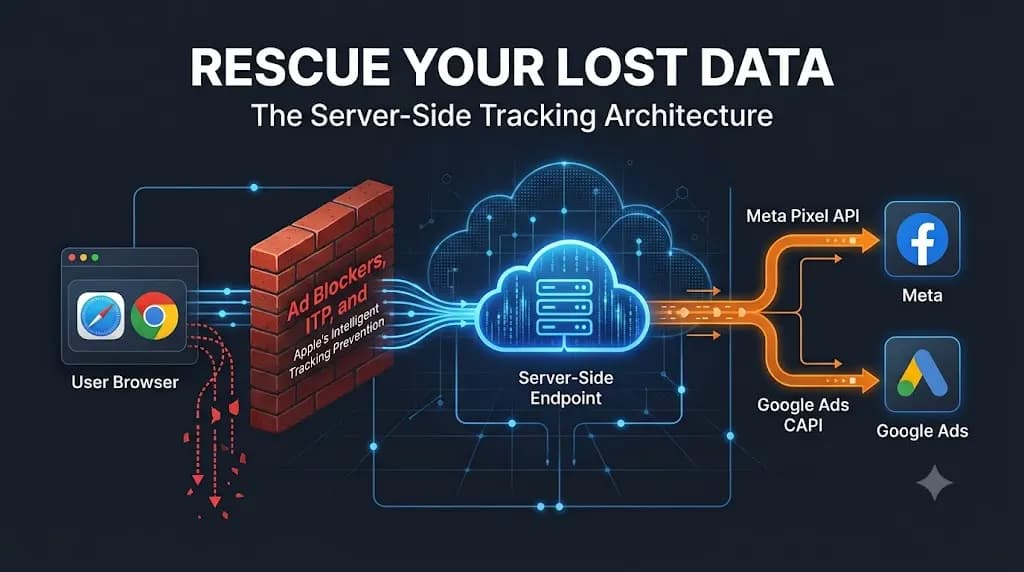
To survive and scale in the current digital landscape, you must implement Server-Side Tracking 2026 architectures. Here is the definitive, elite engineering deep-dive into why client-side pixels are dead, how we architect Google Tag Manager Server-Side (sGTM) containers, and how our developers rescue your lost conversion data to instantly restore your Return on Ad Spend (ROAS).
It is the end of the month. The Chief Marketing Officer of an eight-figure e-commerce brand is staring at two different dashboards.
On screen one, the Shopify (or ERP) dashboard shows $500,000 in gross revenue generated over the last 30 days. On screen two, the Meta Ads and Google Ads managers claim they only drove $350,000 in sales.
Where did the remaining 30% of the revenue go?
The marketing agency blames “organic traffic” or “multi-touch attribution.” But the CMO knows the truth: Ad tracking is fundamentally broken. Due to aggressive iOS updates, widespread ad-blocker adoption, and the systematic deprecation of third-party cookies, traditional browser-based tracking pixels are flying blind.
If your advertising algorithms cannot see the conversions, they cannot optimize for them. You are paying premium prices for ad traffic, but feeding your Meta and Google machine-learning models garbage data.
The Bleeding Neck: Why Client-Side Tracking is Dead
For the last ten years, digital marketing relied on a simple, fragile piece of technology: the Client-Side Pixel.
When a user loaded your website, their web browser (the “client”) downloaded a small piece of JavaScript from Facebook or Google. This script placed a third-party cookie on the user’s browser, watched their behavior, and sent data (like “Add to Cart” or “Purchase”) directly back to the advertising platform.
In 2026, this architecture is a massive liability. The modern web has declared war on the third-party pixel.
1. Intelligent Tracking Prevention (ITP)
Apple’s Safari browser (which commands over 50% of US mobile traffic) utilizes Intelligent Tracking Prevention. ITP ruthlessly blocks third-party cookies and severely restricts the lifespan of first-party cookies set by JavaScript. If a user clicks your Google Ad, leaves, and comes back 8 days later to buy, Safari has already deleted the gclid (Google Click ID). The conversion is lost.
2. Ad Blockers and Network Level Blocking
Privacy-focused browsers like Brave, Mozilla Firefox, and aggressive browser extensions do not just block cookies; they block the actual network requests. If a script tries to send a payload to connect.facebook.net or google-analytics.com, the browser intercepts and kills the request before it ever leaves the user’s device. Up to 30% of your audience is literally invisible to your ad platforms.
3. The Algorithmic Death Spiral
When your Facebook Pixel misses 3 out of 10 purchases, it doesn’t just mess up your reporting. It actively destroys your campaign performance. Meta’s AI relies on positive feedback loops. If it doesn’t receive the “Purchase” signal, it assumes the user it targeted was a bad fit. It stops showing ads to similar high-value users, drastically increasing your Cost Per Acquisition (CPA).
(This tracking failure compounds the issue of sending expensive clicks to unoptimized pages. To maximize ROI, you must pair accurate tracking with highly engineered, hyper-relevant destinations. Read our technical teardown: Stop Sending Google Ads Traffic to Your Homepage).
The Tourniquet: Architecting Server-Side Tracking 2026
To stop the bleeding, you must take the control out of the user’s browser and put it into an environment you own: your server.
Server-Side Tracking 2026 represents a paradigm shift. Instead of the user’s browser talking to Facebook and Google, the browser talks securely to your cloud server. Your server then processes, filters, encrypts, and routes that data directly to the ad platforms via their server-to-server Conversions APIs (CAPI).
The First-Party Data Advantage
Because the server-side container lives on a subdomain of your primary website (e.g., data.yourdomain.com), the browser treats it as a First-Party request. Ad blockers generally do not block first-party network requests, and Safari’s ITP is much more lenient with first-party cookies set directly from a secure server response (HTTP Set-Cookie headers) rather than JavaScript.
This allows you to bypass client-side restrictions and capture near 100% of user behavior.
Deep Engineering: How We Build the Server-Side Tracking Setup
Many marketing agencies claim they offer “Conversions API integration,” but they rely on cheap, automated Shopify apps or simple WordPress plugins that still run through the browser. That is not true server-side architecture.
At Datronix Tech, we approach tracking as a core software engineering discipline. Here is the technical blueprint our developers use to deploy enterprise-grade Server-Side Tracking 2026 environments.
Step 1: Cloud Server Provisioning (GCP or AWS)
We do not rely on shared, slow hosting environments. We provision a dedicated Google Cloud Platform (GCP) App Engine instance, or an AWS Fargate cluster, specifically to run your Google Tag Manager Server container. This ensures infinite scalability during massive traffic spikes (like Black Friday) without dropping a single payload.
Step 2: First-Party DNS Delegation
To bypass ad blockers, we configure custom DNS routing. We create A and AAAA records linking a custom subdomain (e.g., metrics.yourbrand.com) to your cloud server. We provision SSL/TLS certificates to ensure the data stream is strictly HTTPS encrypted. Because the tracking requests match your root domain, they easily bypass traditional client-side firewalls.
Step 3: Web-to-Server Routing (The Data Client)
In your standard “Web” GTM container, we disable all direct communication with third-party vendors. We configure GA4 (Google Analytics 4) to act purely as a transport mechanism. The Web container packages the user event (e.g., “Purchase”) and fires a single HTTP request to metrics.yourbrand.com.
Step 4: Server-Side Processing and CAPI Integration
Once your cloud server receives the payload, the magic happens. The Server GTM container reads the incoming request and triggers specific tags.
- Meta Conversions API (CAPI): The server encrypts user data (email, phone number, IP address) using SHA-256 hashing protocols and sends it directly to Facebook’s graph API.
- Google Ads API: The server fires Enhanced Conversions directly to Google’s backend, ensuring the
gclidand hashed user data are perfectly matched to the ad click.
Step 5: Advanced Event Deduplication (The Technical Safety Net)
Because browser networks can be unstable, best practice dictates running both the browser pixel (for users without ad blockers) and the Server API simultaneously as a fallback system.
However, if you send a “Purchase” event from the browser and the server, Meta will double-count your revenue. Our engineers program complex Event Deduplication logic. We generate a unique event_id in the user’s browser, attach it to both the pixel payload and the server payload, and send them both to Meta. Meta’s API reads the identical event_id, keeps the richer server-side data, and drops the redundant browser data. This requires precise, custom JavaScript execution to ensure zero discrepancies.
(For companies utilizing decoupled architectures, such as a Webflow/React Split Tech Stack, we engineer custom JWT state passing to ensure the event_id remains perfectly intact as the user crosses from the marketing site to the application).
The Financial ROI of Server-Side Architecture
Building a dedicated cloud tracking infrastructure requires an initial capital expenditure. However, the ROI of a proper Server-Side Tracking 2026 setup is realized almost immediately in three critical financial metrics.
1. Reclaiming 20% to 30% of “Lost” Conversions
By bypassing ad blockers and ITP, your ad platforms suddenly see the revenue they were previously blind to. If your campaigns were optimized for a $50 CPA (Cost Per Acquisition), but 30% of sales were invisible, your actual CPA was $35. By feeding this data back to Google and Meta, their algorithms exit the “learning phase” faster and aggressively scale your profitable campaigns.
2. Maximizing Event Match Quality (EMQ)
Meta ranks your data integration on a scale of 1 to 10 called Event Match Quality. A browser pixel usually scores a 4/10 because it fails to capture reliable user identifiers. Our server-side CAPI implementations routinely score 8.5/10 or higher. We hash and send First Name, Last Name, Email, Phone, City, State, ZIP, and external User IDs directly from your secure database. High EMQ directly correlates to lower ad costs because Meta can match the purchase to a specific user profile with pinpoint accuracy.
3. Ultimate Site Speed Optimization
Third-party tracking scripts are the #1 cause of slow websites. Loading the Facebook Pixel, TikTok Pixel, Google Ads tag, and Snapchat tag in the browser forces the user’s device to download megabytes of unoptimized JavaScript.
With Server-Side Tracking, we remove all of those third-party tags from your website. Your site loads a single, lightweight first-party script. Your server handles the heavy lifting of distributing the data to ten different platforms. This drastically improves your Core Web Vitals, which is a major factor in modern SEO, and directly increases your conversion rates.
Advanced SiteOps: Data Enrichment and Privacy Compliance
Beyond basic e-commerce tracking, a server-side environment unlocks enterprise-grade SiteOps capabilities.
1. Data Enrichment (Firestore Lookups)
Imagine a user buys a product, but you don’t want to send their lifetime value (LTV) or profit margin to the browser where a competitor could scrape it. With sGTM, our developers can intercept the “Purchase” event on your server, execute a real-time query to a Google Cloud Firestore database, append the user’s LTV or profit margin to the payload natively, and then send it to Google Ads. You optimize your bidding algorithms for actual profit, not just gross revenue.
2. Bulletproof Privacy Compliance (GDPR/CCPA)
In a world of massive data privacy fines, client-side pixels are a liability. They automatically scrape IP addresses and user agents and send them to Facebook.
With a server-side container, you own the data pipeline. Our engineers configure the server to actively redact Personally Identifiable Information (PII) before it is forwarded to external vendors. If a user opts out via your cookie banner, the server hard-drops the payload. You gain absolute, programmatic control over your data governance, satisfying the strictest GDPR, CCPA, and CPRA regulations.
Conclusion: Stop Flying Blind
The era of easy, plug-and-play browser pixels is over. The digital ecosystem is actively hostile to third-party tracking. If you continue to rely on outdated client-side technology, your tracking discrepancies will only widen, your CPA will continue to rise, and your competitors who have invested in data infrastructure will price you out of the auction.
Server-Side Tracking 2026 is not a marketing tactic; it is an elite engineering requirement. By taking control of your data pipeline, you ensure your ad algorithms are fed with 100% accurate, high-quality, and secure first-party data.
It is time to stop blaming the traffic and start fixing the infrastructure.
(Note: When scoping custom server-side cloud architectures and GTM deployments, all Datronix Tech B2B service proposals natively include the requisite 18% GST charge, ensuring complete financial transparency from the initial audit to final deployment).
Are your Meta and Google Ads managers missing 30% of your actual sales?
👉 Get a Server-Side Tracking Setup Consultation. Stop flying blind and stop wasting ad spend. Let our senior developers audit your current pixel configuration, map your data discrepancies, and architect a secure cloud container to reclaim your lost conversion data. Schedule your technical review today and turn your tracking into a competitive advantage.
Related Posts

Stop Sending Google Ads Traffic to Your Homepage: The Tech Behind 20% Conversion Rate Landing Pages
If you want to stop setting your marketing budget on fire, you must separate your organic website from your paid acquisition funnels. Here is the definitive, technical deep dive into why homepages destroy your Return on Ad Spend (ROAS), and the exact engineering blueprint we use at Datronix Tech to build custom environments that achieve […]
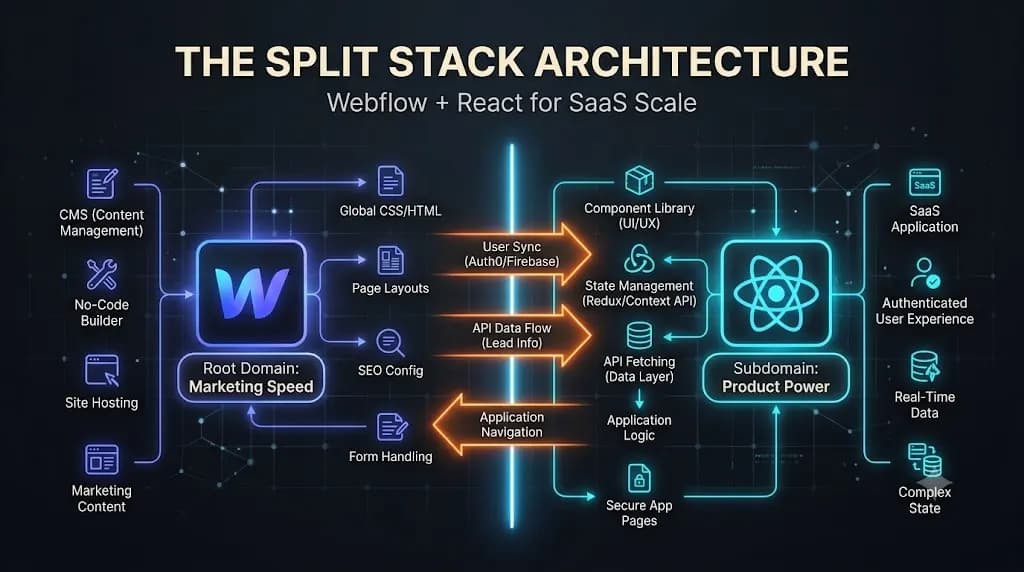
Webflow for Marketing, React for the Product: The Ultimate Split Tech Stack Architecture for SaaS Growth
To scale aggressively in 2026, you must decouple your marketing engine from your product engine. This deep-dive technical guide explores the ultimate split tech stack architecture: utilizing Webflow for the marketing site and React/Next.js for the core product, and how this separation unlocks unprecedented velocity for both your marketing and engineering teams. It is a […]