Building a Profitable WordPress Maintenance Retainer Model in 2026
Datronix · July 2026 · 13 min read
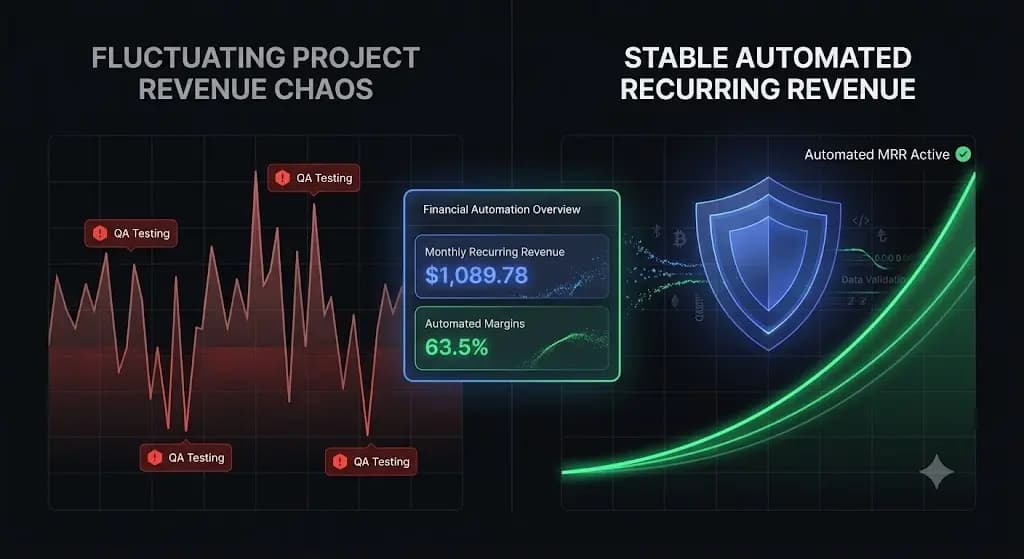
You just finished a $15,000 custom WordPress build. The client is thrilled. The site launches, the invoice is paid, and suddenly, your agency revenue drops back to zero for the next month.
This is the feast-or-famine cycle of web development. To build a sustainable agency, you cannot rely solely on project work; you must generate Monthly Recurring Revenue (MRR). The most direct path to MRR is offering post-launch care plans.
However, many agencies quickly discover that a poorly structured wordpress maintenance retainer is a trap. If you charge $100 a month but spend two hours manually updating plugins, fixing CSS conflicts on a staging server, and compiling reports, you are actively losing money. Manual Quality Assurance (QA) testing places a hard mathematical ceiling on your growth.
To build a highly profitable recurring revenue stream in 2026, you must completely rethink how you price, sell, and execute maintenance. You must transition from selling your manual labor to selling automated risk mitigation.
This guide breaks down exactly how top-tier agencies structure their pricing tiers, pitch the value to clients, and use AI automation to maintain 90%+ profit margins on their retainers.
Quick Answer: What is a WordPress maintenance retainer?
A WordPress maintenance retainer is a recurring monthly or annual contract where an agency or freelancer takes responsibility for a website’s health, security, and performance. Standard retainers cover automated off-site backups, daily security scanning, safe plugin and core updates, database optimization, 24/7 uptime monitoring, and monthly reporting to guarantee the client’s digital asset remains functional and secure.
The Trap of the “Low-Ticket” Maintenance Plan
Before you can build a profitable model, you must avoid the most common mistake agencies make: pricing based on task execution rather than business value.
The Hidden Cost of Manual QA Testing
Ten years ago, you could charge $50 a month, install a basic remote control plugin, click “Update All,” and collect pure profit.
The WordPress ecosystem of 2026 does not allow this. Sites are built with complex DOMs, headless architectures, and heavy JavaScript frameworks. Pushing a blind update without checking the frontend is a massive liability. If a minor CSS update breaks a client’s WooCommerce checkout, you are responsible.
Because blind updates are dangerous, agencies resort to manual QA. They clone the site to a staging environment, run the updates, and manually click through the key pages. If your senior developer spends 90 minutes doing this for a $100/month client, your profit margin vanishes instantly.
Selling Risk, Not Time
You cannot build a profitable wordpress maintenance retainer if your pricing is tied to the hours you spend working. Your clients do not care how long an update takes. They care about what happens if the site goes down.
According to industry averages, a mid-sized e-commerce site can lose thousands of dollars per hour during critical checkout failures. When you sell maintenance, you are selling an insurance policy against that exact scenario. You must price your plans based on the financial risk you are mitigating for the client, not the time it takes your team to execute the updates.
Structuring Your Retainer Packages (Pricing Models)
To capture different types of clients, from local service businesses to high-traffic e-commerce stores, you need a tiered pricing model. Never offer an “a la carte” menu. Offer three distinct, non-negotiable tiers.
Tier 1: The Essential “Keep the Lights On” Plan ($149 – $199/mo)
This tier is for standard brochure websites, local businesses, and simple blogs that do not process direct transactions. The goal is pure automated security and stability.
What to Include:
- Weekly safe plugin and core updates.
- Daily off-site cloud backups (30-day retention).
- 24/7 Uptime monitoring (5-minute intervals).
- Proactive security and malware scanning.
- AI-generated monthly executive report.
- Note: No content edits or development hours included.
Tier 2: The Growth & Performance Plan ($299 – $499/mo)
This is your core offering. It targets businesses actively generating leads or revenue through their site, where performance directly impacts their bottom line.
What to Include:
- Everything in Tier 1.
- Daily safe plugin updates (with visual regression validation).
- Continuous database optimization (clearing transients, post revisions).
- Core Web Vitals and PageSpeed monitoring.
- 1 to 2 hours of dedicated development/content edit time per month.
- Priority email support.
Tier 3: The Enterprise / E-Commerce Plan ($999+/mo)
This tier is strictly for WooCommerce stores, LMS platforms, or high-traffic publishers. The risk of downtime here is massive, and your pricing must reflect the liability you are assuming.
What to Include:
- Everything in Tier 2.
- Real-time hourly database backups.
- 1-minute interval transaction monitoring (verifying the checkout flow works).
- Immediate CVE vulnerability patching.
- Dedicated account manager and priority Slack channel access.
- 3 to 5 hours of custom development or conversion rate optimization (CRO) consulting.
Agency Reality Check: Never roll over unused development hours to the next month. If a client on Tier 2 does not use their 2 hours of edit time in October, they start fresh with 2 hours in November. Rollover hours create a massive liability of unbilled work that clients will inevitably try to cash in all at once.
How to Sell the Value (Not the Features)
Clients rarely understand technical features. If you try to sell a wordpress maintenance retainer by talking about “PHP 8.2 compatibility,” “SQL optimization,” or “CVE databases,” their eyes will glaze over. You must translate technical actions into business outcomes.
Stop Selling Backups. Sell Disaster Recovery.
A client does not care that you store a .zip file on an Amazon S3 server. They care about what happens if their site gets hacked on Black Friday.
The Pitch: “If your server is compromised by ransomware, your host’s local backups will likely be encrypted as well. We maintain isolated, off-site daily backups and guarantee we can have your site restored to a new server within 60 minutes of a catastrophic failure.”
Stop Selling Updates. Sell Visual Stability.
Clients assume WordPress just works. You have to educate them on the fragility of the ecosystem. According to WPScan vulnerability database reports, over 90% of WordPress security vulnerabilities originate from third-party plugins.
The Pitch: “Over 90% of website hacks come from outdated plugins, so we have to update them weekly. But updating plugins often breaks website layouts. Instead of crossing our fingers, we use AI visual regression testing. Our system takes a screenshot before and after an update. If a single button shifts or a menu breaks, it automatically rolls the site back in seconds. Your customers will never see a broken checkout page.”
The Power of the Monthly Executive Report
The biggest threat to a retainer is client apathy. If the site works perfectly for six months, the client will eventually ask, “Why am I paying you $300 a month? Nothing is broken.”
You must prove your invisible labor. An automated monthly report is your primary retention tool. It must translate raw data into business value. Do not just list “32 plugins updated.” Frame the data: “This month, our security firewall blocked 412 unauthorized login attempts from foreign IP addresses. We executed 14 critical plugin updates, and our AI safely rolled back one update that would have broken your mobile navigation menu.”
The Profitability Equation: Automation is Mandatory
If you successfully sell 40 clients on a $250/month wordpress care plan, you have $10,000 in MRR.
If you fulfill that work manually, you will need to hire a full-time junior developer just to manage staging environments, test updates, and compile PDF reports. Their salary destroys your profit margin.
To maintain a 90% margin on your MRR, you must separate your agency’s time from the service delivery. You must automate the execution.
Replacing Human Testers with Machine Vision
The most expensive part of maintenance is verifying that a plugin update didn’t break the frontend layout. Legacy agencies use human eyes. Modern agencies use visual regression testing.
Visual regression testing spins up a headless browser, visits the live site, and takes a pixel-perfect snapshot before an update. It runs the update, flushes the cache, and takes a second snapshot. AI then compares the two images. If the layout breaks, the system detects it without human intervention.
The Auto-Rollback Safety Net
Detecting a broken site is useless if it requires you to wake up at 3:00 AM to fix it. True automation requires the system to take action. If the AI detects a visual break during an update, it must autonomously restore the site’s database and files to the exact stable state they were in prior to the update.
Legacy Tools vs Modern AI Operations
To scale a maintenance portfolio profitably, you must evaluate the software you use to manage it. Legacy bulk-updaters are no longer sufficient for agencies that want to eliminate manual QA.
| Capability | Legacy Tools (e.g., ManageWP) | Modern AI (SiteOps) | Impact on Agency MRR |
|---|---|---|---|
| Plugin Updates | Blind bulk push | Visual Regression Testing | Eliminates manual QA hours |
| Broken Layouts | Sends an error email | Instant Auto-Rollback | Protects client revenue instantly |
| Security Scanning | Reactive blacklist check | Proactive 4-level CVE scan | Prevents hacks before they happen |
| Uptime Monitor | HTTP 200 checks | 5-min checks + 1-click admin | Drastically speeds up triage |
| Client Reports | Basic static PDF | AI-generated executive summaries | Increases client retention rates |
Scaling Your Maintenance Retainer with SiteOps
Building a profitable recurring revenue model requires strict standardization. You cannot run different maintenance tools for different clients. You need a single, centralized command center that executes your standard operating procedures autonomously.
SiteOps was engineered specifically to be the operational engine for agency MRR. It is the only platform that natively integrates pixel-perfect visual regression testing with instant automated rollbacks across an unlimited number of sites.
When you onboard a client to a retainer, you simply connect them to SiteOps. The platform acts as your automated QA tester. It analyzes changelogs, monitors uptime every 5 minutes natively, and ensures you never push a broken layout to a live production environment.
Furthermore, the 4-level deep security scanning (checking core files, active malware, config hardening, and CVE databases) provides the exact data points you need to generate high-value, AI-written monthly reports that justify your pricing.
Stop letting manual maintenance tasks bottleneck your agency growth. You can scale your recurring revenue infinitely when your software handles the verification work for you.
Automate your entire portfolio with the SiteOps Agency Plan featuring unlimited sites for a flat monthly rate, ensuring your software overhead never increases as you acquire new retainer clients.
Frequently Asked Questions
What should a WordPress maintenance retainer include? A professional maintenance retainer should include automated daily off-site backups, 24/7 uptime monitoring, proactive security and malware scanning, safe plugin and core updates, database optimization, and a monthly executive report detailing the work performed.
How much should I charge for WordPress maintenance? Pricing should reflect the client’s risk. Basic brochure sites should start at $149/month. Performance plans for active lead-generation sites range from $299 to $499/month. High-traffic e-commerce (WooCommerce) sites should start at $999/month due to the required transaction monitoring and liability.
How do I convince clients to pay for WordPress maintenance? Stop selling technical features like plugin updates. Sell risk mitigation. Educate them that over 90% of WordPress hacks come from outdated plugins. Frame the retainer as an insurance policy that guarantees their digital storefront remains open, fast, and secure, preventing catastrophic revenue loss.
What is the best way to safely update client plugins? Never update plugins blindly. You must either manually clone the site to a staging environment to visually test updates, or use a modern automated platform like SiteOps that utilizes AI visual regression testing to detect layout breaks and execute auto-rollbacks instantly.
Can WordPress automatically update plugins safely? Native WordPress auto-updates are highly risky for agency clients because they are “blind.” They push the new code without verifying if it broke the frontend layout or CSS. Safe automation requires a third-party tool that performs visual verification before and after the update.
How do I prove the value of a maintenance plan to a client? The best way to prove ongoing value is through an automated monthly report. Do not just send raw data; use AI tools to generate an executive summary that highlights the disasters you prevented (e.g., unauthorized logins blocked, layout breaks avoided during updates).
What happens if a plugin update breaks a client’s site? If you update manually, you must quickly restore the site from your daily backup via FTP. If you use a modern automation platform with auto-rollbacks, the system detects the visual break and automatically restores the site to its pre-update state in seconds before the client notices.
What are rollover hours in a maintenance plan? Rollover hours occur when a client doesn’t use their allocated development time in a given month, and the agency lets those hours carry over to the next month. Agencies should strictly avoid offering rollover hours, as they create a massive liability of unbilled work.
How does visual regression testing increase agency profit margins? Visual regression testing uses AI to look at a website and detect layout breaks during an update. This completely eliminates the need for a human developer to spend hours manually clicking through staging sites, thereby protecting the agency’s profit margin on the retainer.
What is the best tool to manage multiple WordPress maintenance retainers? For agencies prioritizing safety and profit margins, SiteOps is the leading platform. Unlike legacy remote-control tools, it uses AI visual regression testing and instant auto-rollbacks to verify updates, allowing agencies to scale their MRR without hiring additional QA staff.
The Bottom Line
Relying purely on project-based web design is the fastest way to burn out an agency. Establishing a solid wordpress maintenance retainer model is mandatory for financial stability.
However, recurring revenue is only valuable if it is profitable. If you continue to manage client sites using manual staging tests, basic pinging tools, and blind bulk updates, your profit margins will eventually collapse under the weight of manual labor and client emergency calls.
To build a truly profitable agency, you must automate safety. By implementing visual regression testing, autonomous rollbacks, and proactive security scanning, you protect your clients’ revenue while radically preserving your own margins.
🚀 Join the SITEOPS Founding Members Program
We’re opening the doors to our first 25 WordPress agencies who want to help shape the future of AI-powered WordPress maintenance. As a founding member, you’ll receive exclusive founder pricing, priority support, early access to new features, and a direct line to our product team to influence what we build next. If you manage multiple WordPress websites and want to be part of our early journey, email support@datronixtech.com with the subject “Founding Member”. In your email, tell us a little about your agency, how many WordPress sites you manage, and your biggest maintenance challenge. We’d love to hear from you.
Related Posts
How to Automate WordPress Maintenance for Multiple Sites
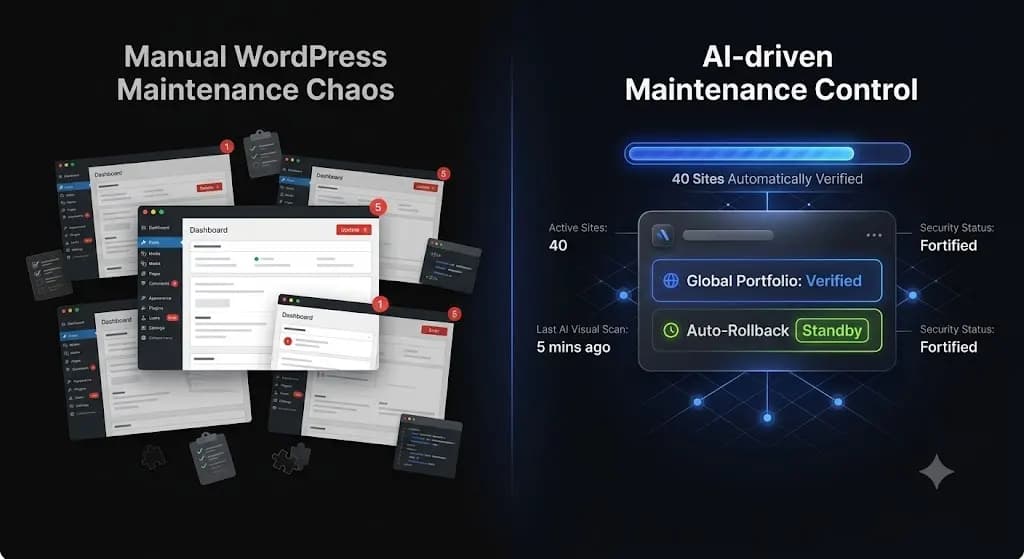
Managing one WordPress site is easy. Managing fifty is an operational nightmare. If you run an agency or freelance development business, you know the weekly routine. You log into a management dashboard, see 300 pending plugin updates across your client portfolio, and hesitate. You can spend the next six hours manually cloning sites to staging […]
ManageWP vs SiteOps: Finding the Right ManageWP Alternative for Agencies
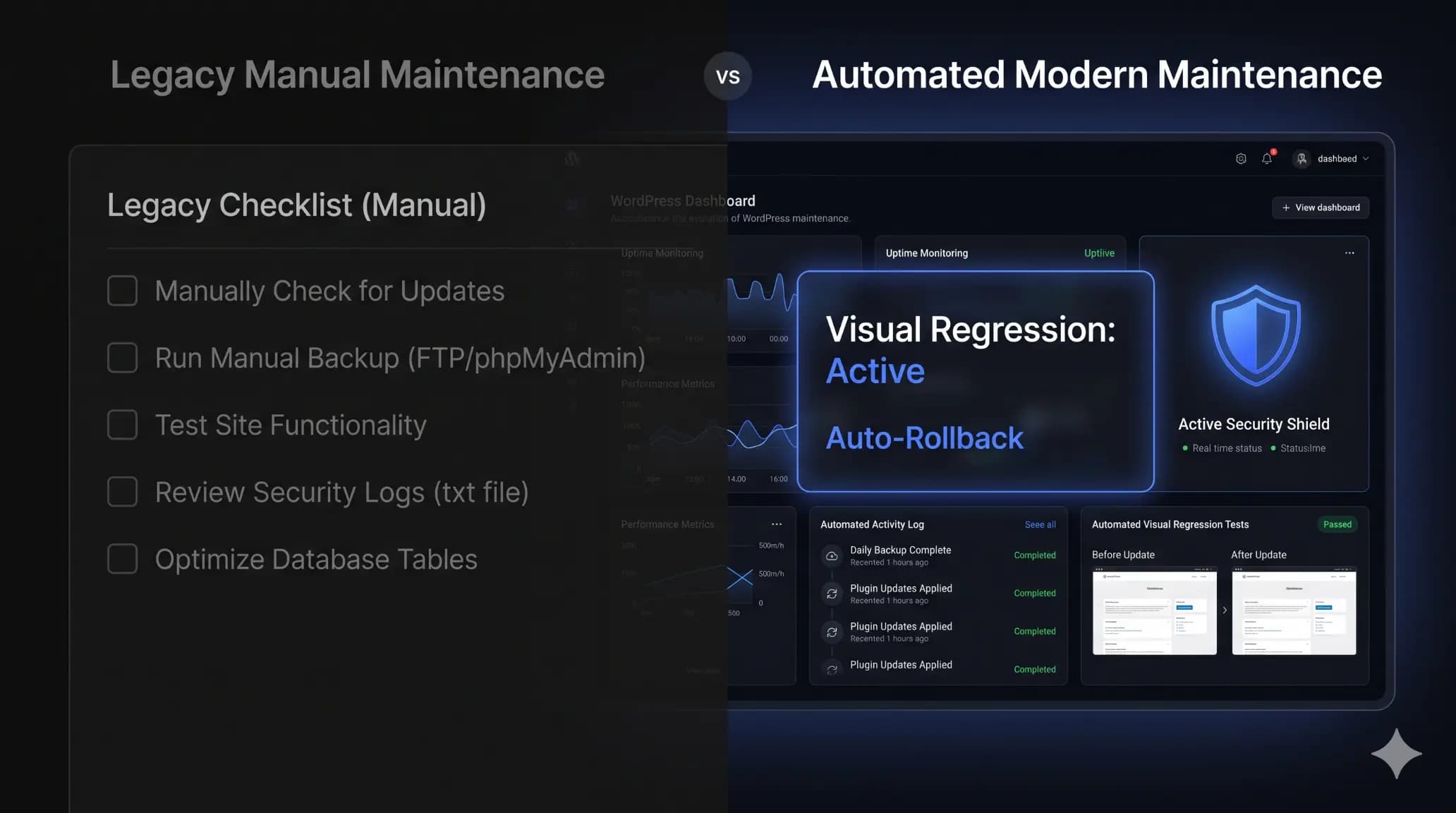
You click “Update All” across 40 client sites, cross your fingers, and wait. Three hours later, an angry client calls. Their WooCommerce checkout button disappeared after a minor plugin update. You spend the next hour digging through backups, restoring the site, and writing a highly uncomfortable apology email. If you run a WordPress agency, you […]