Custom Quiz Funnel: The Engineering Secret to Halving Your Meta Ads CPA
Datronix · October 2026 · 11 min read
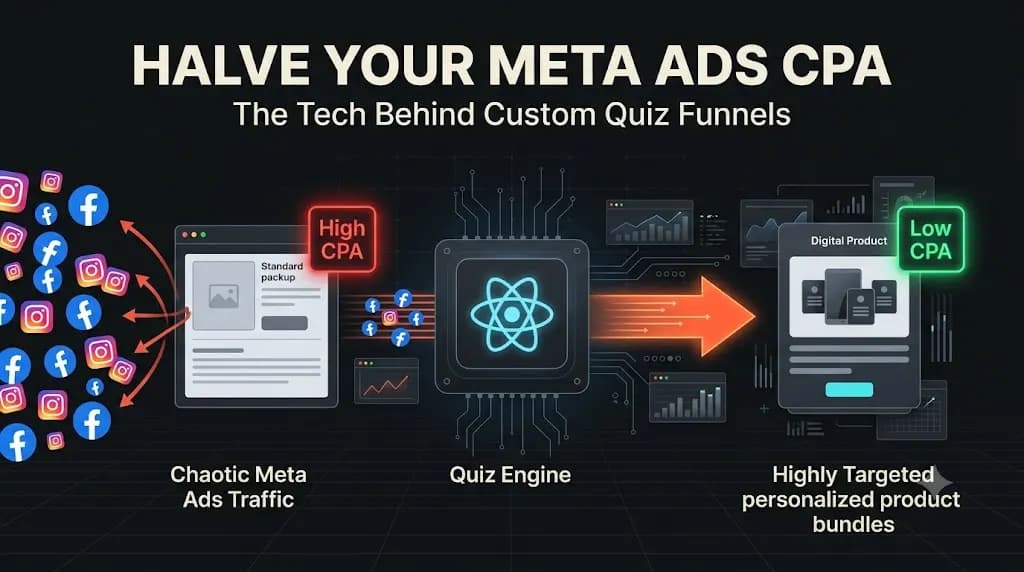
When you send distracted, scrolling social media traffic directly to a standard, static Shopify Product Detail Page (PDP), you introduce immediate friction, confusion, and the “Paradox of Choice.” To survive and scale profitably in 2026, elite direct-to-consumer (DTC) and wellness brands are abandoning the standard PDP route. Instead, they are implementing a custom quiz funnel.
It is Monday morning, and your e-commerce dashboard paints a frustratingly common picture. Your performance marketing agency is spending $25,000 a month on Meta Ads (Facebook and Instagram). The creative is stunning, the ad copy is sharp, and the Click-Through Rate (CTR) is exceptionally high.
Traffic is flooding into your Shopify store. But your Customer Acquisition Cost (CPA) is sitting at a horrific $80. You are acquiring customers at a loss, hoping to make it back on their second or third purchase six months down the line.
You ask the agency what is wrong. They blame the iOS updates, the algorithm, or say the traffic needs time to “season.”
The hard truth? The ads are doing their job perfectly. The problem is your post-click destination.
Here is the definitive, CTO-level playbook on why standard e-commerce funnels bleed cash, the technical flaws of generic “quiz apps,” and how engineering a bespoke, React-driven diagnostic tool can instantly halve your Meta Ads CPA while collecting priceless zero-party data.
The Bleeding Neck: Why Standard Product Pages Fail Paid Traffic
To understand the cure, we must deeply analyze the disease. Why is sending paid social traffic directly to a product page an architectural mistake?
1. The Intent Mismatch
Traffic generated from Google Search is “High Intent.” The user searched for “vegan protein powder for bloating.” If you send them to a page selling exactly that, they convert.
Traffic from Meta Ads is “Discovery/Low Intent.” The user was looking at photos of their friends, saw a compelling video about gut health, and clicked out of curiosity. When they land on a generic product page loaded with 15 different flavor variants, subscription options, and technical ingredient lists, they experience cognitive overload. They aren’t ready to buy; they are still trying to figure out if this product solves their unique problem. So, they bounce.
2. The Paradox of Choice
If you run a skincare brand and send an ad click to a “Shop All” collection page featuring 30 different serums, cleansers, and moisturizers, you are forcing the user to do the work. The user has to diagnose their own skin type, read the ingredients, and build their own routine.
In a world of infinite scrolling, consumers will not do the work for you. If the path to purchase requires heavy thinking, they will abandon the cart. (You can read more about how cognitive load destroys e-commerce conversion rates in Baymard Institute’s UX research).
3. The Cold Start Problem
A standard Shopify page treats every single visitor exactly the same. Whether the visitor is a 20-year-old athlete looking for muscle recovery or a 50-year-old executive looking for joint pain relief, the copy, the imagery, and the offer are identical. This lack of personalization destroys conversion rates.
(This is precisely why we champion performance marketing for lead generation strategies that segment users immediately upon arrival).
The Psychological Shift: The Diagnostic Approach
The solution is to insert a buffer between the ad click and the product page. This buffer is the custom quiz funnel.
Think of it like visiting a high-end doctor versus walking into a pharmacy. When you walk into a pharmacy, you stare at hundreds of bottles, confused. When you visit a doctor, they ask you a series of diagnostic questions: “Where does it hurt? How long have you felt this way? What is your goal?” At the end, they hand you a specific prescription.
A well-engineered quiz funnel does exactly this.
- Micro-Commitments: By asking the user a low-friction question (e.g., “What is your biggest skin concern?” with simple, tappable buttons), you initiate engagement.
- The Sunk Cost Fallacy: As the user progresses through a lightning-fast, 6-step quiz, they invest time and psychological momentum into the process. By the time they reach the final “Get My Results” screen, they are highly committed to seeing the outcome.
- Hyper-Personalization: The final page does not show them 30 products. It shows them one product (or a curated bundle), explicitly tying the product’s benefits back to the exact answers they gave in the quiz.
The Tourniquet: Why Generic Quiz Apps Destroy Your Site Speed
Once a brand realizes they need a quiz, they usually make a fatal technical error: they go to the Shopify App Store and install a generic, $29/month drag-and-drop quiz plugin (like Octane AI or Typeform).
While these tools are okay for testing an MVP, they are disastrous for scaling a high-volume paid media campaign.
1. The DOM Bloat Penalty
Generic quiz apps are not native to your theme. They operate by injecting massive amounts of heavy JavaScript and CSS into your Document Object Model (DOM). When a user clicks your Meta Ad, the browser has to load your Shopify theme, and then it has to download and execute the heavy quiz plugin.
This results in a 3 to 5-second delay before the first question even appears on the screen. On mobile devices, a 3-second delay causes over 50% of your paid traffic to bounce before the page loads. You are literally paying Meta for clicks that never see your first question.
2. Clunky, Refresh-Heavy Transitions
Standard plugins often rely on iframe embeds or traditional page reloads to move from Question 1 to Question 2. This creates a clunky, disjointed user experience that feels cheap, breaking trust with high-ticket buyers.
3. Limited Branching Logic and Data Silos
Cheap plugins limit your ability to write complex algorithms. What if you want to recommend Product A if they answer “Oily Skin” but Product B if they answer “Oily Skin AND Sensitive to Fragrance”? Generic apps struggle with complex, multi-variable logic matrices. Furthermore, they often trap your valuable customer data inside their third-party dashboards, making it incredibly difficult to sync back to your email flows (like Klaviyo) in real-time.
Architecting the Custom Quiz Funnel (The Engineering Blueprint)
To slash your CPA, you must transition from renting generic plugins to owning bespoke software. At Datronix Tech, we approach the custom quiz funnel as a standalone software engineering project.
Whether we are integrating it directly into a Shopify Liquid theme or building a decoupled headless Shopify architecture, here is the technical blueprint for a 20%+ conversion rate funnel.
Pillar 1: Lightning-Fast React/Next.js UI
We completely bypass Shopify’s liquid rendering for the quiz interface. We build the quiz as a dedicated Single Page Application (SPA) using React or Next.js.
- Zero-Latency State Management: We utilize modern state management libraries (like Zustand or Redux). When a user taps an answer, the transition to the next question happens in milliseconds. There are zero page reloads. The interface is fluid, engaging, and feels like a premium native mobile app.
- Component Pre-loading: Because it is built in React, we can pre-load the images and logic for Question 2 while the user is still reading Question 1, ensuring the experience never stutters, even on weak 4G connections.
Pillar 2: The Complex Logic Matrix
A true diagnostic tool requires robust algorithmic logic. We don’t just map “Answer A to Product A.” We write custom JavaScript matrices that assign weighted scores to every single answer.
If you are selling a personalized vitamin subscription, the algorithm calculates their stress score, sleep score, and dietary gaps simultaneously in the background. When they hit the final step, the custom React application formats a highly dynamic “Results Page.”
This page dynamically injects their name, dynamically swaps out the headline to address their primary pain point, and dynamically renders the exact product bundle they need using the Shopify Storefront API.
Pillar 3: Zero-Party Data Collection & Email Sync
A custom quiz funnel is the greatest data-harvesting tool in modern e-commerce. You are actively collecting Zero-Party Data data the customer intentionally and proactively shares with you (their exact age, their exact pain points, their specific goals).
Before we show the user their personalized results, we introduce a frictionless lead capture step: “Enter your email to unlock your personalized skin report and 15% off your first order.”
Because we control the code, we route this data seamlessly via API directly to Klaviyo or HubSpot. If the user doesn’t buy immediately, they are dropped into a highly segmented email flow. You don’t just send them a generic “Come back” email; you send them an email that says, “Hey Sarah, we know you are struggling with dry skin. Here is why this specific moisturizer will help.” This level of personalization skyrockets Customer Lifetime Value (LTV).
Pillar 4: Server-Side Meta Ads Tracking (The CAPI Advantage)
This is where the true power of custom engineering comes in. If a user completes your quiz and adds to cart, but their Safari browser is running an ad-blocker or Apple’s Intelligent Tracking Prevention (ITP), the Meta Pixel will miss the event. Meta’s algorithm will think the click was a waste of money and will raise your CPA.
To prevent this, our custom quiz funnel builds natively integrate with Server-Side Tagging.
When a user answers questions and submits their email, our secure Node.js backend intercepts that rich data, encrypts it, and fires it directly to the Meta Conversions API (CAPI) from the server. Meta’s algorithm receives perfect, rich data (including the user’s email for a perfect match rate) and immediately learns exactly what type of user converts on your quiz.
Your ad algorithm gets smarter by the hour, systematically driving down your CPA by targeting hyper-relevant lookalike audiences.
The Financial ROI: The Math of a Quiz Funnel
Building a bespoke React quiz application requires a higher initial capital expenditure (CapEx) than installing a $29 plugin. However, for a brand spending over $10,000 a month on Meta Ads, the operational ROI is staggering and immediate.
Let’s look at a conservative scenario:
- The Old Way: You spend $10,000 to get 10,000 clicks to a standard product page. It converts at a standard 1.5%. You get 150 orders. Your CPA is $66.66.
- The Custom Quiz Funnel: You send those 10,000 clicks to a lightning-fast React quiz. The micro-commitments and hyper-personalization increase your conversion rate to 3%. You get 300 orders. Your CPA drops to $33.33.
In a single month, the architecture pays for itself. But the hidden value is the data. Even the users who didn’t buy left their emails and their zero-party data, allowing your backend email marketing to convert them for free over the next 30 days.
Conclusion: Stop Treating Traffic Like a Commodity
Your performance marketing agency is likely doing a great job finding the right people. But if you are dumping those people onto a generic, unoptimized, and impersonal product page, you are actively sabotaging your own marketing budget.
To scale profitably in 2026, you must stop treating your website as a digital catalog and start treating it as a diagnostic sales machine.
By utilizing elite custom web development services to build a frictionless, data-rich custom quiz funnel, you seize control of the customer journey. You lower your CPA, you increase your Average Order Value (AOV) through customized bundles, and you build a database of deeply segmented zero-party data that will fuel your growth for years to come.
It is time to stop hoping for conversions and start engineering them.
(Note: When scoping custom React applications, Shopify Storefront API connections, and server-side tracking, all Datronix Tech B2B service proposals natively include the requisite 18% GST charge, ensuring complete financial transparency from the initial architecture audit to final deployment).
Are your Meta Ads generating clicks but bleeding cash on conversions?

👉 Get a Quiz Funnel Blueprint & Scoping Call. Do not spend another $10,000 on Facebook Ads until you secure your post-click destination. Submit your URL and ad spend to Datronix Tech. Our senior engineers and conversion specialists will map the exact logic, React architecture, and tracking infrastructure you need to launch a high-converting diagnostic tool.

Schedule your strategic technical review today and start converting clicks into highly profitable customers.
Related Posts
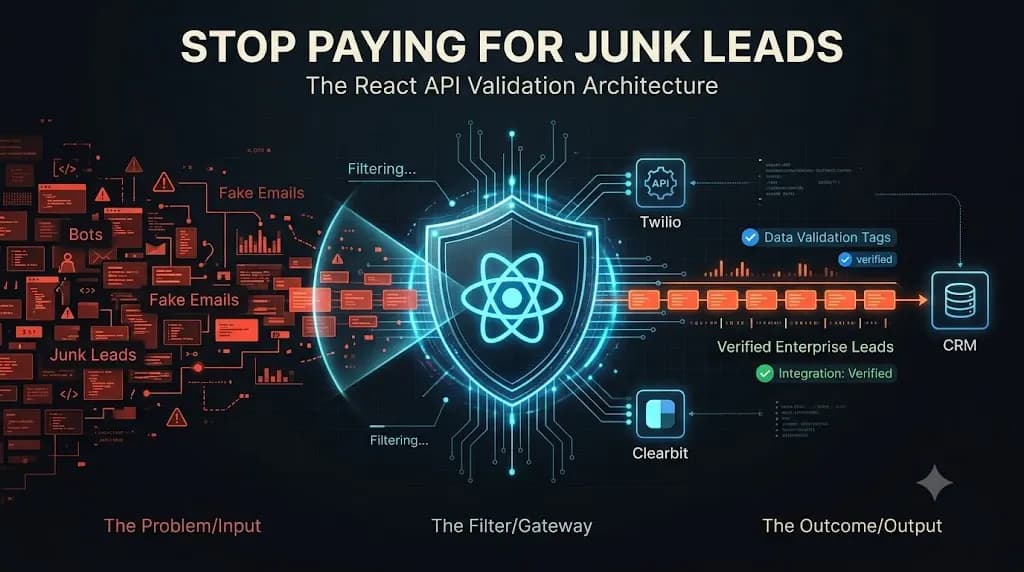
Stop Paying for Junk Leads: The Engineering Behind Custom React Forms API Validation
When you rely on basic, off-the-shelf WordPress forms or standard HTML inputs, you are rolling out the red carpet for bots, unmotivated browsers, and unqualified traffic. To protect your pipeline and scale your revenue, you must implement custom React forms API validation. It is a Tuesday morning, and the tension in your weekly revenue meeting […]
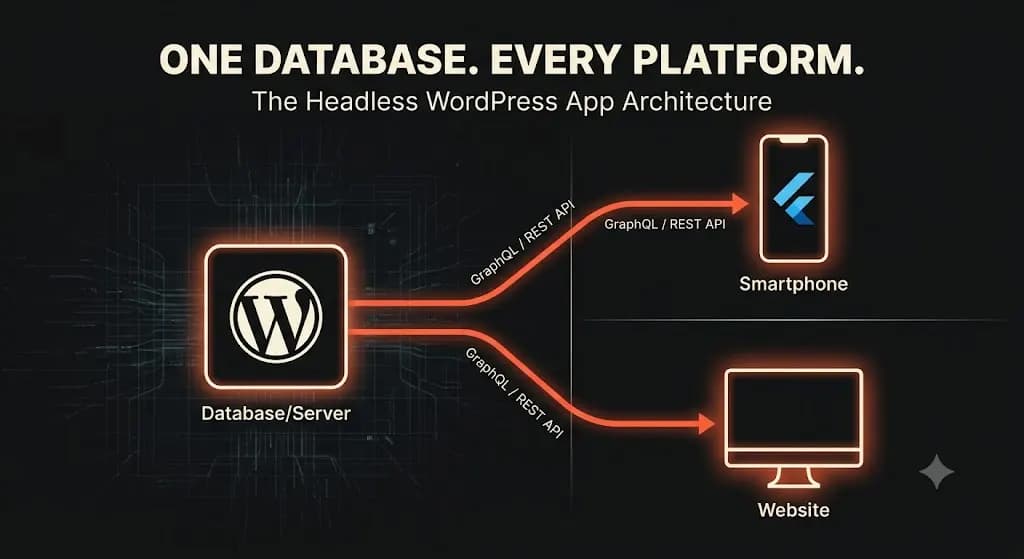
Turning Your WordPress Site into a Native Mobile App: The Headless API Architecture
Here is the definitive, elite engineering playbook on how we build a Headless WordPress mobile app that allows your team to publish once, and instantly update everywhere. It is a conversation that happens in boardrooms of scaling media companies, massive e-commerce retailers, and high-traffic directory sites every day. The CEO says, “Our mobile traffic is […]