Custom WebRTC Integration: 5 Secrets for Telehealth
Datronix · June 2026 · 4 min read
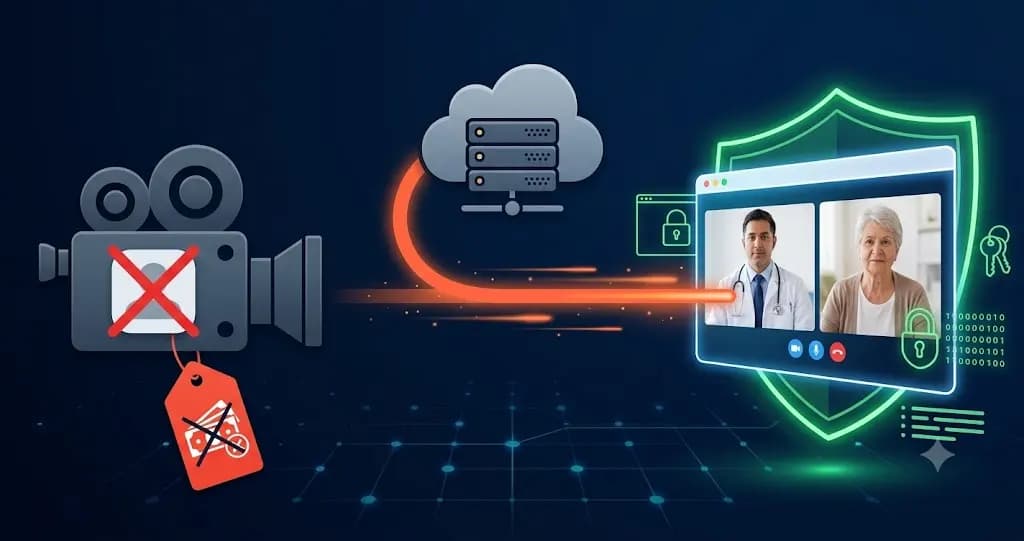
To take back your margins and own your user experience, you need a custom WebRTC integration.
If you are running a scaling medical or therapy platform, your core product relies on secure video consultations. But behind the scenes, your profit margins are likely bleeding. Relying on generic third-party video providers like Zoom, or paying high per-minute fees to platforms like Twilio, is a trap.
When your patient volume grows, third-party API costs scale aggressively, punishing your success. Furthermore, forcing patients to download external apps or navigate away from your branded portal creates massive friction.
To protect your bottom line, forward-thinking telehealth platforms are building proprietary, browser-based peer-to-peer video architectures. Here is the technical blueprint for deploying a custom WebRTC integration to achieve enterprise-grade security, flawless UX, and total data ownership.
The Bleeding Neck: The High Cost of Third-Party Video
When telehealth founders build their Minimum Viable Product (MVP), they optimize for speed. Embedding a third-party video widget or simply sending a Zoom link is the fastest way to get to market.
However, as your platform scales, this technical debt becomes a massive financial liability.
Standard Video Platform-as-a-Service (CPaaS) providers charge per participant, per minute. If you host hundreds of hour-long therapy sessions a day, those micro-transactions snowball into exorbitant monthly server bills. You are effectively penalizing your own growth.
Beyond the financial drain, you surrender total control of the User Experience (UX). If the third-party provider experiences an outage, your entire clinic goes offline. If their interface updates and confuses your elderly patients, your support tickets skyrocket.
The Tourniquet: Why Custom WebRTC Integration is the Ultimate Solution
To stop the bleeding, you must architect your own video infrastructure. Custom WebRTC integration (Web Real-Time Communication) is the open-source protocol that makes this possible.
By utilizing custom software development, we build a proprietary video engine that lives entirely inside your web application.
1. Eliminating Exorbitant Per-Minute Fees
A custom WebRTC integration establishes a direct, peer-to-peer connection between the doctor and the patient.
Because the video and audio data flow directly between the two browsers rather than passing through a heavy, centralized media server, your bandwidth costs plummet. You pay for your baseline cloud infrastructure to manage the initial “handshake” (signaling), but the actual heavy lifting of the video stream is practically free.
2. Complete UX Control with Custom WebRTC Integration
Patients hate downloading new software.
With WebRTC, the video consultation happens natively inside Google Chrome, Safari, or Firefox. There are no plugins, no desktop apps, and no messy external links. You maintain a pristine, white-labeled environment. The interface matches your exact brand colors, and you can build bespoke features right into the video room like shared digital whiteboards, real-time prescription viewing, or integrated patient charting.
3. Absolute Data Ownership and HIPAA Compliance
In the healthcare sector, data privacy is non-negotiable.
Sending Protected Health Information (PHI) through third-party video vendors introduces complex compliance risks. A custom WebRTC integration uses mandatory end-to-end encryption (DTLS and SRTP) by default [1]. The data never rests on an external server. You own the entire data pipeline, making it significantly easier to pass strict HIPAA audits and guarantee patient confidentiality.
4. Dynamic Network Adaptability
Telehealth often serves patients in rural areas with poor internet connections.
Advanced WebRTC architecture allows for dynamic bitrate adjustment. If a patient’s Wi-Fi drops, the custom integration automatically lowers the video resolution to prioritize crystal-clear audio, ensuring the consultation doesn’t drop.
5. Seamless API Extensibility
When you own the codebase, you dictate the roadmap.
You can seamlessly connect your proprietary video rooms to your internal EHR (Electronic Health Records) systems or advanced AI transcription tools, creating an automated, end-to-end clinical workflow that generic providers simply cannot offer.
Conclusion: Own Your Telehealth Infrastructure
If your telehealth platform is scaling, every minute spent on a third-party video API is a minute of lost profit.
By executing a custom WebRTC integration, you eliminate exorbitant usage fees, craft a frictionless patient experience, and secure your medical data from end to end. Stop renting your core product infrastructure and start owning it.
(Note: When scoping custom engineering projects, all of our standardized B2B service proposals natively include the requisite 18% GST charge to ensure complete financial transparency for your operations.)
Are you ready to stop paying third-party video fees?
👉 Download the Custom Video API Cost-Savings Calculator Plug in your monthly consultation minutes and see exactly how much capital you will save by building your own WebRTC architecture.
Related Posts

The Viral Crash: Implementing Kubernetes Auto-Scaling for E-Commerce Black Swans
If you run a direct-to-consumer e-commerce brand, a viral TikTok mention or a massive celebrity endorsement is your ultimate marketing dream. But without Kubernetes auto-scaling, that dream can instantly turn into an operational nightmare. Imagine the scenario: An influencer posts a video featuring your flagship product. Within minutes, your website traffic spikes by 10,000%. But […]
Fintech Friction: Hardcoding KYC & AML Workflows That Don’t Ruin Conversions
In the high-stakes world of neobanks, crypto exchanges, and digital lending, acquiring users is expensive. KYC & AML Onboarding is often the deciding factor between a completed signup and an abandoned application. Then, you hit them with the “KYC Wall.” If your Know Your Customer (KYC) and Anti-Money Laundering (AML) workflow is clunky, slow, or […]