How to Sell WordPress Maintenance Retainers (2026 Agency Guide)
Datronix · July 2026 · 12 min read
You just launched a beautiful, $15,000 custom WooCommerce build. The client loves it. They pay the final invoice. You sit down for the offboarding meeting and pitch your $250 a month maintenance package to keep the site updated.
The client smiles and says, “Thanks, but my nephew is pretty good with computers. We will just click the update buttons ourselves.”
Your Monthly Recurring Revenue (MRR) drops to zero, and you are back to hunting for the next big project. Six months later, the client calls you in a panic because a plugin update shattered their checkout page on Black Friday, and they expect you to fix it for free.
This is the most common, frustrating cycle in web development. If you want to scale a stable agency, you must learn how to sell wordpress maintenance retainers effectively. The problem is not the price of your care plan; the problem is your pitch.
Most developers try to sell technical features. Business owners do not buy features. They buy risk mitigation, revenue protection, and peace of mind.
This guide breaks down the exact psychological shifts, pitch scripts, and operational frameworks top tier agencies use to sell maintenance retainers easily, and how they use AI automation to fulfill those promises at a 90% profit margin.
Quick Answer: How do you sell a WordPress maintenance retainer?
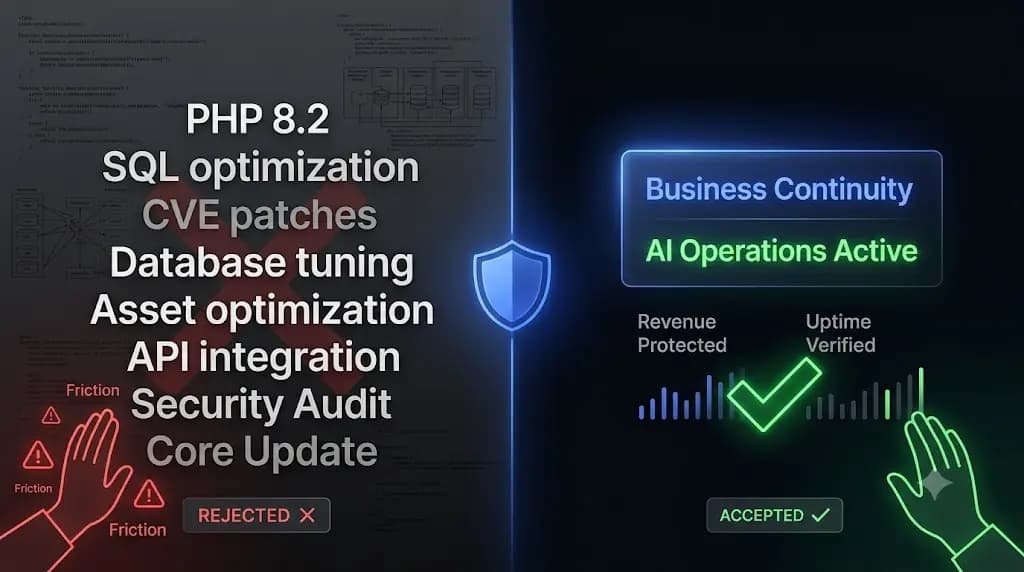
To successfully sell a WordPress maintenance retainer, you must stop pitching technical features like “plugin updates” and “database optimization.” Instead, pitch business continuity. Frame the retainer as an insurance policy that protects their digital storefront from hackers, catastrophic downtime, and broken checkout pages. To make the service highly profitable, agencies use AI automated platforms like SiteOps to handle the updates via visual regression testing, eliminating the need for unbillable manual labor.
The Fatal Flaw: Selling Technical Jargon
When a developer pitches a wordpress care plan, the proposal usually looks like a spec sheet:
- Weekly WordPress Core updates
- PHP 8.x compatibility checks
- MySQL database transient cleaning
- CVE vulnerability patching
To a non technical business owner, this reads like a foreign language. Because they do not understand the value of a “MySQL transient,” they assign it a value of zero. They immediately look at the $300 monthly price tag and view it as an unnecessary expense.
You must completely translate your technical deliverables into business outcomes.
The Translation Matrix
- Stop Selling: “We update your plugins every week.”
- Start Selling: “We prevent software conflicts from breaking your checkout page so you never lose a sale.”
- Stop Selling: “We do daily off site database backups.”
- Start Selling: “If your site is ever hacked or hit by ransomware, we guarantee we can have your business back online in under an hour without losing your customer data.”
- Stop Selling: “We monitor for CVE vulnerabilities.”
- Start Selling: “We actively block hackers from accessing your customer data and destroying your search engine rankings.”
How to Pitch WordPress Maintenance: The 3 Frameworks
To close retainers at a high conversion rate, you need to use specific sales frameworks that resonate with business owners.
Framework 1: The Digital Storefront (For E Commerce)
If a client runs a physical retail store, they gladly pay for locks, security cameras, and a landlord to fix a leaky roof. They understand physical maintenance. You must apply this logic to their digital asset.
The Script: “Your new WooCommerce site is your digital storefront. If the front door to a physical store breaks, you call a locksmith immediately because customers cannot get in. WordPress is complex software. If a minor update breaks your digital ‘Buy Now’ button on a Friday night, your store is effectively locked until Monday. Our maintenance plan is the 24/7 security team and repair crew that ensures your doors never close.”
Framework 2: The Liability Shift (For Lead Gen/B2B)
Business owners hate liability. They want to delegate risk. You need to make them realize that managing a website is a massive operational risk.
The Script: “Right now, your website generates about 30 high value leads a month. If a hacker breaches the site because a form plugin was outdated, Google will blacklist your domain, and those leads will instantly drop to zero. You could manage the updates internally, but if a staff member clicks ‘Update’ and the layout shatters, it becomes an internal crisis. For $250 a month, you transfer 100% of that liability to our agency. We take on the risk so your team can focus on closing deals.”
Framework 3: The “Done For You” Insurance Policy
For local businesses, simplicity is key. Frame the retainer as a straightforward insurance policy.
The Script: “Think of this retainer like car insurance for your brand. You don’t want to learn how to rebuild an engine, you just want the car to start every morning. We handle the backups, the security firewalls, and the code updates autonomously. You will receive a clear executive report every month showing exactly how many attacks we blocked, so you know your investment is protected.”
Overcoming the “We Can Do It Ourselves” Objection
This is the most common objection you will face. When a client says they will just click the update buttons themselves, you must gently expose the danger of that action.
The Rebuttal: “You absolutely can click the update button. The problem isn’t clicking the button; the problem is what happens next. Over 90% of WordPress hacks come from outdated plugins, so you have to update them. But plugin updates frequently conflict with custom code and break website layouts.”
“If you click update and your mobile navigation menu disappears, do you have a staging environment to test it? Do you have an immediate database backup ready to restore via FTP? Our system uses artificial intelligence to take screenshots of your site before and after an update. If anything breaks, our AI automatically rolls the site back in seconds. You are paying us to prevent the disasters that happen after the update button is clicked.”
The Profitability Trap: Why Selling Is Only Half the Battle
Let us assume you successfully use these scripts and sell 30 clients on a $200/month maintenance retainer. You now have $6,000 in MRR. Congratulations.
Now, you have to fulfill those promises.
If you fulfill that work manually, using legacy bulk update tools, you will destroy your profit margins. To guarantee the site does not break during an update, your team must manually clone 30 sites to staging environments, run the updates, and click through the homepages to verify the CSS layouts.
If you spend 15 hours a month performing unbillable Quality Assurance (QA) testing, you are actively losing money. The hidden cost of broken WordPress updates places a hard ceiling on your agency growth.
To build a truly profitable WordPress maintenance retainer, you must automate the fulfillment.
Delivering on Your Promises with SiteOps
When you sell a client on “flawless uptime and safe updates,” you must use technology that actually guarantees it. Legacy remote control tools (like a standard ManageWP alternative) push updates blindly. They do not verify if the site broke.
SiteOps was engineered specifically to be the autonomous engine that fulfills your sales promises profitably.
When you connect a client site to SiteOps, you stop acting as a manual QA tester. The platform acts as your autonomous WebOps team.
1. Fulfilling the “Safe Update” Promise
When SiteOps executes your weekly plugin updates, it utilizes AI visual regression testing. It takes a pixel perfect snapshot of the live site, runs the update, and takes a second snapshot.
If the AI detects that an update broke the layout or hid a checkout button, it instantly triggers an autonomous auto rollback. The MySQL database and file system are restored to their exact pre update state in seconds. You deliver on your promise of 100% stability without spending a single minute on manual staging tests. To see exactly how this works, review our guide on how to safely update WordPress plugins.
2. Fulfilling the “Proactive Security” Promise
Clients expect you to stop hackers. SiteOps utilizes a 4 level deep scanning architecture. It actively cross references your client’s installed plugins against global CVE vulnerability databases, ensuring you can patch zero day exploits before hackers compromise the site. This level of proactive WordPress security monitoring is a massive selling point.
3. Fulfilling the “Proof of Value” Promise
If you want the client to renew their retainer next year, you must prove your invisible labor. Sending a generic PDF listing “34 plugins updated” will lead to client churn.
SiteOps uses artificial intelligence to generate white-label WordPress maintenance reports. It transforms raw data into human readable executive summaries. It translates your technical execution into clear business value automatically, ensuring the client gladly pays their invoice every month.
Scale Your Agency MRR Infinitely
Learning how to sell maintenance is about changing your vocabulary. Learning how to scale maintenance is about changing your tech stack.
If you are using manual staging tests or legacy bulk updaters to manage your portfolio, you cannot grow without hiring a massive QA team. As you look to automate WordPress maintenance for multiple sites, you must choose a platform that verifies its own work.
Stop letting manual maintenance tasks bottleneck your agency growth.
Automate your entire SLA fulfillment with the SiteOps Agency Plan, featuring unlimited sites for a flat monthly rate, ensuring your software overhead never increases as you sign new retainer contracts.
Frequently Asked Questions
How do you pitch WordPress maintenance to a client? Stop pitching technical features like database optimization and core updates. Pitch business continuity and risk mitigation. Frame the retainer as a digital insurance policy that prevents hackers from stealing their data and ensures broken plugin updates never take their checkout page offline.
How much should I charge for WordPress maintenance? Pricing should reflect the client’s business risk. Basic brochure sites should start at $149 per month. Performance plans for active lead generation sites range from $299 to $499 per month. High traffic e commerce (WooCommerce) sites should start at $999 per month due to the required transaction monitoring and high liability.
How do I overcome the objection that they will update it themselves? Explain that clicking the update button is easy, but fixing the site when the update breaks the layout is hard. Inform them that plugin conflicts frequently shatter website designs, and your agency uses AI visual regression testing to automatically roll back bad updates before their customers ever see a broken page.
What should a WordPress maintenance contract include? A strong contract must include the exact scope of services (updates, backups, security), explicit exclusions (custom development, content creation), a Service Level Agreement (SLA) for response times, limitation of liability for third party hacks, and clear payment and cancellation terms.
How do I prove the value of a maintenance retainer every month? The best way to prove ongoing value is through an automated monthly report. Do not just send raw server data. Use AI tools to generate an executive summary that highlights the specific disasters you prevented, such as unauthorized logins blocked or layout breaks avoided by auto rollbacks.
What is the best way to safely update client plugins? Never update plugins blindly. To fulfill your contract safely, you must either manually test every update on a staging server, or use an automated maintenance platform like SiteOps that utilizes AI visual regression testing to detect layout breaks and execute auto rollbacks instantly.
Why do clients churn from maintenance retainers? Clients usually churn due to a lack of communication. If their website works perfectly for a year, they assume they no longer need you. You must send high quality, business focused executive reports every single month to remind them of the invisible labor you are performing to keep the site stable.
Can WordPress automatically update plugins safely? Native WordPress auto updates are highly risky for agency clients because they execute blindly. They push the new code without verifying if it broke the frontend layout or CSS. Safe automation requires a dedicated third party tool with visual verification capabilities.
How do agencies fulfill maintenance retainers profitably? Top tier agencies no longer use manual staging tests for every update because they are highly unprofitable. They use automated AI platforms like SiteOps that utilize visual regression testing to verify frontend layouts autonomously, completely eliminating unbillable human QA hours.
Should I offer rollover hours in my maintenance packages? No. You should explicitly state in your contracts that unused support or development hours do not roll over to the next month. Allowing rollover hours creates a massive liability of unbilled work that clients may attempt to cash in all at once during a busy season.
The Bottom Line
Selling a WordPress maintenance retainer is the most important action you can take to stabilize your agency’s cash flow. By shifting your sales pitch away from technical jargon and toward risk mitigation, you instantly elevate your perceived value to the client.
However, selling the retainer is only the first step. If you rely on legacy platforms or manual labor to fulfill those retainers, your profit margins will collapse.
By implementing AI WordPress maintenance platforms that utilize automated visual regression testing and instant auto rollbacks, you guarantee the visual integrity of every update. You protect your clients’ revenue, secure your agency’s reputation, and radically preserve your profit margins.
Stop selling your time. Start selling automated peace of mind. SiteOps automates the entire workflow.
Related Posts
The Ultimate WordPress Maintenance Contract Template (Agency Guide)
Selling a $500-a-month maintenance retainer is a massive win for your agency’s Monthly Recurring Revenue (MRR). But if that client emails you on a Saturday morning demanding three hours of custom development work, or threatens to sue you because their WooCommerce checkout broke during a plugin update, that retainer suddenly becomes a massive liability. A […]
How Often Should You Update WordPress Plugins? (The 2026 Agency Standard)
For years, the standard advice given to website owners was simple: log in once a month and click “Update All.” In 2026, that advice is not just outdated; it is actively dangerous. The WordPress ecosystem is the foundation of the modern web, powering highly complex e-commerce stores, membership portals, and headless applications. With this complexity […]