How to Productize WordPress Care Plans (Scale Your MRR in 2026)
Datronix · August 2026 · 10 min read
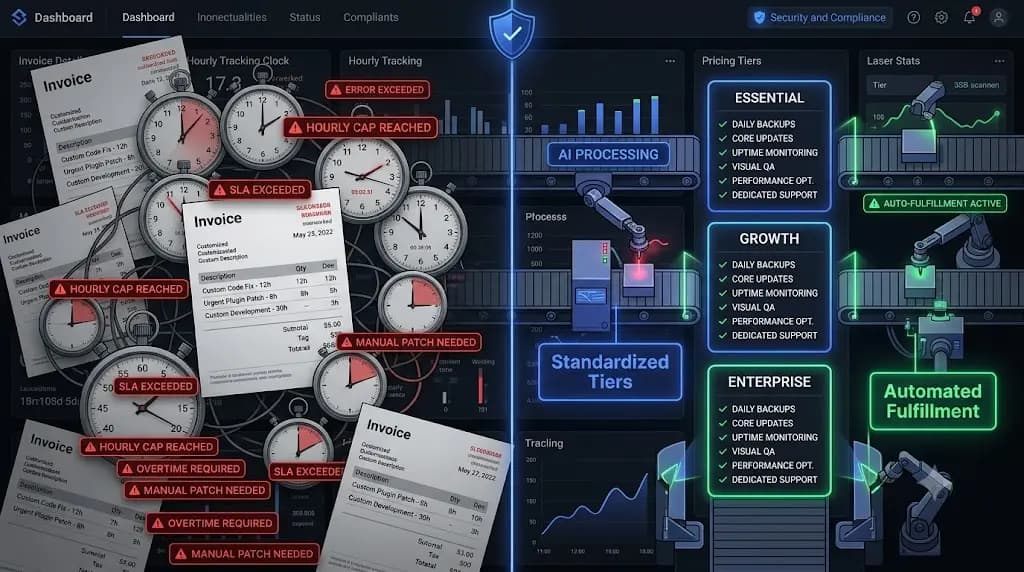
If you ask ten different clients what “website maintenance” means, you will get ten different answers. One client thinks it means fixing a broken image. Another thinks it means writing a new blog post every week. A third assumes it means you are personally monitoring their server at 3:00 AM.
If you sell custom, hourly maintenance contracts based on these wild expectations, your agency will eventually collapse under the weight of scope creep. You will spend more time negotiating what is “in scope” than actually doing the work.
To build a highly profitable WordPress maintenance retainer, you must stop acting like a custom contractor and start acting like a software company. You must learn how to productize wordpress care plans.
A productized service is a standardized offering sold at a fixed price, with a strictly defined scope, delivered via repeatable, automated systems.
This guide breaks down exactly how to productize your wordpress recurring revenue, from defining the strict boundaries of your tiers to utilizing AI to automate the fulfillment, allowing you to scale your agency infinitely.
Quick Answer: How do you productize WordPress maintenance?
To productize WordPress maintenance, you must stop selling custom hourly work. Instead, create three standardized, fixed-price tiers (e.g., Essential, Growth, Enterprise). Strictly define the exact deliverables (updates, backups, security, reports) and explicitly state what is excluded (custom development). Finally, fulfill these standard plans using an automated platform like SiteOps to handle visual QA testing and reporting, ensuring high profit margins without manual labor.
Step 1: Define the Strict Scope (The “No” List)
The foundation of any productized wordpress maintenance services offering is not what you do, but what you refuse to do.
When a service is custom, the client controls the scope. When a service is productized, you control the scope. You must draw a hard line between maintenance (keeping the existing site healthy) and development (building new things).
What Must Be Included (The Core Engine)
Every productized care plan, regardless of the tier, must include the non-negotiable fundamentals:
- Automated off-site cloud backups.
- Proactive security and malware scanning.
- Safe core, theme, and plugin updates.
- 24/7 Uptime monitoring.
- Monthly executive reporting.
What Must Be Explicitly Excluded
Your contract and sales page must explicitly state that the following items are out of scope and require a separate hourly billing agreement:
- Fixing issues caused by the client installing third-party plugins themselves.
- Major layout redesigns or page building.
- Graphic design or copywriting.
- Custom PHP or Javascript development.
- SEO strategy or link building.
By clearly defining the exclusions upfront, you eliminate scope creep and protect the profitability of your flat-rate package.
Step 2: Structure Your Three Pricing Tiers
A productized service requires transparent, fixed pricing. Never ask a client “What is your budget?” for maintenance. You must offer three distinct, non-negotiable packages. This anchors the pricing and guides the client to the middle option.
Tier 1: The Essential Stability Plan ($149/month)
Target: Standard brochure sites and local businesses. The Goal: Pure automated security and stability. Zero human touch time required from your agency. Deliverables:
- Weekly plugin and core updates.
- Daily off-site backups.
- Basic security scanning.
- Uptime monitoring.
- Automated monthly report.
- Zero development hours included.
Tier 2: The Performance & Growth Plan ($299/month)
Target: Active B2B sites and heavy lead-generation platforms. The Goal: Proactive optimization and minor support. Deliverables:
- Everything in Tier 1.
- Daily safe plugin updates (using visual regression).
- Continuous database optimization (clearing transients and revisions).
- Core Web Vitals tracking.
- 1 to 2 hours of dedicated content edit/support time.
Tier 3: The E-Commerce / Enterprise Plan ($799+/month)
Target: WooCommerce stores, LMS platforms, and high-traffic publishers. The Goal: Absolute revenue protection and rapid emergency response. Deliverables:
- Everything in Tier 2.
- Real-time hourly database backups.
- 1-minute interval transaction monitoring.
- Immediate CVE vulnerability patching (zero-day protection).
- Dedicated Slack channel access.
- 3 to 5 hours of priority support time.
Step 3: Automating the Fulfillment (The Profit Engine)
You have successfully defined how to productize wordpress maintenance. You have standard tiers and a strict scope.
However, if you fulfill those standard tiers using manual labor—logging into staging sites, manually clicking through pages to ensure a plugin update didn’t break a layout, and manually compiling PDF reports—your productized service will still be unprofitable.
The secret to scaling a productized service is decoupling your agency’s time from the delivery of the service. You must automate the execution.
The Problem with Legacy Remote Controls
Many agencies attempt to automate using legacy tools like ManageWP or MainWP. They use these tools to click “Bulk Update All” across their productized portfolio.
This is a massive liability. If you push blind updates to 50 clients on your Tier 1 plan and a minor CSS update shatters three of their homepages, you have to spend hours in unbillable triage mode fixing them. The hidden cost of broken WordPress updates actively destroys the margins of your productized offering.
The Shift to Autonomous AI Operations
To truly productize, your fulfillment engine must verify its own work. This is why modern agencies use AI WordPress maintenance platforms.
When you connect your productized clients to an autonomous platform, you replace the human QA tester with machine vision.
- Visual Verification: Instead of blindly pushing code, the AI takes a headless browser screenshot of the live site, runs the update, clears the cache, and takes a second screenshot.
- Autonomous Rollbacks: If the AI detects a visual layout break (a missing button or shattered CSS grid), it instantly and autonomously rolls the site back to its stable pre-update state.
By automating the safety check, you can comfortably push updates to hundreds of clients on your Tier 1 plan, knowing that a broken site will never reach the live production environment.
Step 4: Productizing the Client Experience (Reporting)
In a productized model, client communication must also be standardized and automated.
If you spend an hour at the end of every month typing out custom emails to 50 different clients explaining what you did, your model will break. Conversely, if you send them a raw, robotic PDF listing “34 plugins updated,” they will assume you do nothing of value and eventually churn.
You must productize the proof of value.
Modern white-label WordPress maintenance tools use AI to bridge this gap. The platform analyzes the month’s raw server data (uptime metrics, firewall blocks, layout breaks prevented by auto-rollbacks) and autonomously generates a customized, human-readable executive summary.
It translates your technical automation into clear business value, formatting it perfectly with your agency’s branding, and emails it to the client automatically on the first of every month.
Scaling Your Productized Service with SiteOps
When you productize a service, your software stack dictates your profitability.
If you use a legacy ManageWP alternative that charges you a-la-carte fees per site (extra for backups, extra for safe updates, extra for reports), your operational overhead increases every time you sign a new client. You are actively penalized for growing your productized business.
SiteOps was engineered specifically to be the fulfillment engine for productized agency retainers.
It completely eliminates manual QA testing by natively integrating pixel-perfect visual regression testing and instant automated rollbacks. It acts as an autonomous WebOps team, handling 4-level deep security scanning, 5-minute WordPress uptime monitoring, and AI-generated client reporting without requiring human intervention.
Most importantly, SiteOps operates on a flat-rate Agency Plan. Whether you manage 25 sites or 250 sites, your software overhead is fixed. Every time you sell a new productized care plan, you retain 100% of the profit margin.
Stop selling your time. Start selling automated peace of mind. You can automate WordPress maintenance for multiple sites effortlessly.
Test the visual regression engine today. SiteOps is free for 3 sites, no credit card required.
Frequently Asked Questions
What does it mean to productize WordPress maintenance? To productize maintenance means to package your services into standardized, fixed-price tiers with a strictly defined scope of deliverables. Instead of selling custom hourly work, you sell a repeatable product (like a software subscription) that can be delivered efficiently at scale.
How do I price productized WordPress care plans? Do not price based on your hourly rate. Price based on the client’s risk. Basic brochure sites should start at $149/month. Performance plans for active lead-generation sites range from $299 to $499/month. High-traffic e-commerce (WooCommerce) sites should start at $799+ per month.
How do I prevent scope creep in a productized service? You must explicitly define what is not included. Your terms of service and sales page must clearly state that custom PHP development, graphic design, content creation, and SEO strategy are out of scope and will be billed at a separate hourly rate.
What is the best way to safely update client plugins? In a productized model, you cannot afford manual staging tests. You must use an automated maintenance platform like SiteOps that utilizes AI visual regression testing to detect layout breaks and execute auto-rollbacks instantly, guaranteeing safe updates without human intervention.
What should a productized maintenance report look like? A productized report must be automated but valuable. Do not just send raw server logs. Use AI reporting tools to generate an executive summary that highlights the specific disasters you prevented, such as unauthorized logins blocked or layout breaks avoided by auto-rollbacks.
How do I overcome the client objection that they will update it themselves? Explain that clicking the update button is easy, but fixing the site when the update breaks the layout is hard. Inform them that your productized plan uses AI visual regression testing to automatically roll back bad updates before their customers ever see a broken page.
What is visual regression testing in WordPress? Visual regression testing uses a headless browser to take a screenshot of a client’s site before an update, and another screenshot immediately after. AI compares the images pixel-by-pixel to automatically detect visual breaks, missing elements, or layout shifts.
Is it safe to use ManageWP for a productized service? While seeking a MainWP alternative or ManageWP replacement, agencies realize legacy tools push updates blindly. They do not verify if the frontend broke. Using blind updates in a productized service is a massive liability; modern agencies prefer visual regression automation.
Should I offer rollover hours in my maintenance packages? No. You should explicitly state in your productized terms that unused support or development hours do not roll over to the next month. Allowing rollover hours creates a massive liability of unbilled work that clients may attempt to cash in all at once.
How do agencies fulfill productized retainers profitably? Top-tier agencies eliminate unbillable human hours. They use automated AI platforms like SiteOps that utilize visual regression testing to verify frontend layouts autonomously, combined with flat-rate software pricing to protect gross margins as the portfolio scales.
The Bottom Line
Custom, hourly maintenance work is a fast track to agency burnout. It traps you in endless negotiations over scope and unpredictable revenue cycles.
By shifting to a productized model, you take control of your agency’s future. You dictate the deliverables, you set the fixed pricing, and most importantly, you standardize the fulfillment process.
However, a productized model is only profitable if it is highly automated. If you rely on legacy tools that require your team to manually verify plugin updates or manually compile PDF reports, your margins will collapse as you scale.
By implementing an autonomous WordPress maintenance tool powered by AI visual regression testing and instant auto-rollbacks, you guarantee the flawless delivery of your productized service.
Stop selling your time. Start selling automated stability. SiteOps automates the entire workflow flawlessly.
Related Posts
The Winning WordPress Maintenance Proposal Template (Agency Guide)
You just launched a stunning, high-converting WooCommerce website for a client. The final invoice is paid. Now, you need to transition them into a monthly care plan. You send over your proposal, outlining your weekly plugin updates, daily database backups, and malware scanning schedule. The client replies, “Thanks, but we will just click the update […]
How to Sell WordPress Maintenance Retainers (2026 Agency Guide)
You just launched a beautiful, $15,000 custom WooCommerce build. The client loves it. They pay the final invoice. You sit down for the offboarding meeting and pitch your $250 a month maintenance package to keep the site updated. The client smiles and says, “Thanks, but my nephew is pretty good with computers. We will just […]