AI Code Technical Debt: 4 Proven Fixes to Scale Your App
Datronix · September 2026 · 5 min read
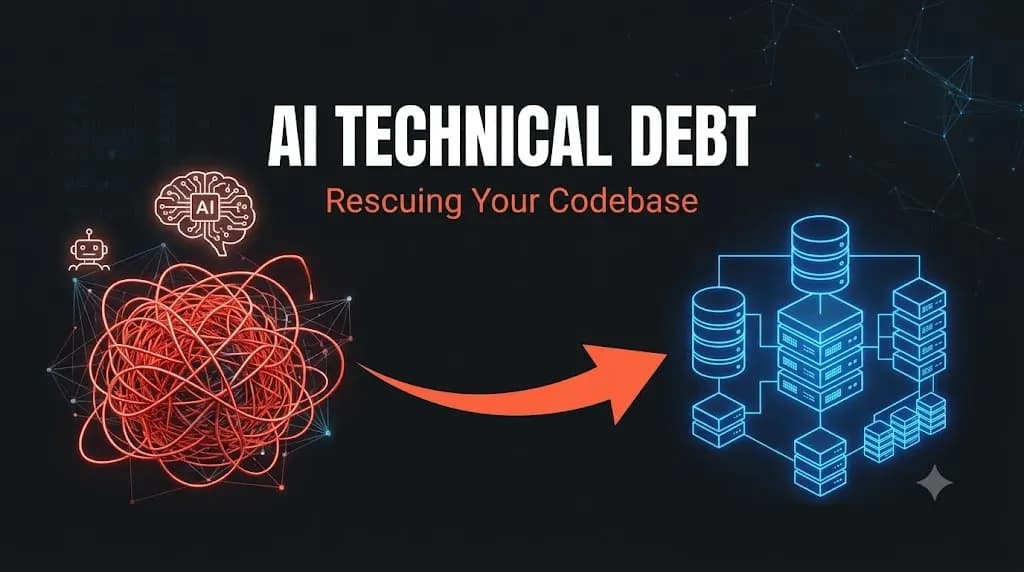
By relying heavily on tools like ChatGPT or GitHub Copilot without strict architectural oversight, your team has accumulated massive AI code technical debt.
Your Minimum Viable Product (MVP) was built in record time. Your lead developer seemed like a wizard, pushing out complex features in days instead of weeks. You launched, acquired your first thousand users, and prepared to scale.
Then, the nightmare began.
You ask for a simple feature update perhaps a new payment gateway or a minor UI tweak. Your developer says it will take three weeks. When they finally push the update, the login page suddenly breaks. The checkout crashes. Your developer spends days digging through the codebase, looking completely lost in a system they supposedly built.
The hard truth? Your developer didn’t build the architecture; an AI did.
Here is the technical deep dive into why AI-generated codebases become unscalable “black boxes,” and the exact engineering roadmap we use to rescue, refactor, and scale your application.
The Anatomy of AI Code Technical Debt
Large Language Models (LLMs) are incredibly powerful coding assistants. They are fantastic at writing boilerplate functions, generating regex, or solving isolated algorithmic problems.
However, AI lacks context. It writes functions, not architectures.
When junior or overwhelmed developers use AI to generate entire features, they often copy and paste code blocks without deeply understanding how those blocks interact with the global state of the application. Over months, this creates a “Frankenstein” codebase.
According to recent industry analysis on AI coding assistants (such as the research published by SonarSource on AI Code Quality), heavily AI-assisted codebases often see a massive spike in code churn, duplication, and hidden security vulnerabilities.
The 3 Symptoms of an AI-Generated “Black Box”
- The “House of Cards” Effect: Touching a component in the user profile mysteriously breaks the inventory database. There is no separation of concerns.
- Zero Documentation: Because the developer didn’t write the logic from scratch, they can’t accurately explain how it works. Code comments are either missing or hallucinated by the AI.
- Velocity Death: Feature development drops to zero because the developer is terrified of breaking the fragile, poorly understood system.
If you are experiencing these symptoms, you cannot solve the problem by hiring more developers to guess their way through the mess. You need a surgical intervention to eliminate the AI code technical debt.
4 Proven Fixes to Rescue and Scale Your App
At Datronix Tech, we frequently audit and rescue platforms suffering from rapid, unstructured AI development. Whether you are dealing with a messy React Native app or a fragile backend, here is our roadmap for fixing it.
1. The Architectural Audit & Dependency Mapping
Before writing or deleting a single line of code, we must map the chaos. We use static analysis tools to map the data flow and identify circular dependencies areas where AI generated highly coupled code. We separate the application into isolated domains (e.g., Auth, Payments, User Data) to see exactly where the architecture is failing under scale.
(If you are unsure if your current team can handle this audit, read our guide: Is Outsourced Web Development Reliable for Startups?).
2. Test-Driven Refactoring (The Safety Net)
You cannot fix what you cannot test. AI-generated codebases notoriously lack unit and integration tests. Before we refactor the messy logic, we write automated tests around the expected behavior of the app.
Once the tests are in place, we can confidently rewrite the underlying “spaghetti code.” If our new, scalable code passes the tests, we know we haven’t broken the user experience.
3. Retroactive Documentation & Standardization
A codebase is only as scalable as its documentation. We strip out the fragmented AI logic and enforce strict coding standards (like SOLID principles). We document the API endpoints, database schemas, and component hierarchies.
When we hand the codebase back to your internal team, they will actually understand how the engine works, rather than just staring at the dashboard.
4. Strategic Code Replacements
Not all AI code is bad. We isolate the functional, performant AI code and ruthlessly replace the “hallucinated” architecture. We implement robust error handling, API rate limiting, and proper state management the critical custom software development foundations that AI prompts usually ignore.
Conclusion: Stop Building on Quicksand
Using AI to accelerate development is smart. Using AI as a substitute for senior software architecture is fatal.
If your developer has lost track of how your application functions, every new user you acquire is a liability. Your system will eventually collapse under its own weight. You must pause feature development and pay down your AI code technical debt immediately.
(Note: When scoping custom codebase audits and refactoring projects, all Datronix Tech B2B service proposals natively include the requisite 18% GST charge, ensuring complete financial transparency from the initial audit to final deployment).
Is your app crashing under the weight of AI-generated spaghetti code?
👉 Contact Datronix Tech for an Enterprise Code Audit. We specialize in rescuing fragile apps, writing robust documentation, and re-architecting systems for high-growth scale.
Schedule your strategic technical review today and let our senior engineering team future-proof your product.
Related Posts

The “Right to be Forgotten” Nightmare: Engineering Hard-Deletes in Event-Sourced Systems
Here is the technical roadmap for bridging the gap between immutable logs and compliance, focusing on the industry standard for GDPR event sourcing: Cryptographic Erasure. It’s 4:00 PM on a Friday. Your legal team forwards you a standard GDPR “Right to Erasure” request from a user in Berlin. In a traditional CRUD (Create, Read, Update, […]
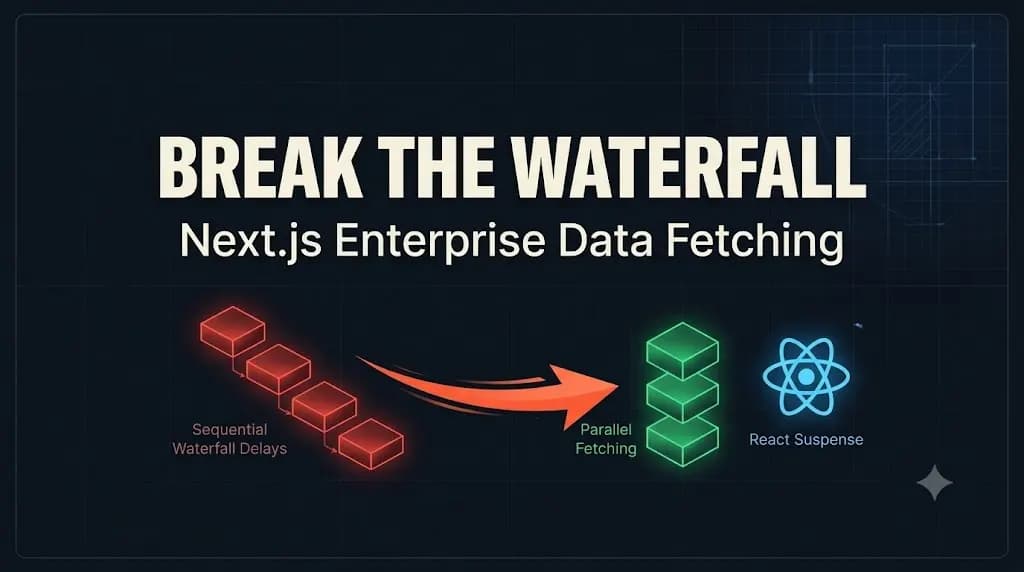
5 Proven Fixes for Next.js App Router Waterfalls
If this sounds familiar, your application is likely a victim of a Next.js App Router waterfall. It is the most frustrating paradox in modern web development. Your engineering team spent three months migrating your enterprise application from the old Pages Router to the new App Router. You adopted React Server Components (RSC) to ship less […]