For mid-market e-commerce directors, Checkout API Timeouts are the ultimate silent revenue killer. Your customers are clicking “Complete Purchase,” but behind the scenes, a third-party shipping or tax software is failing to respond in time. The checkout spins, crashes, and the customer walks away.
You are looking at your analytics dashboard, and the math simply does not make sense. Your ad traffic is steady, your “Add to Cart” rates are exceptionally high, yet your final revenue randomly dips during peak hours. You assume users are just getting cold feet at the last second.
But what if they aren’t abandoning their carts? What if your website is actively rejecting their money?
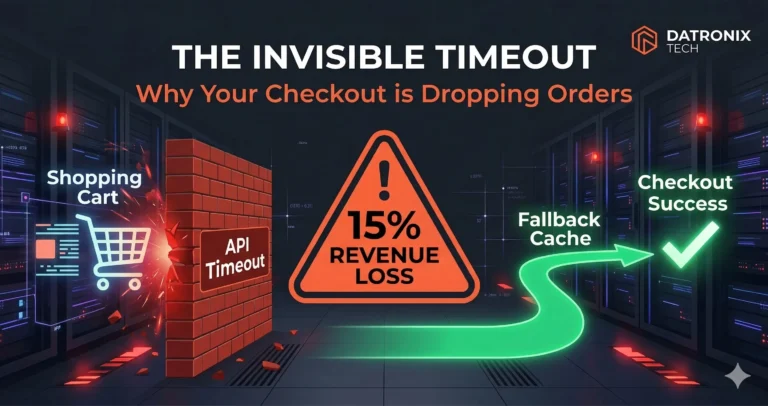
This is not a marketing problem; it is a critical infrastructure failure. Here is a technical breakdown of why your checkout is dropping 15% of your high-intent buyers and how to architect a fail-safe system to capture every dollar.
The Anatomy of the “Invisible” Drop-Off
Modern e-commerce checkouts are incredibly complex. When a user enters their address and clicks “Next,” your server does not just load a new page. It fires off multiple synchronous API calls to third-party services:
Tax Calculation: Pinging software like Avalara or TaxJar to get live local tax rates.
Shipping Rates: Pinging FedEx, UPS, or USPS to calculate real-time dimensional shipping costs.
Fraud Detection: Pinging machine-learning risk assessment tools.
If you are running a major promotion and 500 people hit checkout simultaneously, those third-party APIs can buckle under the pressure. If the Tax API takes more than a few seconds to respond, the browser simply gives up.
The user receives a generic “Something went wrong, please try again” error. They try once more, get the same error, and leave.
Why Your Analytics Cannot See It
The most dangerous part of Checkout API Timeouts is that they are practically invisible to standard marketing tools like Google Analytics 4 (GA4).
To GA4, this simply looks like traditional “Cart Abandonment.” The user made it to the checkout page but never hit the “Thank You” page. Your marketing team will waste thousands of dollars tweaking the button colors or offering abandoned cart discount codes, completely unaware that the users were literally begging to pay you.
To see the real issue, you have to look at server-level logs. When you open your server monitoring tools, you will see a massive spike in 504 Gateway Timeouts or 500 Internal Server Errors directly correlated with your highest traffic spikes.
The Technical Tourniquet: Fallbacks and Asynchronous Queues
You cannot control when a third-party shipping API goes down, but you can control how your website reacts to it. To stop the bleeding, we must re-architect the checkout flow using Fallback Caching and Asynchronous Processing.
1. Implementing Fallback Caching (The Lifesaver)
If a third-party API fails to respond within a strict time limit (e.g., 2.0 seconds), your checkout should never crash. Instead, it must trigger a Fallback Cache.
Shipping Fallback: If the live UPS API times out, the system automatically falls back to a pre-defined flat-rate table (e.g., “Standard Shipping: $9.99”).
Tax Fallback: If the live tax calculator fails, the system uses the last known cached tax rate for that specific zip code.
Yes, you might occasionally undercharge for shipping by a few dollars, but eating a $3 shipping margin loss is infinitely better than losing a $500 order entirely.
2. Asynchronous Post-Purchase Processing
Many stores mistakenly place post-purchase actions like syncing the order to an ERP, updating inventory, or adding loyalty points on the main checkout thread.
If your ERP is undergoing maintenance, the checkout will stall. We fix this by decoupling these actions. Once the payment clears, the order is placed into an Asynchronous Background Queue (like AWS SQS or RabbitMQ). The user instantly sees the “Thank You” page, and the server safely updates the ERP in the background.
3. Graceful Degradation
If a non-essential service fails (like an address autocomplete API), the checkout must “gracefully degrade.” The system should immediately switch to manual address entry rather than freezing the entire page with a loading spinner.
The Financial ROI of Resilience
The math behind fixing your checkout architecture is staggering.
Imagine a mid-market brand generating $50,000 a day in revenue. If API timeouts are quietly dropping 10% of orders during peak hours, you are bleeding roughly $5,000 a day, or $1.8 Million a year.
Investing in a robust, custom-architected checkout flow isn’t just an IT expense; it is the highest-ROI revenue recovery strategy you can execute.
Conclusion: Stop Rejecting Your Customers
Your customers did the hard part. They clicked the ad, browsed the site, built a cart, and pulled out their credit cards. Do not let a third-party software glitch turn them away at the finish line.
By building resilient fallback mechanisms and asynchronous queues, you guarantee that your checkout stays open, no matter what happens to the rest of the internet.
Do you suspect your checkout is quietly dropping orders?
👉 Book a 30-Minute Checkout Flow Stress-Test We’ll simulate peak traffic on your staging environment and show you exactly where your APIs are breaking.