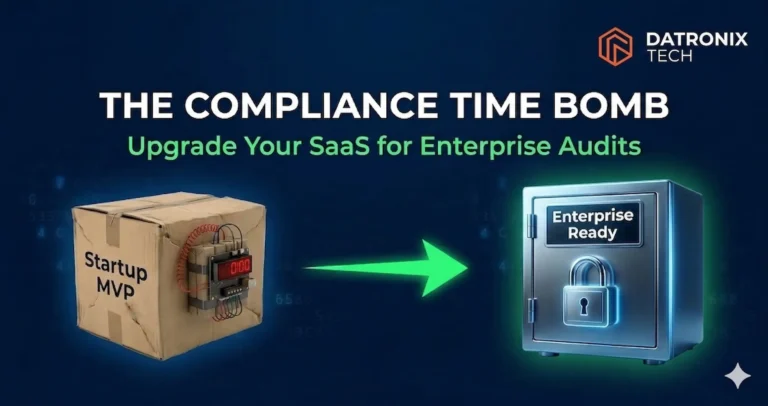
This is the Compliance Time Bomb. Building an app that “works” is vastly different from building an app that is “Enterprise-Ready.” To rescue your deal and secure your revenue, you must prioritize SaaS MVP SOC2 compliance and GDPR-level data security.
You built a brilliant Minimum Viable Product (MVP). Users love the interface, your growth metrics are up, and you finally landed a pitch with a Fortune 500 company. They love the software. The champion is ready to sign.
Then, procurement sends over the “IT Security Questionnaire.”
Suddenly, your massive enterprise deal is dead in the water. The security team asks about encryption protocols, tenant isolation, and audit trails. Because your MVP was built rapidly on a shoestring budget, you have to answer “No” to almost everything.
Here is a CTO-level guide on how to refactor your existing application to pass the strictest IT audits without rebuilding your platform from scratch.
The Bleeding Neck: The “Consumer” vs. “Enterprise” Gap
When most startups build an MVP, speed is the only metric that matters. Developers often lump all user data into a single database without strict partitioning. Passwords might be hashed, but the actual database isn’t encrypted at rest.
For a consumer app, this might slide. But for an enterprise client handling sensitive financial, healthcare, or proprietary data, it is a non-starter. If your architecture allows a developer with database access to view a client’s raw data, you will instantly fail a SOC2 audit.
To move upmarket, you must transition from a custom web application development mindset focused solely on features, to one focused entirely on data governance.
The Tourniquet: Refactoring for Enterprise Security
You don’t need to scrap your codebase. However, you do need to implement three critical architectural upgrades to satisfy enterprise Chief Information Security Officers (CISOs).
1. Row-Level Security (RLS) and Tenant Isolation
If you are running a multi-tenant SaaS (where multiple companies share the same database), your biggest risk is a “data bleed” where Company A accidentally sees Company B’s data.
To fix this, we implement Row-Level Security (RLS) at the database level. Instead of relying on your application code (like a simple WHERE company_id = X query) to filter data, RLS enforces access policies directly within the database engine. Even if a developer writes a buggy API endpoint, the database will refuse to serve the wrong tenant’s data.
2. Encrypted Data-at-Rest and In-Transit
Enterprise questionnaires will always ask how their data is stored.
In-Transit: Ensure every endpoint is secured via TLS 1.2 or higher.
At-Rest: Your database volumes must be encrypted. If you are using AWS, GCP, or Azure, enabling AES-256 encryption on your storage drives is a foundational step in scaling cloud infrastructure securely.
For highly sensitive fields (like Personally Identifiable Information under GDPR), you should implement Application-Level Encryption. This means the data is encrypted before it hits the database, ensuring that even someone with raw database access only sees scrambled ciphertext.
3. Compliance-Ready Audit Logs
SOC2 and GDPR demand accountability. If a breach occurs, or if a disgruntled employee deletes a file, the enterprise needs to know exactly who did it and when.
Your MVP must be retrofitted with an Immutable Audit Log. Every time a user creates, reads, updates, or deletes (CRUD) sensitive information, the system must generate a timestamped log containing the User ID, Action, and IP Address. These logs must be stored in a separate, append-only database so they cannot be tampered with by bad actors.
The ROI of Security Engineering
Refactoring for compliance is not cheap, and it is not glamorous. But it is the ultimate revenue unlock.
When you can confidently hand an enterprise IT team a clean SOC2 Type II report and a completed security questionnaire, you transition from a “risky startup” to a “trusted vendor.” The cost of the engineering sprint pays for itself the moment that first six-figure enterprise contract clears.
Conclusion: Defuse the Bomb Before It Blows
Don’t wait for a massive deal to stall before taking security seriously. Your MVP got you to the table, but enterprise-grade security is what will get the contract signed. By hardcoding row-level security, encryption, and audit logs into your architecture today, you future-proof your growth for tomorrow.
Is an IT Security Questionnaire holding up your biggest deal?
👉 Download The Enterprise Readiness Tech Checklist: Pass the IT Audit Get the exact technical requirements your app needs to clear procurement and close the contract.