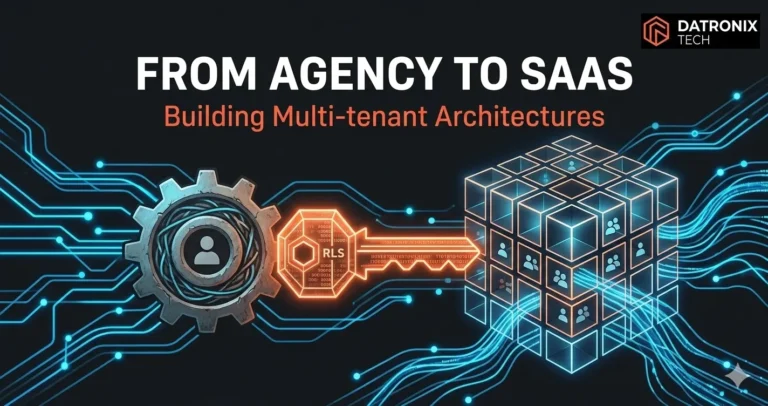
It’s the ultimate pivot transforming an internal tool into a Multi-tenant SaaS platform that can scale across multiple customers.
Your agency built a custom internal dashboard to manage logistics or automate marketing reports. It worked so well that your clients started asking, “Can we buy access to that?” Suddenly, you aren’t just an agency anymore; you’re a SaaS founder.
But there is a massive technical hurdle standing between your “Internal Tool” and a “Software Subscription”: Multi-tenancy.
Your current database was built for one company (yours). To sell it to others, you need an architecture that allows hundreds of different companies (tenants) to live in the same app while keeping their data completely isolated, secure, and invisible to each other.
Here is the technical roadmap to re-architecting your agency tool into a scalable, enterprise-grade SaaS.
The “Privacy Wall”: Choosing Your Multi-tenant Model
When moving to a multi-tenant SaaS architecture, you have to decide how to separate your customers’ data. There are three primary ways to build the “Privacy Wall”:
Database-per-Tenant: Each customer gets their own physical database. This is the most secure but the hardest to manage at scale.
Schema-per-Tenant: Customers share a database but have their own “folders” (schemas). It’s a middle-ground solution.
Shared Database (Row-Level Security): All customers live in the same tables, but every single row has a
tenant_id. This is the most cost-effective and scalable method used by giants like Slack and Shopify.
For most web development services for startups, we recommend the Shared Database model combined with Row-Level Security (RLS) at the database level to ensure that Company A can never accidentally query Company B’s data.
The Tourniquet: Hardening Your Data Isolation
If you are “white-labeling” your tool, a simple WHERE tenant_id = X in your code isn’t enough. A single developer error could lead to a catastrophic data leak.
True SaaS isolation requires:
Database Sharding: As you grow from 10 to 1,000 tenants, you can’t keep everyone on one server. Sharding allows you to split your database across multiple servers based on the
tenant_id, ensuring the app stays fast even as your user base explodes.Encrypted Data-at-Rest: Ensure that if a server is compromised, one tenant’s sensitive data remains unreadable to others.
Custom Subdomains: Giving each client their own URL (e.g.,
client-name.yourtool.com) provides a “Pro” feel and simplifies session management.
Validating the Pivot: Is Your Tool Ready?
Before you hire an outsourced web development team to rebuild your backend, you must validate the “Product-Market Fit” of the tool itself.
Internal tools are often “ugly-but-functional.” A SaaS product needs a polished Admin Panel, a Subscription Billing Engine (like Stripe Billing), and a Self-Service Onboarding flow. You are moving from a tool that “works” to a product that “sells.”
Conclusion: Build Once, Sell Forever
The transition from a service-based agency to a product-based SaaS is the fastest way to increase your company’s valuation. But the foundation of that valuation is Trust. If your architecture isn’t built for multi-tenancy from Day 1, a single data leak could kill your reputation before you even scale.
Architect for isolation today, so you can scale for growth tomorrow.
Ready to turn your internal tool into a revenue engine? 👉 Get the SaaS MVP Blueprint We’ll help you validate your tool’s market potential and map out the multi-tenant architecture needed to scale.