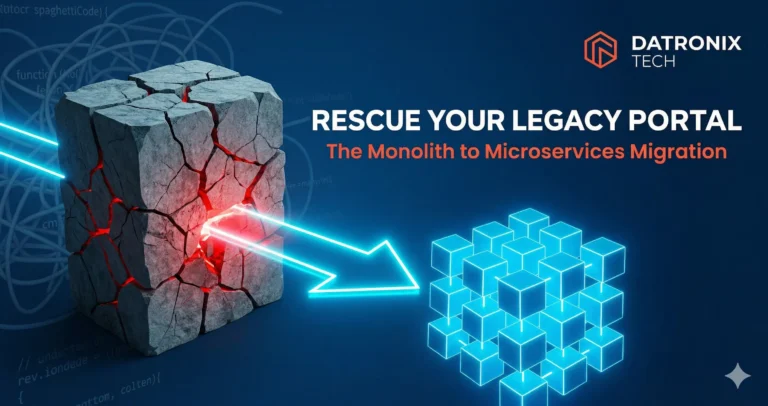
You are drowning in technical debt. When your software reaches this level of fragility, you can no longer patch your way out of the problem. To save your core infrastructure, you must execute a strategic migration from a monolith to microservices.
Five years ago, your custom internal portal was a massive success. It centralized your operations, streamlined your team’s workflow, and gave you a serious competitive edge.
But today, that same portal has become a “Frankenstein” of code.
Every time you ask your development team to add a single new feature, three other unrelated features break. A simple update to the invoicing module somehow crashes the user dashboard. Development has ground to a complete standstill, and your engineers are terrified to touch the core codebase.
Here is the hard truth about legacy code, and the technical roadmap for rescuing your portal without taking your business offline.
The Bleeding Neck: The Monolithic Trap
When a custom portal is first built, it is almost always built as a Monolith. This means the user interface, the database connections, the billing logic, and the reporting engine are all tangled together in one massive block of code.
For an MVP (Minimum Viable Product), a monolith is fast and cost-effective. But as years pass and new features are bolted on, the code becomes deeply intertwined.
The Ripple Effect: Because everything shares the same memory and database, a memory leak in the “Reporting” feature can crash the “Checkout” feature.
Deployment Paralysis: You cannot update just one small piece of the app. To deploy a minor bug fix, you have to redeploy the entire massive application, risking widespread downtime.
Onboarding Nightmares: New developers take months to understand the tangled codebase, making custom software development incredibly expensive and slow.
The Tourniquet: The Strangler Fig Pattern
When operations directors hear the word “rewrite,” they panic. They picture a two-year, million-dollar project where nothing gets released until the very end.
But modern engineering doesn’t work that way. We do not burn the monolith to the ground. Instead, we use the Strangler Fig Pattern.
Named after a vine that slowly wraps around and replaces a tree, this strategy involves breaking the monolith apart piece by piece, routing traffic to the new microservices while the old system continues to run safely in the background.
1. Identify the High-Risk Modules
We start by auditing your codebase to find the most fragile, resource-heavy functions. Usually, this is the Reporting Engine or the Billing/Invoicing System.
2. Extract into a Secure Microservice
Instead of fixing the billing logic inside the tangled monolith, we completely extract it. We build a brand-new, isolated Microservice dedicated only to billing. It has its own lightweight database and communicates with the main portal via a secure API.
If the new Billing Microservice crashes, the rest of your portal stays online. The “Ripple Effect” is destroyed.
3. The API Gateway (Zero Downtime)
To ensure your team experiences zero downtime during the migration, we implement an API Gateway. When a user requests an invoice, the Gateway acts as a traffic cop. It routes the invoice request to the shiny new microservice, while routing everything else back to the old monolith.
Over the next few months, we continue extracting features one by one until the monolith is completely “strangled” and can be safely deleted. This is the cornerstone of effective technical debt reduction.
Conclusion: Stop Paying the “Fragility Tax”
Every week your team spends fixing bugs instead of building new features, you are paying a massive “fragility tax.” A monolithic architecture places a hard ceiling on your company’s operational growth.
Transitioning to a microservices architecture is a major engineering investment, but it is the only way to rescue a paralyzed portal. By strategically extracting features, you restore development speed, isolate your server risks, and ensure your custom software can scale for the next decade.
Is your development team terrified to update your codebase?
👉 Get a Technical Debt Assessment: Rescue Your Legacy Software We’ll audit your monolith and map out a safe, zero-downtime microservices migration plan.