Every visionary founder has been there imagining a dog-walking, tutor-finder, or on-demand service app often without realizing a Geolocation Service Marketplace MVP doesn’t require a costly native build.
Then, you hit the wall.
You go to a high-end agency, and they quote you $200k to $500k for a native iOS and Android build. You try “No-Code” tools, but they break the moment you need a custom payment split or a complex map filter.
The truth? You don’t need a native app to validate your business. You need a Geolocation Service Marketplace MVP built on a robust, scalable bridge.
The Gap Between “No-Code” and “Over-Engineered”
Most startups die in the “Development Gap.” They either build something too cheap that fails under real-world usage, or they spend their entire seed round on a “Ferrari” of an app before they’ve even found their first ten customers.
The true cost of a website or marketplace isn’t just the code; it’s the logic.
For an MVP (Minimum Viable Product), your goal is to prove that User A will pay Provider B for a service at Location C. WordPress, when combined with custom Map APIs and a headless frontend, is the perfect bridge for this phase.
The Architecture: WordPress + Mapbox + Twilio
By using WordPress as your “Backend Admin” and a custom-coded frontend, you get enterprise-grade logic without the enterprise price tag.
1. The Geolocation Engine (Mapbox API)
Instead of standard Google Maps (which can get expensive quickly), we use Mapbox GL JS. This allows us to create custom “Search in this area” filters. When a user searches for a “Dog Walker,” the system calculates the distance between the user’s coordinates and the provider’s “Active Zone” in real-time.
2. The Marketplace Logic (User vs. Provider)
A marketplace has two distinct “Heads.”
The Customer: Needs to book, pay, and track.
The Provider: Needs to accept jobs, manage a calendar, and get paid.
We build these as custom React dashboards that talk to your WordPress database. This gives you the “App Feel” on a mobile browser without the $100k cost of submitting to the App Store.
3. The Communication Bridge (Twilio)
The “Uber” magic isn’t the map; it’s the notification. We integrate Twilio so that the moment a booking is made, the provider gets an SMS. This ensures high response rates the lifeblood of any new marketplace.
Why Mid-Tier ($10k-$20k) is the Sweet Spot
Top web development agencies will tell you that a custom build is the only way. But for a startup, Speed-to-Market is more important than “Native Code.”
A $15,000 MVP built on a WordPress/API bridge allows you to:
Test the Unit Economics: Does the commission cover your lead gen costs?
Gather Real User Data: What features do they actually use? (Hint: It’s rarely the ones you think).
Raise Capital: It is 10x easier to get funding with a live platform and 100 paying users than with a Figma prototype.
Conclusion: Build to Validate, Not to Impress
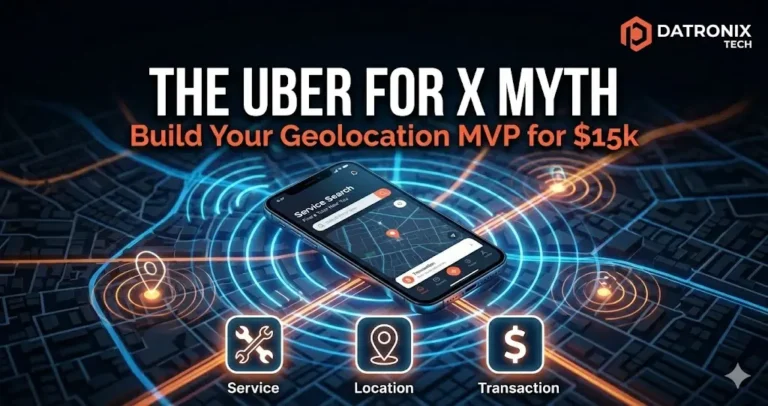
Don’t let the “Uber for X” myth lead you into a $500k trap. The technology exists to build high-performance, geolocation-based marketplaces at a fraction of that cost. Focus on the service, the location, and the transaction.
Build your bridge, get your first 100 transactions, and then build your native app.
Ready to map out your startup logic? 👉 Download the Marketplace Logic Flowchart We’ll help you visualize the data flow between your Users and Providers before you write a single line of code.