Every CEO wants an AI support agent working 24/7 but without Custom AI Agent RAG, most chatbots hallucinate instead of delivering reliable answers.
So, you install a “ChatGPT Wrapper” plugin on your site. You give it a prompt like, “You are a helpful assistant for our company.”
Two days later, a customer asks for a discount, and your new AI happily offers them 80% off your flagship product. Or worse, it confidently explains a return policy you don’t actually have. This is called an AI Hallucination, and in a business setting, it is a massive liability.
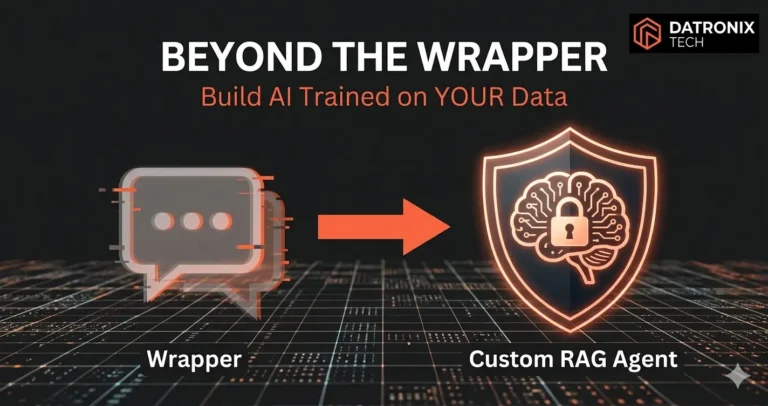
Generic Large Language Models (LLMs) are trained on the public internet. They know how to speak, but they don’t know your business. Here is the technical roadmap to moving beyond the “Wrapper” and building a secure, custom AI Agent that acts as a perfect, policy-abiding employee.
The Problem: The Hallucination Trap
When you use a generic AI wrapper, you are relying on the model’s “internal memory” to answer questions.
If a user asks, “Does the X-500 model come in blue?” the AI tries to guess the answer based on billions of random web pages. If it doesn’t know, it will often invent a plausible-sounding lie rather than admit ignorance.
This is why generic CRM AI chatbots fail at enterprise scale. They are too creative. You don’t want a creative customer service rep; you want a factual one.
The Tourniquet: Retrieval-Augmented Generation (RAG)
To stop the hallucinations, we use an architecture called Retrieval-Augmented Generation (RAG).
RAG changes the AI’s job description. Instead of asking the AI to know the answer, we ask the AI to read the answer from your secure database and summarize it for the user.
How RAG Works in Practice:
The Knowledge Base: We take your proprietary data—your PDFs, your internal wikis, your private product catalog—and convert it into mathematical coordinates (Vector Embeddings). We store these in a secure Vector Database (like Pinecone or Weaviate).
The Retrieval: When a customer asks a question, the system searches your Vector Database for the most relevant paragraphs first.
The Generation: The system sends the user’s question and the exact paragraphs from your database to the LLM with strict instructions: “Answer the user’s question using ONLY the provided text. If the answer is not in the text, say ‘I don’t know.'”
The Security Wall: Grounding the AI
The beauty of RAG is that the LLM never actually “learns” your proprietary data. Your data is not used to train OpenAI or Anthropic’s public models [1].
Your data remains safely behind your firewall. The LLM acts purely as a linguistic processor, reading the secure context we provide and formatting it into a polite, conversational response. This is how we build secure AI-powered WordPress websites for enterprise clients who require strict data compliance.
Use Cases for Grounded AI Agents
When you connect an LLM to your specific database, the possibilities scale far beyond simple FAQs:
B2B Sales Engineer: An agent that can instantly query complex, 500-page technical manuals to tell a buyer exactly which industrial part is compatible with their machinery.
Internal HR Assistant: An agent that allows employees to ask, “What is our parental leave policy?” and receives an answer sourced directly from your private employee handbook.
Dynamic Quoting: Connecting the agent to your live inventory API so it can provide real-time pricing and stock levels without hallucinating outdated discounts.
Conclusion: Stop Playing with Toys
AI is the biggest buzzword in tech, but most agencies are just selling “wrappers”—toys that break under real business pressure.
A custom AI agent built on RAG architecture is a piece of enterprise software. It requires serious engineering, secure database management, and strict prompt grounding. But when built correctly, it is the most powerful operational asset your company will ever own.
Ready to build an AI that actually knows your business? 👉
Book an AI Agent Proof of Concept (PoC) Strategy Session Let’s discuss how to securely connect an LLM to your proprietary data.