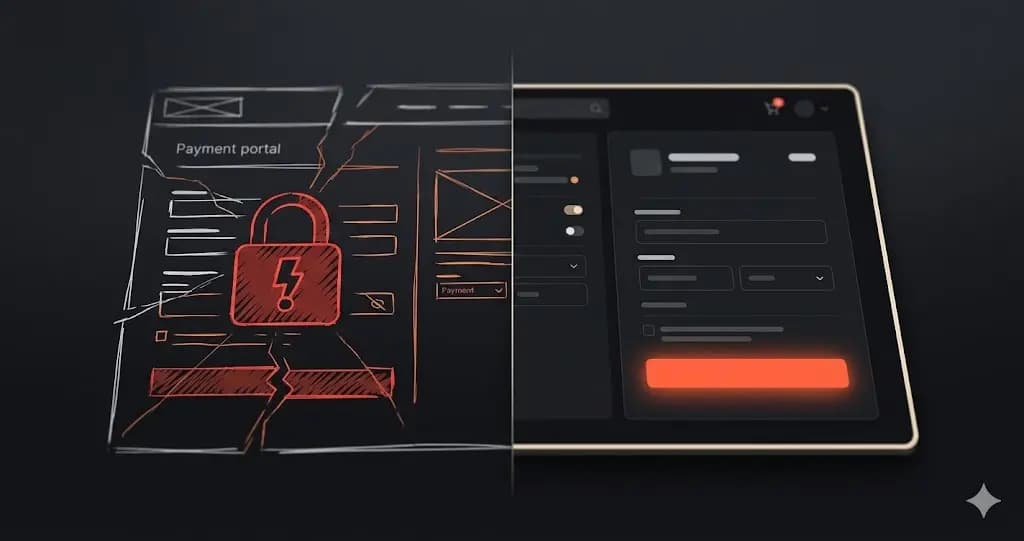
When you are selling premium services, the transaction environment must match the prestige of the price tag. Sending your highest-paying clients to a generic payment overlay is a massive conversion killer. To protect your brand equity and close the deal seamlessly, you must abandon third-party redirects and implement a custom Stripe API integration.
You have spent weeks nurturing a high-value lead. You delivered a flawless pitch, mapped out the perfect strategy, and the client is finally ready to sign the $10,000 contract. They click the “Pay Invoice” button on your beautifully branded website.
Instantly, the screen flashes. The URL changes. They are abruptly redirected away from your professional domain to a clunky, unbranded third-party payment portal that looks like it was designed a decade ago.
The client pauses. Is this secure? Did I click a spam link? Cognitive dissonance sets in, trust evaporates, and the deal stalls.
Here is why checkout hijacks destroy trust, and how to architect an embedded, high-fidelity payment flow that keeps your buyers securely on your website.
The Bleeding Neck: The Psychology of High-Ticket Friction
In the world of low-ticket retail, consumers are used to minor checkout friction. But high-ticket B2B sales operate on a completely different psychological wavelength.
When a corporate client is handing over $10,000 or signing a high-retainer service contract, they require absolute security and consistency. If your digital footprint features a highly editorial, minimalist design aesthetic complete with dark mode interfaces and premium typography your checkout screen cannot suddenly look like a cheap dropshipping template.
-
URL Anxiety: The moment the browser URL changes from
youragency.comtopay.thirdparty-portal.com, the buyer’s internal alarm bells ring. -
The “Bait and Switch” Feel: A disjointed UI makes your enterprise operation feel like a fragmented, amateur setup.
-
Loss of Analytics: When a user leaves your domain to pay, you lose the ability to accurately track the final conversion step natively, breaking your performance marketing attribution.
The Tourniquet: Architecting a Custom Stripe API Integration
To stop the trust bleed, we have to eliminate the redirect entirely. By utilizing custom web application development, we bring the payment gateway directly into your native environment.
1. Embedded UI with Stripe Elements
Instead of using Stripe Checkout (which redirects the user to a Stripe-hosted page), a true custom Stripe API integration utilizes Stripe Elements.
Stripe Elements are highly customizable UI components that we inject directly into your React, Next.js, or HTML frontend. The credit card input fields live natively on your domain, styled perfectly to match your exact brand colors, warm stone backgrounds, and premium typography. The buyer never leaves your site.
2. Complex B2B Billing Logic
High-ticket service contracts often require complex financial calculations that generic overlays cannot handle smoothly.
With a custom integration, your backend server (using Node.js or similar) acts as the brain. For example, if you need to dynamically inject a mandatory 18% GST charge onto all your service proposals before the card is charged, the custom logic instantly calculates and updates the total on your native UI without forcing the user to reload the page or jump to a separate tax portal. The process is frictionless, transparent, and mathematically perfect.
3. Server-Side PCI Compliance
The beauty of modern API architecture is that you achieve total design control without adopting the legal liability of storing credit card data.
When the user types their card number into your embedded form, the data never actually touches your server. The custom Stripe API integration securely tokenizes the payment data directly between the browser and Stripe’s servers. You maintain strict, enterprise-grade PCI compliance while delivering a flawless, on-brand user experience.
Conclusion: Own the Final Mile
The checkout screen is the most important page on your entire website. It is the exact moment a prospect becomes a client.
You should not hand control of that critical moment over to a generic third-party overlay. By investing in an embedded, bespoke payment architecture, you eliminate checkout anxiety, project enterprise-level authority, and ensure your high-ticket deals close without a second thought.
Are your clients hesitating at the payment screen?
👉 Download the Custom Checkout Flow Security Brief Discover the exact technical roadmap to embed secure, high-fidelity payment processing directly into your branded ecosystem.