
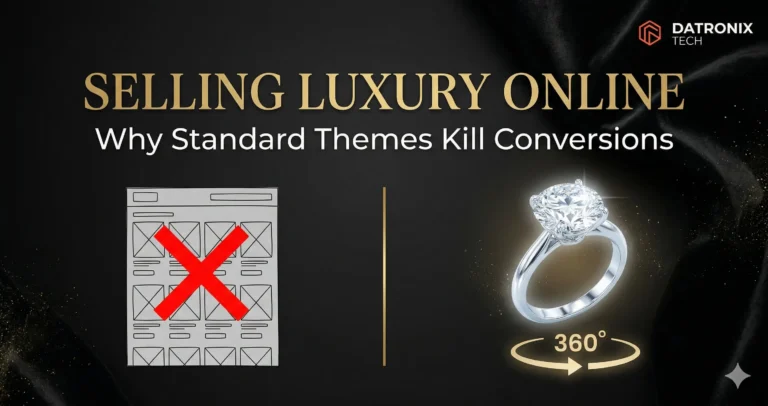
To command premium pricing, you must invest in luxury Shopify customization. By abandoning standard templates and architecting an “editorial commerce” experience, you bridge the gap between digital convenience and high-end retail. Here is how custom development transforms your store into a digital boutique.
You are selling a breathtaking, $5,000 diamond necklace. But when a highly qualified buyer lands on your product page, the experience feels identical to a dropshipping store selling $15 phone cases. The layout is blocky, the image zoom is clunky, and the transaction feels entirely transactional rather than experiential.
The buyer hesitates. Is this legitimate? Why does this feel cheap? They close the tab.
This is the ultimate conversion killer for high-end jewelers and premium brands. When you sell luxury, the digital environment must reflect the prestige of the physical product. If your website feels like a generic template, your buyers will not trust you with their credit cards.
The Bleeding Neck: The “Dropshipping” Aesthetic
Standard Shopify themes are built for mass-market retail. They rely on rigid grid structures, basic white backgrounds, and standard “Add to Cart” buttons. They are designed for speed and volume, not storytelling or desire.
When high-net-worth individuals buy jewelry online, they are not just buying metal and stone; they are buying an emotion. A standard theme strips that emotion away. It forces your bespoke creations into a sterile box, actively degrading your brand equity and killing your conversion rates. To fix this, you must look toward luxury web design that prioritizes the sensory experience.
The Tourniquet: Architecting “Editorial Commerce”
Editorial commerce blends the immersive storytelling of a high-fashion magazine with the frictionless checkout of modern e-commerce. It requires a complete departure from the “grid” through advanced, custom code.
1. WebGL and 3D Product Visualization
In a physical boutique, a buyer can hold a ring, turn it in the light, and inspect the setting. A flat, 2D JPEG cannot replicate this.
Through custom Shopify development, we integrate WebGL, a JavaScript API that renders interactive 2D and 3D graphics directly in the browser. This allows your buyers to rotate a 3D model of your jewelry 360 degrees, zoom in on the exact faceting of a diamond, and see how the light reflects off the gold all without any noticeable lag.
2. Micro-Animations and Scroll-Jacking
Luxury is all about the details. The way a page loads should feel like a velvet curtain being pulled back.
We replace rigid page jumps with smooth, physics-based micro-animations. As the user scrolls, the product images float into place, typography fades in elegantly, and background colors softly transition to match the mood of the specific jewelry collection. This deliberate, guided pacing forces the user to slow down and appreciate the craftsmanship.
3. Custom Liquid & Headless Architecture
To break out of the standard Shopify mold, we have to rewrite the rules at the server level. By writing Custom Liquid (Shopify’s templating language) or moving to a fully Headless Commerce architecture (connecting a custom React frontend to Shopify’s backend checkout), we remove all design limitations.
Your product pages no longer look like “product pages.” They become immersive landing pages tailored to the unique story of every single piece.
Conclusion: Match Your Price Tag
You would never display a Rolex in a cheap plastic display case. You should not display your premium products on a cheap, off-the-shelf theme.
When you invest in bespoke, high-fidelity digital design, you eliminate the cognitive dissonance for your buyers. You build immediate, undeniable trust. By turning your website into an editorial experience, you stop competing on price and start competing on prestige.
Are you losing high-ticket sales because your website feels cheap?
👉 Get The Luxury E-Commerce Conversion Audit We will audit your current Shopify theme and tell you exactly where your digital experience is failing your price tag.