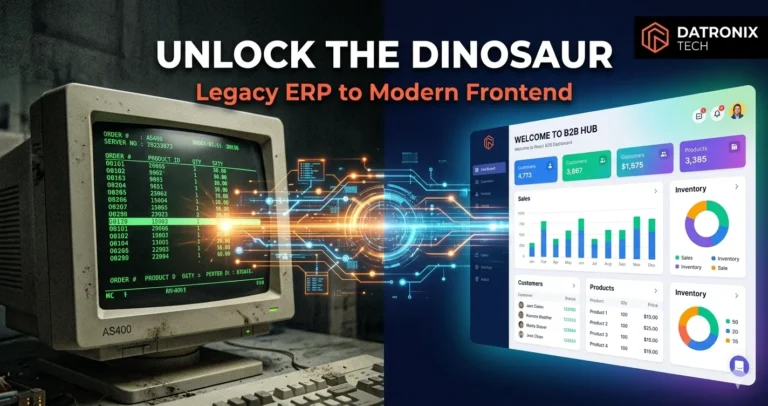
In manufacturing, stability is king which is why many giants still rely on AS400 or legacy SAP systems, making Legacy ERP Modernization a strategic priority.
These systems are bulletproof, but they are also silos. Your customers want a slick, Amazon-like B2B ordering portal. They want to see real-time pricing and stock levels on their smartphones. Meanwhile, your ERP is still using a “Green Screen” interface and doesn’t know what a Webhook is.
The fear of a full core migration replacing the “brain” of the company is enough to keep any CEO awake at night. The risk of data loss or operational downtime is simply too high.
But you don’t have to replace the Dinosaur. You just need to build a bridge. Here is how Datronix Tech provides a modern “facelift” to legacy systems without the risk of a core migration.
The Middleware Strategy: The “Translator” in the Middle
You cannot connect a modern React or Next.js frontend directly to an AS400. They speak different languages. To bridge the gap, we build a Secure Middleware Layer.
Think of middleware as a high-speed translator.
On one side: It talks to the legacy system using old protocols (like ODBC, JDBC, or flat-file exports).
On the other side: It provides a clean, lightning-fast REST or GraphQL API to your modern frontend.
This allows your custom web development to stay agile and fast while the legacy system continues to do what it does best: process the heavy lifting of inventory and finance.
The Security Tourniquet: Protecting the Core
When you open an on-premise ERP to the web, security is the #1 priority. We don’t “open ports” to your internal server. Instead, we implement a DMZ (Demilitarized Zone) Architecture.
VPN/Tunneling: The middleware connects to your on-premise server through a secure, encrypted tunnel (like AWS Site-to-Site VPN).
Request Validation: Every request from the B2B portal is sanitized and authenticated by the middleware before it ever touches the legacy database.
Caching Layer: To prevent the “Dinosaur” from being overwhelmed by web traffic, we cache real-time data (like product catalogs) in a modern database (like Redis). The legacy system only gets “hit” when a final order is placed.
Why This Beats a Full Migration
A full ERP migration can take 2–3 years and cost millions. A “Headless Facelift” where we build a modern frontend on top of your existing system can be completed in months for a fraction of the cost.
It allows you to:
Improve UX Instantly: Your customers get a modern portal today.
Retain Stability: Your accounting and manufacturing teams don’t have to learn a new system.
Scale Securely: You get the performance of the cloud with the security of on-premise data.
This approach is what separates the top web development agencies from the rest: the ability to handle complex, high-stakes enterprise integration.
Conclusion: Give Your Dinosaur a Facelift
Your legacy ERP isn’t a liability; it’s a foundation. Don’t let its age stop you from providing a world-class digital experience. By building a secure, API-driven bridge, you can unlock the data hidden in your “Dinosaur” and serve it to the modern web.
Terrified of a full ERP migration?
👉 Book a Legacy Systems Modernization Consultation We’ll audit your on-premise server and map out a secure path to a modern B2B portal.