It’s the holiday rush orders surge, but warehouse bottlenecks appear exactly the moment when 3PL API Integration becomes critical for real-time fulfilment.
Because your “standard” fulfillment plugin keeps dropping orders or failing to sync, your operations manager is sitting in a dark room, manually exporting CSV files from Shopify and emailing them to your Third-Party Logistics (3PL) provider.
By the time the warehouse receives the file, three items are already out of stock. The result? Late shipping, split shipments, and a “Lost Order” epidemic that is currently torching your brand reputation.
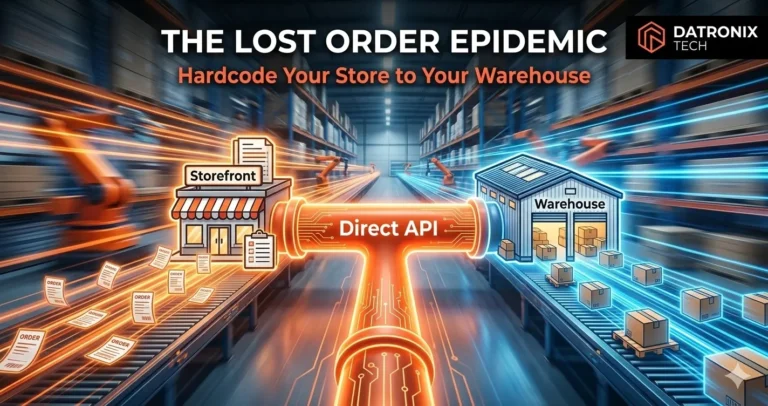
If you are scaling past 50 orders a day, “plugins” are no longer enough. You need to hardcode a custom, two-way API bridge that turns your storefront and your warehouse into a single, unified organism.
The Failure of “Off-the-Shelf” Fulfillment Plugins
Most 3PL plugins are built for the “lowest common denominator.” They work fine if your catalog is simple and your volume is low. But they fall apart when:
Bundles & Kits: The store sees one “Bundle SKU,” but the warehouse needs to pick four individual items.
Partial Fulfillments: One item is on backorder, but the plugin doesn’t know how to tell the store to ship the rest.
Inventory Lag: The warehouse sells the last unit at 2:00 PM, but the plugin doesn’t update your store until 4:00 PM. That’s two hours of selling products you don’t have.
This is a classic Shopify website mistake relying on a $29 app to manage a $2M logistics operation.
The Tourniquet: A Custom Two-Way API Bridge
Instead of a generic middleman, we build a direct communication line using your 3PL’s proprietary API (such as ShipStation, ShipBob, or a custom warehouse management system).
1. The Real-Time Order Push
The second an order is placed, our custom script validates the data (address, SKU mapping) and pushes it to the 3PL’s queue. No CSVs, no emails, no human intervention.
2. The Inventory Heartbeat
We implement a “Webhook” system. Every time a picker scans an item in the warehouse, your store’s inventory levels are updated within seconds. This allows you to run “Low Stock” alerts with 100% confidence.
3. Automatic Tracking Write-Back
As soon as a shipping label is generated in the warehouse, the API pulls the tracking number and “writes it back” to the customer’s order in your store, triggering the fulfillment email immediately.
Why This is Essential for Ecommerce Web Development
In modern e-commerce, Logistics is Marketing. A customer who receives their package in 48 hours with perfect tracking is a customer for life. A customer who waits 10 days because of a “sync error” is a customer who leaves a 1-star review on Trustpilot. Hardcoding your integration ensures that your “Brand Promise” matches your “Warehouse Reality.”
Conclusion: Stop the Manual Madness
If your team is still “managing files” instead of “managing growth,” you are hitting an operational ceiling. A custom 3PL integration isn’t just a technical upgrade; it’s a scalability insurance policy. It removes the human error from your fulfillment chain and allows you to scale to 1,000+ orders a day without adding a single administrative head.
Ready to make the fulfillment pain stop?
👉 Book a Logistics Integration Mapping Call We’ll audit your 3PL’s API and map out a fail-safe sync for your store.